


An Interactive 5-Day Training Course
Annulus Pressure Management & Barrier Verification
Monitoring, Limits and Verification
Secure your spot now!
Duration
5 Days
Price
$ 3,500
Starting From
20 Dec 2027



Annulus Pressure Management & Barrier Verification
Have Questions ?
Annulus Pressure Management & Barrier Verification - PE-APM-PEA27
| Code | Date | Time | Duration | Location | Currency | Early Bird Fee Per Person |
|---|---|---|---|---|---|---|
| PE-APM-PEA27 | 20 - 24 Dec 2027 | 10 AM CST | 4 Hours Per Day |
Online |
USD |
3500 |
Need this for a group? We deliver the same course in-house — face-to-face at your location or online — tailored to your assets and team level. Contact info@peassociations.com.
Boost your team's skills and your budget! Enjoy group discounts for collaborative learning. Send an inquiry to info@peassociations.com.
Annulus Pressure Management & Barrier Verification
Description
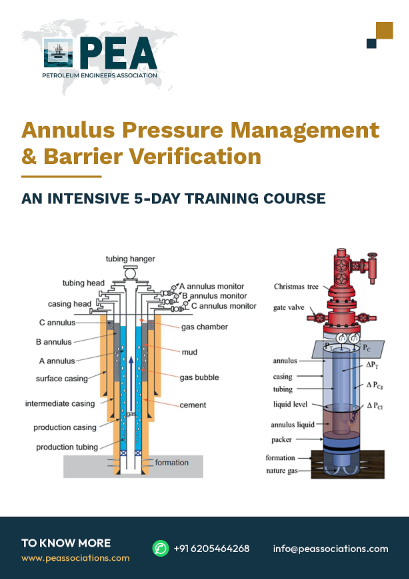
Annulus pressure is the most accessible indicator of well integrity. It can be read at the wellhead on every well every day, and its behaviour reveals whether barriers are holding. Managing annuli well means knowing what each pressure should be, what limits apply, how often to check and what to do when a reading changes.
This course covers that discipline. It starts with annulus configurations, nomenclature and the sources of pressure, including thermal effects, trapped pressure, communication and leaks. It then covers the calculation of maximum allowable annulus pressures from casing, wellhead and formation limits, and the setting of operating envelopes. The second half covers barrier verification: pressure testing of tubing, packers, valves and wellhead seals, inflow testing, safety valve testing, cement and casing logging, and the acceptance criteria that determine whether a barrier is verified. The course closes with anomaly escalation, monitoring regimes and the records required for compliance and audit.
A well typically has several annuli, each bounded by casing strings, cement and the wellhead. Each has an expected pressure, which may be zero or may reflect the fluid column and temperature in it. Departures from that expectation matter, but so does the routine behaviour: annuli breathe with temperature as wells are produced, shut in and restarted, and distinguishing thermal expansion from a leak is a daily judgement in the field.
Every annulus also has a pressure limit. It is set by the weakest of the burst rating of the inner casing, the collapse rating of the outer casing, the rating of the wellhead and hanger seals, and the fracture pressure of the shallowest exposed formation. Calculating these limits and making them visible to operations is one of the most useful things a well integrity engineer can do, because it converts an ambiguous reading into a clear decision.
Barrier verification is the other half. A barrier that has never been tested is an assumption. Verification defines what the test is, what result is acceptable and how often it is repeated, for every barrier element in the well. Where testing is not possible, alternative verification such as logging or monitoring must be specified. This course covers the calculations, the tests and the records that hold the system together.
By the end of this training, participants will be able to:
- Describe annulus configurations, nomenclature and normal pressure behaviour.
- Distinguish thermal, trapped, communication and leak-induced annulus pressure.
- Calculate maximum allowable annulus pressure from casing, wellhead and formation limits.
- Set operating envelopes and action levels for each annulus.
- Design and execute barrier element pressure tests.
- Apply acceptance criteria for tubing, packer, valve and wellhead barrier tests.
- Plan inflow testing and subsurface safety valve testing.
- Select logging and inspection methods for barrier verification.
- Manage anomalies and escalation when pressures exceed limits.
- Maintain annulus and verification records for compliance and audit.
Organisations sending participants to this training will:
- Make annulus limits explicit and visible to operations staff.
- Detect integrity problems earlier through better monitoring practice.
- Ensure barriers are verified rather than assumed.
- Reduce unnecessary shut-ins caused by misreading normal annulus behaviour.
- Meet regulatory and audit requirements for barrier verification.
Participants will:
- Understand why annulus pressures behave as they do.
- Be able to calculate maximum allowable annulus pressures.
- Be able to design and interpret barrier verification tests.
- Be able to judge when an annulus reading requires action.
- Be able to maintain defensible integrity records.
- Well integrity engineers
- Production engineers
- Operations engineers and supervisors
- Completion and well engineering staff
- Well intervention engineers
- Technical authorities and compliance staff
Module 1: Annulus Configurations and Behaviour
- Annulus nomenclature and well schematics
- Fluid columns and hydrostatic pressures
- Thermal expansion and pressure breathing
- Trapped pressure
- Normal versus abnormal behaviour
Module 2: Maximum Allowable Annulus Pressure
- Casing burst and collapse limits
- Wellhead and seal rating limits
- Formation fracture limits at the shoe
- Calculating maximum allowable pressures
- Documenting and communicating limits
Module 3: Monitoring Practice
- Monitoring frequency and methods
- Manual and automated pressure recording
- Bleed-down procedures
- Recording and trending data
- Action levels and alarms
Module 4: Barrier Element Testing
- Tubing pressure testing
- Packer and seal assembly testing
- Wellhead and valve testing
- Test pressures, durations and acceptance criteria
- Recording and reporting results
Module 5: Inflow and Safety Valve Testing
- Inflow test principles and procedures
- Subsurface safety valve testing
- Surface safety valve and shutdown system testing
- Test frequency requirements
- Handling failed tests
Module 6: Verification by Logging and Inspection
- Cement evaluation logs
- Casing inspection and caliper logs
- Corrosion monitoring methods
- Verification where pressure testing is not possible
Module 7: Anomaly Management and Escalation
- Defining an anomaly
- Immediate actions on exceeding limits
- Risk assessment and temporary operating limits
- Escalation and approval routes
- Repair planning
Module 8: Records, Compliance and Assurance
- Required records and retention
- Verification status tracking
- Regulatory reporting
- Audit preparation
- Performance indicators for barrier verification
Upon successful completion of this training course, delegates will be awarded an official Certificate of Completion issued by the Petroleum Engineers Association (PEA), an ISO 9001:2015 certified training organization. The certificate carries 10 Credits and formally records the total learning hours completed.
Each certificate is signed by the Course Facilitator and the CEO of the Petroleum Engineers Association, and serves as verifiable proof of professional training that delegates can present to employers and professional bodies worldwide.
Frequently Asked Questions
All course bookings made through PEA are strictly non-refundable. By registering for a course, you acknowledge and accept that all fees are payable in full and are not subject to refund under any circumstances, including changes in personal or professional commitments or partial attendance.
PEA reserves the right to make reasonable adjustments to course content, trainers, or schedules where necessary, without entitling delegates to a refund. Comprehensive details of each course — including objectives, target audience, and content — are clearly outlined before enrolment, and it is the responsibility of the delegate to ensure the course's suitability prior to booking.
For any inquiries related to cancellations or bookings, please contact our support team, who will be happy to assist you.
