


An Interactive 5-Day Training Course
Corrosion & Materials Selection for Production Wells
Choosing Materials That Last
Secure your spot now!
Duration
5 Days
Price
$ 3,500
Starting From
27 Dec 2027



Corrosion & Materials Selection for Production Wells
Have Questions ?
Corrosion & Materials Selection for Production Wells - PE-CMS-PEA27
| Code | Date | Time | Duration | Location | Currency | Early Bird Fee Per Person |
|---|---|---|---|---|---|---|
| PE-CMS-PEA27 | 27 - 31 Dec 2027 | 10 AM CST | 4 Hours Per Day |
Online |
USD |
3500 |
Need this for a group? We deliver the same course in-house — face-to-face at your location or online — tailored to your assets and team level. Contact info@peassociations.com.
Boost your team's skills and your budget! Enjoy group discounts for collaborative learning. Send an inquiry to info@peassociations.com.
Corrosion & Materials Selection for Production Wells
Description
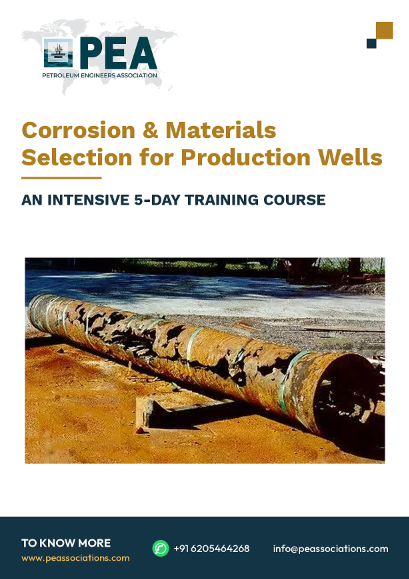
Produced fluids attack the steel that contains them. Carbon dioxide, hydrogen sulphide, chlorides, oxygen ingress, bacteria, high temperature and flow-induced erosion all contribute, and the result is tubing leaks, casing failures, wellhead damage and loss of containment. Material selection is the first line of defence and corrosion management is the second.
This course covers both. It starts with electrochemical corrosion principles and the specific mechanisms seen in wells: sweet carbon dioxide corrosion, sour service and hydrogen sulphide effects, chloride pitting, microbiologically influenced corrosion, oxygen corrosion in injection systems and erosion-corrosion. It then covers cracking mechanisms and the standards that govern sour service material selection, followed by corrosion rate prediction and material options from carbon steels through corrosion resistant alloys, including cost and availability. The second half covers elastomers and non-metallics, corrosion inhibition programmes, monitoring and inspection methods, and building a life-of-well materials and corrosion management strategy.
A production well is a long steel pressure vessel carrying corrosive fluid at high temperature for twenty years or more. Its failure modes depend on the fluid it carries. Carbon dioxide produces general and localised wall loss at rates that can reach millimetres per year. Hydrogen sulphide adds cracking risk, which is not a rate problem but a threshold problem: the wrong steel in sour service can fail suddenly rather than gradually.
Material selection is therefore a risk decision made at the design stage, when fluid compositions are often uncertain and the well's future conditions, particularly water cut and souring, are unknown. Choosing carbon steel with inhibition is cheaper up front and depends on an inhibition programme running reliably for decades. Choosing a corrosion resistant alloy costs more and removes that dependency. Both are legitimate; what is not legitimate is choosing carbon steel and then not funding the inhibition.
Monitoring closes the loop. Coupons, probes, caliper and ultrasonic logs, iron counts and inhibitor residual measurements show whether the strategy is working while there is still time to change it. Most corrosion failures are preceded by data that showed the rate was higher than assumed. This course covers selection, protection and monitoring as one connected subject.
By the end of this training, participants will be able to:
- Explain electrochemical corrosion principles and the main mechanisms in production wells.
- Assess carbon dioxide and hydrogen sulphide corrosion risk from fluid composition and conditions.
- Identify cracking mechanisms and apply sour service material requirements.
- Predict corrosion rates and understand the limits of prediction models.
- Select tubulars and components from carbon steels and corrosion resistant alloys.
- Select elastomers and non-metallic materials for well service conditions.
- Design corrosion inhibition programmes, including selection, dosage and application.
- Specify corrosion monitoring and inspection methods and frequencies.
- Interpret monitoring and inspection data and act on trends.
- Develop a life-of-well corrosion and materials management strategy
Organisations sending participants to this training will:
- Reduce well failures caused by corrosion.
- Match material selection to real well conditions over field life.
- Improve the effectiveness and cost of inhibition programmes.
- Detect corrosion problems early through better monitoring.
- Extend safe well life and reduce integrity-driven workovers.
Participants will:
- Understand how and why production wells corrode.
- Be able to assess corrosion risk from fluid and well data.
- Be able to select materials for given service conditions.
- Be able to design and monitor an inhibition programme.
- Be able to interpret inspection and monitoring data.
- Well integrity engineers
- Production engineers
- Completion and well engineering staff
- Materials and corrosion engineers
- Production chemists
- Facilities engineers dealing with produced fluids
Module 1: Corrosion Principles
- Electrochemical corrosion
- Corrosion cells and driving forces
- General, localised and galvanic corrosion
- Effect of temperature, pressure, flow and water chemistry
Module 2: Carbon Dioxide Corrosion
- Mechanism and carbonic acid chemistry
- Effect of partial pressure, temperature and water cut
- Corrosion product films
- Localised attack and mesa corrosion
- Rate prediction models
Module 3: Hydrogen Sulphide and Sour Service
- Sour corrosion mechanisms
- Sulphide stress cracking
- Hydrogen induced cracking and stress-oriented cracking
- Sour service definitions and thresholds
- Material requirements and industry standards
Module 4: Other Corrosion Mechanisms
- Chloride pitting and crevice corrosion
- Microbiologically influenced corrosion
- Oxygen corrosion in injection and workover fluids
- Erosion-corrosion and velocity limits
- Under-deposit corrosion
Module 5: Materials Selection
- Carbon and low alloy steels
- Martensitic, duplex and austenitic stainless steels
- Nickel-based and corrosion resistant alloys
- Selection criteria, cost and availability
- Clad and lined tubulars
- Selection for changing conditions over field life
Module 6: Elastomers and Non-Metallics
- Elastomer types and service limits
- Explosive decompression and chemical attack
- Seals, packers and control line components
- Non-metallic liners and coatings
Module 7: Corrosion Inhibition
- Inhibitor types and mechanisms
- Selection and laboratory qualification
- Continuous injection, batch and squeeze treatments
- Dosage, residuals and monitoring
- Common failures of inhibition programmes
Module 8: Monitoring and Inspection
- Coupons and electrical resistance probes
- Iron counts and water analysis
- Caliper, ultrasonic and electromagnetic inspection logs
- Wall thickness monitoring
- Inspection frequency and data interpretation
Module 9: Life-of-Well Corrosion Management
- Corrosion management strategy and documentation
- Predicting remaining life
- Rerating and operating restrictions
- Repair and replacement decisions
- Feeding experience into new well design
Upon successful completion of this training course, delegates will be awarded an official Certificate of Completion issued by the Petroleum Engineers Association (PEA), an ISO 9001:2015 certified training organization. The certificate carries 10 Credits and formally records the total learning hours completed.
Each certificate is signed by the Course Facilitator and the CEO of the Petroleum Engineers Association, and serves as verifiable proof of professional training that delegates can present to employers and professional bodies worldwide.
Frequently Asked Questions
All course bookings made through PEA are strictly non-refundable. By registering for a course, you acknowledge and accept that all fees are payable in full and are not subject to refund under any circumstances, including changes in personal or professional commitments or partial attendance.
PEA reserves the right to make reasonable adjustments to course content, trainers, or schedules where necessary, without entitling delegates to a refund. Comprehensive details of each course — including objectives, target audience, and content — are clearly outlined before enrolment, and it is the responsibility of the delegate to ensure the course's suitability prior to booking.
For any inquiries related to cancellations or bookings, please contact our support team, who will be happy to assist you.
