

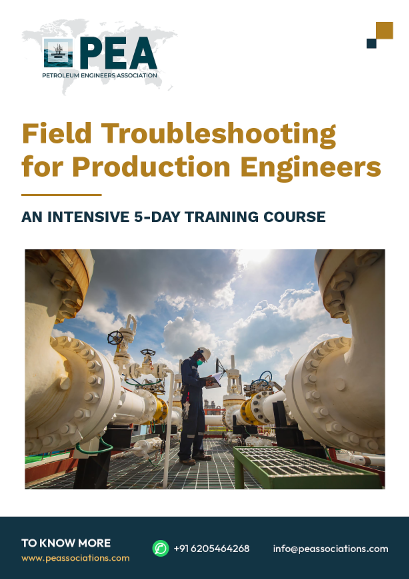
An Interactive 5-Day Training Course
Field Troubleshooting for Production Engineers
Diagnosing Problems in the Field
Secure your spot now!
Duration
5 Days
Price
$ 3,000
Starting From
24 May 2027



Field Troubleshooting for Production Engineers
Have Questions ?
Field Troubleshooting for Production Engineers - PE-FTS-PEA27
| Code | Date | Time | Duration | Location | Currency | Early Bird Fee Per Person |
|---|---|---|---|---|---|---|
| PE-FTS-PEA27 | 24 - 28 May 2027 | 10 AM CST | 4 Hours Per Day |
Online |
USD |
3000 |
Need this for a group? We deliver the same course in-house — face-to-face at your location or online — tailored to your assets and team level. Contact info@peassociations.com.
Boost your team's skills and your budget! Enjoy group discounts for collaborative learning. Send an inquiry to info@peassociations.com.
Field Troubleshooting for Production Engineers
This course builds systematic troubleshooting skill. Participants study diagnostic method and evidence gathering, well problem diagnosis, artificial lift and surface equipment faults, measurement and data errors, flow assurance and integrity symptoms, multi-cause problems, decision making under uncertainty and structured problem solving.
Description
Troubleshooting is the everyday work of production engineering: a well that stopped, a rate that fell, a separator carrying over, a pump that keeps failing, a reading that does not make sense. Doing it well means working from evidence in a structured way rather than guessing, and knowing which measurement would settle the question before spending money on an intervention.
This course teaches that method and applies it across the production system. It starts with diagnostic reasoning, evidence gathering and the common traps, then works through well problems, artificial lift faults, surface equipment and process problems, and measurement and data errors that look like production problems. It then covers flow assurance and integrity symptoms as they appear in the field, problems with more than one cause, and troubleshooting when data is missing or contradictory. The course closes with structured problem solving, decision making under uncertainty and capturing what was learned.
Most production problems announce themselves as a single symptom: the rate is down. Behind that symptom sits a long list of possible causes spread across the reservoir, the well, the lift system, the flowline, the facility and the measurement. Good troubleshooting is the process of eliminating most of that list quickly with evidence that is already available, then choosing the one measurement that distinguishes between what remains.
The common failure is jumping to a familiar cause. If the last three wells that lost rate had scale, the fourth gets an acid job, and if the problem was really a choke washing out or a meter drifting, the money is wasted and the problem persists. Structured troubleshooting resists that pull by insisting on a hypothesis that explains all the evidence, not just the convenient part.
The second failure is ignoring measurement error. A large share of apparent production problems are data problems: a meter out of calibration, a test taken before stabilisation, an allocation change, a gauge drifting. Checking whether the change is real before investigating why it happened saves a great deal of effort. This course drills both the method and the specific fault patterns engineers meet in the field.
By the end of this training, participants will be able to:
- Apply a structured diagnostic method to production problems.
- Gather and evaluate evidence from production, test, pressure and operating data.
- Distinguish real production changes from measurement and data errors.
- Diagnose well problems, including inflow, completion, tubing and choke faults.
- Diagnose artificial lift faults from surveillance data.
- Diagnose surface equipment and process problems affecting production.
- Recognise flow assurance and integrity symptoms in field data.
- Handle problems with multiple interacting causes.
- Decide between further diagnosis and direct intervention under uncertainty.
- Record and share troubleshooting findings so they are reused.
Organisations sending participants to this training will:
- Diagnose production problems faster and more accurately.
- Reduce spend on interventions aimed at the wrong cause.
- Reduce repeat failures by finding root causes.
- Improve the quality of data used in field decisions.
- Spread diagnostic skill beyond a few experienced individuals.
Participants will:
- Be able to troubleshoot systematically rather than by pattern matching.
- Be able to distinguish data problems from production problems.
- Be able to diagnose faults across wells, lift and surface equipment.
- Be able to decide when more data is worth gathering.
- Be able to document and share diagnostic findings.
- Production engineers
- Operations engineers and supervisors
- Production technologists
- Well surveillance and optimisation engineers
- Field supervisors and technicians
- Graduate engineers in production roles
Module 1: Diagnostic Method
- Symptom, hypothesis and evidence
- Eliminating causes efficiently
- Choosing the decisive measurement
- Common reasoning traps
- Working with incomplete information
Module 2: Is the Change Real?
- Meter drift and calibration errors
- Unstabilised and poorly run well tests
- Allocation and reporting changes
- Gauge and sensor faults
- Verifying before investigating
Module 3: Well Problems
- Inflow decline and reservoir causes
- Skin, scale and near-wellbore damage
- Tubing restrictions, fill and collapse
- Choke and wellhead problems
- Water and gas breakthrough
Module 4: Artificial Lift Faults
- Rod pump faults from card data
- ESP faults from current and gauge data
- Gas lift faults from injection and gradient data
- PCP and plunger lift faults
- Distinguishing lift faults from well problems
Module 5: Surface and Process Problems
- Separator carry-over and carry-under
- Compressor and pump faults
- Control valve and instrument problems
- Back-pressure and routing errors
- Utility and power failures
Module 6: Flow Assurance and Integrity Symptoms
- Hydrate, wax and scale signatures
- Emulsion and separation problems
- Sand production indicators
- Annulus pressure changes
- Leak indications in production data
Module 7: Multi-Cause Problems
- Problems with several contributing causes
- Cascading failures
- Intermittent and recurring faults
- Separating cause from consequence
Module 8: Decisions and Actions
- Cost of further diagnosis against cost of intervention
- Risk of acting on an unconfirmed diagnosis
- Trial actions and their design
- Escalation and asking for help
Module 9: Learning and Sharing
- Recording diagnosis and outcome
- Building a field problem knowledge base
- Root cause analysis for repeat failures
- Passing diagnostic skill to less experienced staff
Upon successful completion of this training course, delegates will be awarded an official Certificate of Completion issued by the Petroleum Engineers Association (PEA), an ISO 9001:2015 certified training organization. The certificate carries 10 Credits and formally records the total learning hours completed.
Each certificate is signed by the Course Facilitator and the CEO of the Petroleum Engineers Association, and serves as verifiable proof of professional training that delegates can present to employers and professional bodies worldwide.
Frequently Asked Questions
All course bookings made through PEA are strictly non-refundable. By registering for a course, you acknowledge and accept that all fees are payable in full and are not subject to refund under any circumstances, including changes in personal or professional commitments or partial attendance.
PEA reserves the right to make reasonable adjustments to course content, trainers, or schedules where necessary, without entitling delegates to a refund. Comprehensive details of each course — including objectives, target audience, and content — are clearly outlined before enrolment, and it is the responsibility of the delegate to ensure the course's suitability prior to booking.
For any inquiries related to cancellations or bookings, please contact our support team, who will be happy to assist you.
