


An Interactive 5-Day Training Course
Matrix Acidizing - Sandstone & Carbonate
Designing Matrix Acid Treatments
Secure your spot now!
Duration
5 Days
Price
$ 3,000
Starting From
06 Sep 2027



Matrix Acidizing - Sandstone & Carbonate
Have Questions ?
Matrix Acidizing - Sandstone & Carbonate - PE-MAC-PEA27
| Code | Date | Time | Duration | Location | Currency | Early Bird Fee Per Person |
|---|---|---|---|---|---|---|
| PE-MAC-PEA27 | 06 - 10 Sep 2027 | 10 AM CST | 4 Hours Per Day |
Online |
USD |
3000 |
Need this for a group? We deliver the same course in-house — face-to-face at your location or online — tailored to your assets and team level. Contact info@peassociations.com.
Boost your team's skills and your budget! Enjoy group discounts for collaborative learning. Send an inquiry to info@peassociations.com.
Matrix Acidizing - Sandstone & Carbonate
Description
Matrix acidising restores or improves near-wellbore permeability by injecting acid below fracture pressure. It is the most common stimulation treatment in the industry and one of the most frequently misapplied. The chemistry differs completely between sandstone and carbonate, and so does the mechanism by which productivity improves: dissolution of damaging material in sandstone, and the creation of highly conductive wormholes in carbonate.
This course covers both. For carbonates it covers acid-rock reaction kinetics, wormhole propagation and optimum injection rate, acid types including emulsified, gelled and in-situ crosslinked systems, and treatment design for vertical and horizontal wells. For sandstones it covers mud acid chemistry, the secondary and tertiary reactions that cause precipitation, preflush and overflush design, fluoboric and retarded acid systems, and mineralogy-driven design. Both parts cover additives, diversion, execution and evaluation.
In carbonate rock, acid dissolves the formation itself. Injected at the right rate, hydrochloric acid forms narrow, deeply penetrating wormholes that bypass the damaged zone and give a large productivity gain. Injected too slowly it dissolves the face of the rock and goes nowhere; too fast and it creates a dense network of short channels that consumes acid without penetrating. Optimum injection rate is central to carbonate acidising design.
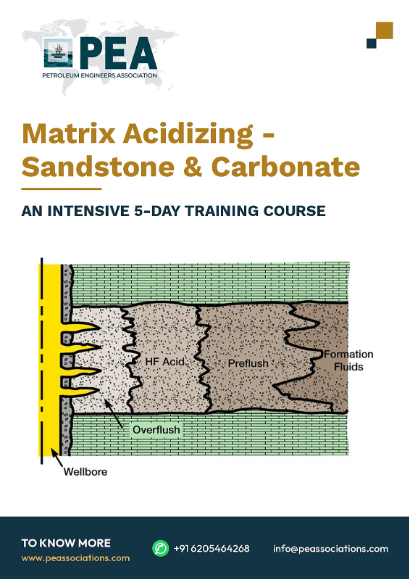
In sandstone, the aim is different. The rock matrix mostly does not dissolve; the target is the material causing the damage, such as drilling fluid solids, clays and precipitates. Hydrofluoric acid is used because it dissolves silicates, but its reaction products precipitate if the fluid chemistry is not controlled, and those precipitates can cause worse damage than the original problem. This is why sandstone acidising requires preflushes, careful volume design and knowledge of the formation mineralogy.
Common failures include acidising a well whose problem is not near-wellbore damage, using hydrofluoric acid in carbonate-bearing sandstone without adequate preflush, ignoring formation temperature when selecting corrosion inhibitor, and pumping without diversion so that acid enters only the highest permeability zone. This course covers the design methods that avoid each of them.
By the end of this training, participants will be able to:
- Explain acid-rock reactions in carbonate and sandstone formations.
- Describe wormhole propagation and determine optimum injection rates in carbonates.
- Select acid systems, including emulsified, gelled, retarded and in-situ crosslinked acids.
- Design sandstone acid treatments from formation mineralogy.
- Control secondary and tertiary precipitation through preflush and overflush design.
- Calculate treatment volumes, rates and maximum injection pressures.
- Select additives for corrosion, iron control, sludging and clay stabilisation.
- Design diversion for effective acid placement.
- Plan job execution, monitoring and flowback.
- Evaluate treatment effectiveness from pressure and production data.
Organisations sending participants to this training will:
- Improve matrix acidising success rates and production gains.
- Reduce treatment failures caused by precipitation and poor placement.
- Match acid systems to formation mineralogy and temperature.
- Reduce acid volumes and cost through better design.
- Build a consistent design and evaluation standard for acid treatments.
Participants will:
- Understand the chemistry behind carbonate and sandstone acidising.
- Be able to design a matrix acid treatment from formation data.
- Understand precipitation risks and how to control them.
- Be able to design diversion and placement.
- Be able to evaluate treatments and learn from failures.
- Production engineers
- Stimulation and well services engineers
- Well intervention and workover engineers
- Completion engineers
- Production chemists
- Operations engineers responsible for well treatments
Module 1: Matrix Acidising Fundamentals
- Objectives of matrix acidising
- Matrix versus fracture acidising
- Fracture pressure and injection limits
- Candidate selection basics
Module 2: Carbonate Acid-Rock Reactions
- Hydrochloric acid reactions with limestone and dolomite
- Reaction kinetics and mass transfer
- Temperature effects
- Spending time and live acid penetration
Module 3: Wormholing in Carbonates
- Wormhole propagation mechanisms
- Optimum injection rate
- Pore volumes to breakthrough
- Core flow test data and its interpretation
- Design for horizontal and long intervals
Module 4: Carbonate Acid Systems
- Plain and gelled hydrochloric acid
- Emulsified acids
- In-situ crosslinked acid systems
- Organic acids and chelants
- Selection by temperature and permeability
Module 5: Sandstone Acidising Chemistry
- Hydrofluoric acid reactions with silicates and clays
- Primary, secondary and tertiary reactions
- Precipitation of fluosilicates and aluminium compounds
- Effect of formation mineralogy
Module 6: Sandstone Treatment Design
- Preflush design and purpose
- Main acid stage volumes and concentrations
- Overflush design
- Fluoboric and retarded acid systems
- Design from mineralogy and temperature
Module 7: Additives
- Corrosion inhibitors and intensifiers
- Iron control agents
- Anti-sludge agents and surfactants
- Mutual solvents
- Compatibility testing
Module 8: Diversion and Placement
- Acid flow into high permeability zones
- Chemical diverters, foams and gels
- Ball sealers and mechanical diversion
- Coiled tubing and straddle placement
- Diversion in long and horizontal intervals
Module 9: Execution and Evaluation
- Pumping schedules and quality control
- Real-time pressure monitoring and rate control
- Flowback and spent acid handling
- Safety and environmental requirements
- Post-treatment skin and production evaluation
Upon successful completion of this training course, delegates will be awarded an official Certificate of Completion issued by the Petroleum Engineers Association (PEA), an ISO 9001:2015 certified training organization. The certificate carries 10 Credits and formally records the total learning hours completed.
Each certificate is signed by the Course Facilitator and the CEO of the Petroleum Engineers Association, and serves as verifiable proof of professional training that delegates can present to employers and professional bodies worldwide.
Frequently Asked Questions
All course bookings made through PEA are strictly non-refundable. By registering for a course, you acknowledge and accept that all fees are payable in full and are not subject to refund under any circumstances, including changes in personal or professional commitments or partial attendance.
PEA reserves the right to make reasonable adjustments to course content, trainers, or schedules where necessary, without entitling delegates to a refund. Comprehensive details of each course — including objectives, target audience, and content — are clearly outlined before enrolment, and it is the responsibility of the delegate to ensure the course's suitability prior to booking.
For any inquiries related to cancellations or bookings, please contact our support team, who will be happy to assist you.
