
An Interactive 5-Day Training Course
Offshore & Subsea Production Operations
Operating Offshore and Subsea Systems
Secure your spot now!
Duration
5 Days
Price
$ 4,000
Starting From
21 Jun 2027



Offshore & Subsea Production Operations
Have Questions ?
Offshore & Subsea Production Operations - PE-OSP-PEA27
| Code | Date | Time | Duration | Location | Currency | Early Bird Fee Per Person |
|---|---|---|---|---|---|---|
| PE-OSP-PEA27 | 21 - 25 Jun 2027 | 10 AM CST | 4 Hours Per Day |
Online |
USD |
4000 |
Need this for a group? We deliver the same course in-house — face-to-face at your location or online — tailored to your assets and team level. Contact info@peassociations.com.
Boost your team's skills and your budget! Enjoy group discounts for collaborative learning. Send an inquiry to info@peassociations.com.
Offshore & Subsea Production Operations
Description
Offshore production adds constraints that onshore operations do not have: limited space and weight, limited personnel, weather dependency, expensive logistics and, for subsea systems, production equipment sitting on the seabed where every intervention needs a vessel. Operating well offshore means designing around those constraints and working within them day to day.
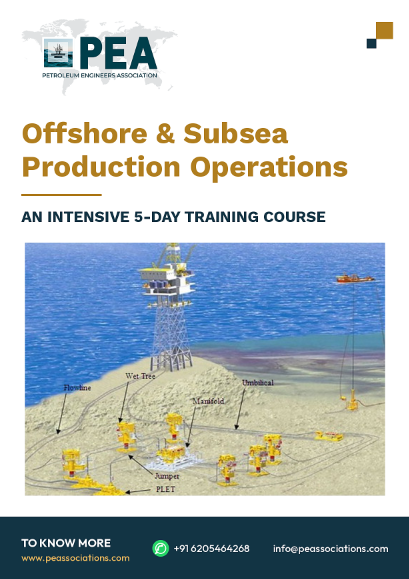
This course covers the system and its operation. It starts with facility types, from fixed platforms to floating production units, and subsea architecture: templates, manifolds, trees, jumpers, flowlines, risers and umbilicals. It then covers subsea control systems, hydraulic and electrical distribution, and the monitoring available from subsea equipment. The course then covers subsea well operations, flow assurance offshore including hydrate and wax management, topside process operations, and intervention and inspection using vessels, remotely operated vehicles and riserless methods. It closes with logistics, marine operations, offshore safety management and emergency response.
A subsea well is a production well whose wellhead sits on the seabed, often in cold water, kilometres from the host facility. Everything that would be simple on a platform, including checking a valve, taking a sample or changing a choke, becomes a planned operation requiring a vessel or a remotely operated vehicle. That changes how systems are designed and how operations think about reliability.
Design compensates with redundancy and instrumentation. Subsea trees carry multiple barriers and remotely operated valves, control systems are duplicated, chemical injection lines run through umbilicals to points that cannot be reached otherwise, and downhole and subsea gauges provide the data that would otherwise require intervention. Flow assurance is designed in, because a hydrate plug in a subsea flowline can shut a field in for weeks.
Operationally, the limits come from weather, logistics and people. Crew changes, supply runs, vessel availability and weather windows govern what can be done and when, and a job that takes a day onshore may wait a month offshore for the right conditions and equipment. This course covers the technology, the operating practice and those practical constraints together.
By the end of this training, participants will be able to:
- Describe offshore facility types and their operating characteristics.
- Describe subsea architecture and the function of each component.
- Explain subsea control systems, umbilicals and power and chemical distribution.
- Plan and supervise subsea well operations, including start-up and shut-in.
- Apply flow assurance management in offshore and subsea systems.
- Operate topside production processes within offshore constraints.
- Plan subsea intervention and inspection using vessels and remotely operated vehicles.
- Manage logistics, marine operations and weather constraints.
- Apply offshore safety management, permit systems and simultaneous operations control.
- Apply emergency response and evacuation procedures offshore.
Organisations sending participants to this training will:
- Improve uptime and reliability of offshore and subsea production.
- Reduce costly subsea interventions through better operating practice.
- Improve flow assurance management and reduce blockage risk.
- Improve planning of vessel, logistics and weather-dependent work.
- Strengthen offshore safety and emergency preparedness.
Participants will:
- Understand offshore facility and subsea system architecture.
- Understand subsea control, monitoring and chemical distribution.
- Be able to plan subsea well operations and interventions.
- Understand offshore flow assurance and process operation.
- Understand the logistics, safety and emergency framework offshore.
- Production engineers working offshore
- Subsea engineers
- Operations engineers and supervisors
- Facilities and process engineers
- Well intervention engineers
- Marine and logistics coordinators supporting production
Module 1: Offshore Facilities
- Fixed platforms and jackets
- Floating production storage and offloading units
- Semi-submersibles, spars and tension leg platforms
- Normally unmanned installations
- Host and tieback arrangements
Module 2: Subsea Architecture
- Subsea trees and wellheads
- Templates and manifolds
- Jumpers, flowlines and risers
- Tiebacks and daisy chains
- Pigging and round-trip arrangements
Module 3: Subsea Control and Umbilicals
- Hydraulic, electro-hydraulic and all-electric systems
- Subsea control modules
- Umbilical design and contents
- Chemical injection distribution
- Subsea instrumentation and data
Module 4: Subsea Well Operations
- Start-up and shut-in of subsea wells
- Choke operation and rate control
- Well testing subsea
- Barrier management and valve testing
- Annulus monitoring subsea
Module 5: Flow Assurance Offshore
- Hydrate prevention and cool-down management
- Wax and asphaltene control
- Blowdown and preservation
- Slugging and riser stability
- Chemical injection reliability
Module 6: Topside Production Operations
- Process facilities offshore
- Space, weight and utility constraints
- Produced water handling and discharge
- Gas compression, export and flaring
- Power generation and utilities
Module 7: Intervention and Inspection
- Remotely operated vehicle operations
- Light well intervention vessels
- Riserless intervention
- Rig-based subsea intervention
- Inspection, maintenance and repair programmes
Module 8: Logistics and Marine Operations
- Supply vessels and materials logistics
- Crew change and helicopter operations
- Weather windows and seasonal limits
- Vessel scheduling and cost
- Planning around logistics constraints
Module 9: Safety and Emergency Response
- Offshore safety management systems
- Permit to work and isolation offshore
- Simultaneous operations
- Emergency response, muster and evacuation
- Regulatory framework offshore
Upon successful completion of this training course, delegates will be awarded an official Certificate of Completion issued by the Petroleum Engineers Association (PEA), an ISO 9001:2015 certified training organization. The certificate carries 10 Credits and formally records the total learning hours completed.
Each certificate is signed by the Course Facilitator and the CEO of the Petroleum Engineers Association, and serves as verifiable proof of professional training that delegates can present to employers and professional bodies worldwide.
Frequently Asked Questions
All course bookings made through PEA are strictly non-refundable. By registering for a course, you acknowledge and accept that all fees are payable in full and are not subject to refund under any circumstances, including changes in personal or professional commitments or partial attendance.
PEA reserves the right to make reasonable adjustments to course content, trainers, or schedules where necessary, without entitling delegates to a refund. Comprehensive details of each course — including objectives, target audience, and content — are clearly outlined before enrolment, and it is the responsibility of the delegate to ensure the course's suitability prior to booking.
For any inquiries related to cancellations or bookings, please contact our support team, who will be happy to assist you.
