


An Interactive 5-Day Training Course
Progressive Cavity Pumps (PCP)
Design, Operation and Failure Prevention
Secure your spot now!
Duration
5 Days
Price
$ 3,000
Starting From
03 May 2027



Progressive Cavity Pumps (PCP)
Have Questions ?
Progressive Cavity Pumps (PCP) - PE-PCP-PEA27
| Code | Date | Time | Duration | Location | Currency | Early Bird Fee Per Person |
|---|---|---|---|---|---|---|
| PE-PCP-PEA27 | 03 - 07 May 2027 | 10 AM CST | 4 Hours Per Day |
Online |
USD |
3000 |
Need this for a group? We deliver the same course in-house — face-to-face at your location or online — tailored to your assets and team level. Contact info@peassociations.com.
Boost your team's skills and your budget! Enjoy group discounts for collaborative learning. Send an inquiry to info@peassociations.com.
Progressive Cavity Pumps (PCP)
Description
Progressing cavity pumps are the preferred lift method for heavy and viscous crude, for wells producing sand, and for many coalbed methane and shallow onshore wells. They move fluid with a steady, non-pulsating action that handles solids and viscous fluids better than centrifugal or reciprocating pumps. Their weak point is the elastomer stator, which is sensitive to temperature, aromatics, gas and dry running.
This course covers the whole PCP system. It starts with pump geometry, single and multi-lobe designs, displacement, differential pressure and slip, then moves to elastomer types, swell and fluid compatibility. Participants then work through system design: rod string sizing and torque, drive head selection, surface drives and speed control, and setting depth. The second half covers installation and start-up, operating limits, monitoring and surveillance, and the diagnosis of the common failure modes, including stator damage, rod failures and backspin incidents.
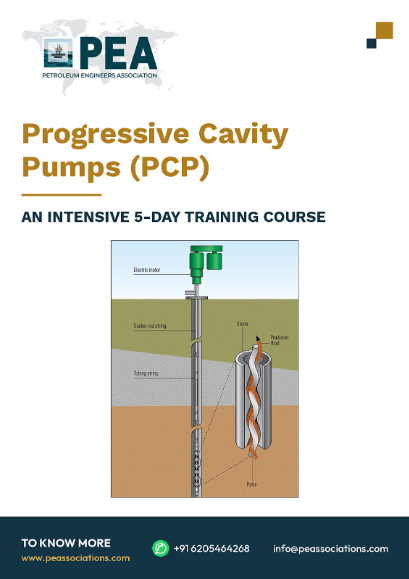
A progressing cavity pump is a single helical rotor turning inside a double helical elastomer stator. Cavities formed between them move fluid up the well at a rate that depends only on geometry and rotational speed. Because there are no valves and no reciprocating parts downhole, the pump handles sand and viscous fluid well and produces a steady flow.
The elastomer is what determines run life. It swells in contact with hydrocarbons, softens at high temperature, degrades with aromatic content, hardens with hydrogen sulphide and abrades when solids and dry running combine. Elastomer selection and the control of temperature and differential pressure are the core of PCP design and operation.
Common failures follow from a few causes: pumps run dry or pumped off, differential pressure above the limit for the number of stages, elastomer and fluid mismatch, rod string torque and axial load beyond limits, and uncontrolled backspin at shutdown. Most are preventable with proper design, correct start-up and disciplined surveillance, which is what this course covers.
By the end of this training, participants will be able to:
- Describe PCP system components and the operating principle of the pump.
- Calculate pump displacement, head and slip from geometry and operating conditions.
- Select elastomers for given fluid, temperature and gas conditions.
- Size rod strings and calculate torque and axial loading.
- Select drive heads, surface drives and speed control equipment.
- Determine setting depth, operating speed and differential pressure limits.
- Plan installation, start-up and commissioning of PCP wells.
- Monitor PCP performance and recognise the early signs of problems.
- Diagnose elastomer, rod, pump and drive head failures and prevent recurrence.
The course is
instructor-led. Pump theory and elastomer behaviour are explained from first
principles and applied through worked design examples for pump selection, rod
loading and torque. Operating practice, surveillance and failure analysis are
taught through field cases and photographs of failed equipment. Participants
are encouraged to bring well conditions and failure histories from their own
fields for discussion.
Organisations sending participants to this training will:
- Improve PCP run life and reduce workovers.
- Match elastomer and pump selection to actual well fluids and temperature.
- Reduce failures caused by dry running, pump-off and backspin.
- Improve installation and start-up quality.
- Build a failure analysis process that feeds back into pump selection.
Participants will:
- Understand how progressing cavity pumps work and where they suit.
- Be able to select a pump and elastomer for given well conditions.
- Be able to size rod strings and calculate torque.
- Understand the operating limits that protect the stator.
- Be able to diagnose common PCP failures.
- Production engineers
- Artificial lift engineers
- Heavy oil production engineers
- Well operations engineers and supervisors
- Field technicians working on PCP wells
- Maintenance engineers supporting PCP installations
Module 1: PCP System Overview
- System components: pump, rod string, drive head and surface drive
- Applications: heavy oil, sand-producing wells and coalbed methane
- Comparison with other lift methods
Module 2: Pump Geometry and Performance
- Rotor and stator geometry
- Single-lobe and multi-lobe designs
- Displacement, speed and flow rate
- Differential pressure, stages and slip
- Pump performance curves
Module 3: Elastomers and Fluid Compatibility
- Elastomer types and properties
- Swell in hydrocarbons and water
- Temperature limits
- Aromatics, hydrogen sulphide and carbon dioxide effects
- Abrasion resistance and solids
Module 4: Rod Strings and Torque
- Rod string sizing
- Torque and axial load calculations
- Rod centralisers and tubing wear
- Rod string failures in PCP service
Module 5: Drive Heads and Surface Equipment
- Drive head types and selection
- Electric and hydraulic drives
- Speed control
- Backspin control and brakes
Module 6: System Design
- Design basis from well inflow
- Setting depth and intake conditions
- Pump selection and staging
- Operating speed and differential pressure limits
- Design for gas and free-gas handling
Module 7: Installation, Start-Up and Operation
- Installation procedures
- Rotor spacing and tag-down
- Start-up and break-in
- Routine operating practice
- Shutdown and backspin management
Module 8: Surveillance and Failure Analysis
- Monitoring torque, speed, load and fluid level
- Early signs of stator damage
- Common failure modes: dry running, pump-off, chemical attack and abrasion
- Dismantle inspection
- Run life improvement
Upon successful completion of this training course, delegates will be awarded an official Certificate of Completion issued by the Petroleum Engineers Association (PEA), an ISO 9001:2015 certified training organization. The certificate carries 10 Credits and formally records the total learning hours completed.
Each certificate is signed by the Course Facilitator and the CEO of the Petroleum Engineers Association, and serves as verifiable proof of professional training that delegates can present to employers and professional bodies worldwide.
Frequently Asked Questions
All course bookings made through PEA are strictly non-refundable. By registering for a course, you acknowledge and accept that all fees are payable in full and are not subject to refund under any circumstances, including changes in personal or professional commitments or partial attendance.
PEA reserves the right to make reasonable adjustments to course content, trainers, or schedules where necessary, without entitling delegates to a refund. Comprehensive details of each course — including objectives, target audience, and content — are clearly outlined before enrolment, and it is the responsibility of the delegate to ensure the course's suitability prior to booking.
For any inquiries related to cancellations or bookings, please contact our support team, who will be happy to assist you.
