


An Interactive 5-Day Training Course
Snubbing & Hydraulic Workover
Working Under Live Well Pressure
Secure your spot now!
Duration
5 Days
Price
$ 3,500
Starting From
01 Nov 2027



Snubbing & Hydraulic Workover
Have Questions ?
Snubbing & Hydraulic Workover - PE-SHW-PEA27
| Code | Date | Time | Duration | Location | Currency | Early Bird Fee Per Person |
|---|---|---|---|---|---|---|
| PE-SHW-PEA27 | 01 - 05 Nov 2027 | 10 AM CST | 4 Hours Per Day |
Online |
USD |
3500 |
Need this for a group? We deliver the same course in-house — face-to-face at your location or online — tailored to your assets and team level. Contact info@peassociations.com.
Boost your team's skills and your budget! Enjoy group discounts for collaborative learning. Send an inquiry to info@peassociations.com.
Snubbing & Hydraulic Workover
Description
Snubbing allows pipe to be run into and pulled out of a well that is under pressure, which means heavy intervention work can be done without killing the well. That avoids the formation damage, kill fluid cost and lost production that come with a conventional workover, and in some wells it is the only safe option because the well cannot be killed at all.
This course covers the engineering and operating practice. It starts with the force balance that defines snubbing and stripping, pipe light and pipe heavy conditions, and buckling limits, then covers unit types, rig-up configurations and the pressure control stack. It then covers tubular handling and make-up under pressure, barrier management, and the main applications: completion and tubing work, fishing, milling, cement and isolation work, and well control assistance. The course closes with job planning, procedures, well control and emergency response.
When a well is under pressure, the pressure acts on the cross-sectional area of the pipe and pushes it out of the hole. Until the weight of the pipe in the well exceeds that force, the pipe must be pushed in against the pressure, which is snubbing. Past the balance point, the pipe becomes heavy and is stripped in under its own weight, with the snubbing unit controlling its descent. Every job crosses that balance point, and knowing where it lies is the first calculation in any snubbing programme.
Working under pressure changes everything about tubular handling. Every connection is made up with the well live below. Barriers must be maintained at all times, usually through a stack of rams that allow the pipe to be stripped through while containing pressure. A failure at any point in that sequence is a well control event with pipe in the hole, which is why procedure discipline in snubbing is stricter than in almost any other intervention.
Snubbing is chosen when killing the well is undesirable or impossible: damage-sensitive formations, depleted zones that would take losses, wells with no way to circulate, or wells that need to keep producing until the last moment. Its cost sits between coiled tubing and a rig workover, and its capability overlaps both. This course covers where it fits and how it is done.
By the end of this training, participants will be able to:
- Explain the force balance in snubbing and stripping operations.
- Calculate pipe light and pipe heavy conditions and the balance point.
- Assess buckling limits and required snubbing force.
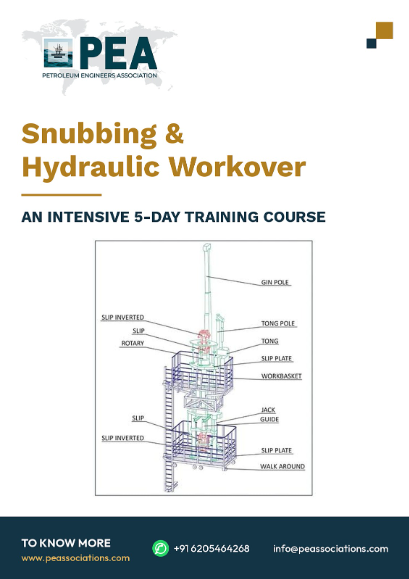
- Describe hydraulic workover and snubbing unit types and rig-up configurations.
- Specify pressure control stacks and manage barriers during live well work.
- Plan tubular handling and connection make-up under pressure.
- Select snubbing for applications including tubing work, fishing, milling and cement jobs.
- Plan a snubbing job, including procedures, equipment and personnel.
- Apply well control principles specific to snubbing operations.
- Apply emergency procedures for pipe failure, stuck pipe and loss of control.
The course is
instructor-led. The force balance and snubbing calculations are developed with
worked examples for a range of well pressures and pipe sizes. Equipment, rig-up
and procedures are covered through drawings, photographs and field programmes.
Well control and emergency response are taught through case studies from real
operations. Participants are encouraged to bring their own well problems for
discussion.
Organisations sending participants to this training will:
- Perform heavy intervention work without killing wells.
- Avoid formation damage and kill fluid losses in sensitive wells.
- Improve the safety and procedure discipline of live well operations.
- Select snubbing appropriately against coiled tubing and rig workover options.
- Improve planning and cost estimation for snubbing jobs.
Participants will:
- Understand the mechanics of running pipe against pressure.
- Be able to calculate snubbing forces and the balance point.
- Understand pressure control stacks and barrier management.
- Be able to plan and supervise a snubbing operation.
- Understand well control and emergency response in live well work.
- Well intervention and workover engineers
- Production engineers
- Completion engineers
- Well services supervisors and operations staff
- Drilling engineers involved in live well operations
- Field supervisors on intervention operations
Module 1: Snubbing Principles
- Working on live wells
- Snubbing compared with coiled tubing and rig workovers
- Applications and selection criteria
- Terminology
Module 2: Forces and Calculations
- Pressure force acting on pipe
- Pipe light and pipe heavy conditions
- The balance point
- Snubbing force requirements
- Buckling and critical buckling load
- Worked examples
Module 3: Units and Rig-Up
- Rig-assist and stand-alone units
- Hydraulic workover units
- Jack, slip bowls and travelling and stationary slips
- Power packs and control systems
- Rig-up configurations and space requirements
Module 4: Pressure Control Equipment
- Blowout preventer stacks for snubbing
- Stripper and annular elements
- Equalising and bleed systems
- Barrier philosophy and verification
- Testing and certification
Module 5: Tubular Handling Under Pressure
- Pipe handling and make-up equipment
- Connection make-up and torque control
- Stripping through rams
- Tapered and multi-size strings
- Pipe inspection and handling practice
Module 6: Applications
- Running and pulling tubing and completions
- Fishing under pressure
- Milling and clean-out
- Cement and isolation work
- Snubbing in well control operations
- Working in high pressure and sour wells
Module 7: Job Planning
- Well data requirements and pressure analysis
- Job programme and procedures
- Equipment selection and spares
- Personnel, competence and crew structure
- Risk assessment and management of change
Module 8: Well Control in Snubbing
- Well control principles with pipe in the hole
- Monitoring and detection
- Kill methods available during snubbing
- Roles and responsibilities
Module 9: Emergencies and Contingencies
- Stuck pipe under pressure
- Pipe failure and dropped strings
- Loss of pressure control
- Emergency shutdown and abandonment of the operation
- Incident review and lessons learned
Upon successful completion of this training course, delegates will be awarded an official Certificate of Completion issued by the Petroleum Engineers Association (PEA), an ISO 9001:2015 certified training organization. The certificate carries 10 Credits and formally records the total learning hours completed.
Each certificate is signed by the Course Facilitator and the CEO of the Petroleum Engineers Association, and serves as verifiable proof of professional training that delegates can present to employers and professional bodies worldwide.
Frequently Asked Questions
All course bookings made through PEA are strictly non-refundable. By registering for a course, you acknowledge and accept that all fees are payable in full and are not subject to refund under any circumstances, including changes in personal or professional commitments or partial attendance.
PEA reserves the right to make reasonable adjustments to course content, trainers, or schedules where necessary, without entitling delegates to a refund. Comprehensive details of each course — including objectives, target audience, and content — are clearly outlined before enrolment, and it is the responsibility of the delegate to ensure the course's suitability prior to booking.
For any inquiries related to cancellations or bookings, please contact our support team, who will be happy to assist you.
