


An Interactive 5-Day Training Course
Sustained Casing Pressure - Diagnosis & Remediation
Finding and Fixing Annulus Leaks
Secure your spot now!
Duration
5 Days
Price
$ 3,500
Starting From
13 Dec 2027



Sustained Casing Pressure - Diagnosis & Remediation
Have Questions ?
Sustained Casing Pressure - Diagnosis & Remediation - PE-SCP-PEA27
| Code | Date | Time | Duration | Location | Currency | Early Bird Fee Per Person |
|---|---|---|---|---|---|---|
| PE-SCP-PEA27 | 13 - 17 Dec 2027 | 10 AM CST | 4 Hours Per Day |
Online |
USD |
3500 |
Need this for a group? We deliver the same course in-house — face-to-face at your location or online — tailored to your assets and team level. Contact info@peassociations.com.
Boost your team's skills and your budget! Enjoy group discounts for collaborative learning. Send an inquiry to info@peassociations.com.
Sustained Casing Pressure - Diagnosis & Remediation
Description
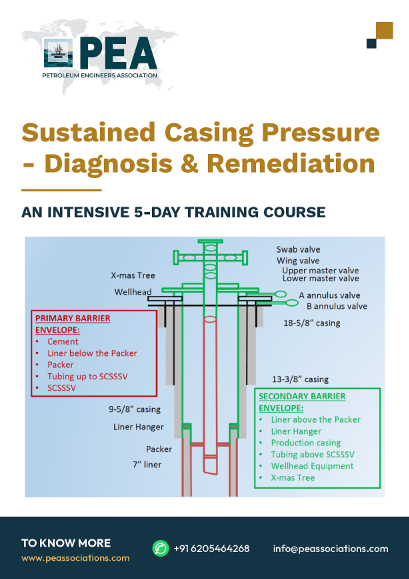
Sustained casing pressure is annulus pressure that rebuilds after being bled down. It indicates a leak somewhere in the well: a tubing or casing hole, a packer or seal failure, a leaking wellhead component, or gas migrating through or behind cement. It is one of the most common well integrity anomalies and one of the most frequently mismanaged, because bleeding the annulus and continuing to produce is easy and treats the symptom rather than the cause.
This course covers diagnosis first. It sets out the possible leak paths and their signatures, then covers the diagnostic tests: bleed-down and build-up behaviour, pressure and volume relationships, fluid sampling and gas composition analysis, temperature and noise logging, ultrasonic and casing inspection logging, and how to combine these into an identification of the leak. It then covers risk assessment against maximum allowable annulus pressures, operating limits and monitoring regimes, and the remediation options: squeeze cementing, casing patches and liners, tubing repair or replacement, wellhead repair, and when the correct answer is to shut in or abandon.
When an
annulus holds pressure that returns after bleeding, something is leaking. The
important question is what, because the answer determines whether the well can
keep producing. Gas migrating slowly through cement in a shallow annulus is a
different problem from a corroded tubing leak feeding the A annulus at
reservoir pressure, even though both present as sustained casing pressure at
the wellhead.
Diagnosis is
done mostly from the wellhead. The rate at which pressure builds, the volume
bled to reach zero, the fluid and gas produced during the bleed, and the way
pressure in different annuli responds to each other narrow the possibilities
considerably before any logging tool is run. Gas composition analysis can
identify the source formation. Temperature and noise logs can locate the leak
point. Each step should be chosen to answer a specific question, not run as a
routine.
The
management decision that follows is a risk decision. Maximum allowable annulus
pressures define what is acceptable, and many wells operate safely for years under
a monitoring regime with a known, characterised leak. Others require
intervention or shut-in. The failure mode to avoid is the well that is bled
daily by operators, recorded in a log nobody reviews, and never diagnosed until
the leak reaches the outer annulus or the surface.
By the end of this training, participants will be able to:
- Define sustained casing pressure and distinguish it from thermal and operational pressure effects.
- Identify the possible leak paths in a well and their pressure signatures.
- Design and interpret bleed-down and build-up diagnostic tests.
- Use fluid and gas composition analysis to identify leak sources.
- Select and interpret temperature, noise, ultrasonic and casing inspection logs.
- Determine maximum allowable annulus pressures and operating limits.
- Assess the risk of continued operation with a characterised leak.
- Select remediation options, including squeeze cementing, patches and tubing replacement.
- Plan monitoring regimes for wells operating with sustained casing pressure.
- Meet regulatory reporting requirements for annulus pressure anomalies.
Organisations sending participants to this training will:
- Identify the cause of annulus pressure rather than managing the symptom.
- Reduce the risk of escalation to loss of containment.
- Make informed decisions on continued operation, repair or shut-in.
- Reduce unnecessary interventions on wells that can be safely monitored.
- Meet regulatory requirements for annulus pressure management.
Participants will:
- Understand the leak paths that cause sustained casing pressure.
- Be able to design and interpret diagnostic tests.
- Be able to determine operating limits and assess risk.
- Know the remediation options and when each applies.
- Be able to make and defend a recommendation on a well with annulus pressure.
- Well integrity engineers
- Production engineers
- Well intervention and workover engineers
- Completion engineers
- Operations engineers and supervisors
- Technical authorities and regulatory compliance staff
Module 1: Annulus Pressure Fundamentals
- Annulus configurations and nomenclature
- Thermal and operational pressure effects
- Defining sustained casing pressure
- Trapped pressure and its behaviour
Module 2: Leak Paths and Causes
- Tubing leaks and connection failures
- Packer and seal assembly leaks
- Casing corrosion and splits
- Wellhead and hanger seal leaks
- Gas migration through and behind cement
- Signatures of each path
Module 3: Diagnostic Testing
- Bleed-down test design and execution
- Build-up rate interpretation
- Pressure and volume relationships
- Cross-annulus response testing
- Data quality and common test errors
Module 4: Fluid and Gas Analysis
- Sampling from the annulus
- Gas composition and isotope analysis
- Source identification
- Water chemistry evidence
Module 5: Logging and Leak Location
- Temperature logs
- Noise and acoustic logs
- Ultrasonic and cement evaluation logs
- Casing inspection and caliper logs
- Selecting the right log for the question
Module 6: Operating Limits and Risk Assessment
- Maximum allowable annulus pressure determination
- Well integrity risk categorisation
- Assessing escalation potential
- Deciding to produce, restrict or shut in
Module 7: Remediation Options
- Squeeze cementing and cement placement
- Casing patches, liners and expandables
- Tubing repair and replacement
- Packer and seal replacement
- Wellhead component repair
- Selecting by cause, cost and risk
Module 8: Monitoring and Long-Term Management
- Monitoring regimes and frequency
- Bleed-down procedures and records
- Trend analysis and escalation triggers
- Regulatory reporting requirements
- Case reviews and lessons learned
Upon successful completion of this training course, delegates will be awarded an official Certificate of Completion issued by the Petroleum Engineers Association (PEA), an ISO 9001:2015 certified training organization. The certificate carries 10 Credits and formally records the total learning hours completed.
Each certificate is signed by the Course Facilitator and the CEO of the Petroleum Engineers Association, and serves as verifiable proof of professional training that delegates can present to employers and professional bodies worldwide.
Frequently Asked Questions
All course bookings made through PEA are strictly non-refundable. By registering for a course, you acknowledge and accept that all fees are payable in full and are not subject to refund under any circumstances, including changes in personal or professional commitments or partial attendance.
PEA reserves the right to make reasonable adjustments to course content, trainers, or schedules where necessary, without entitling delegates to a refund. Comprehensive details of each course — including objectives, target audience, and content — are clearly outlined before enrolment, and it is the responsibility of the delegate to ensure the course's suitability prior to booking.
For any inquiries related to cancellations or bookings, please contact our support team, who will be happy to assist you.
