


A Comprehensive Introduction to Key Well Construction and Maintenance Operations
Basic Drilling, Completion, and Workover Operations
Understand the Fundamentals of Drilling, Completion, and Workover Practices in Oil and Gas Operations



Basic Drilling, Completion, and Workover Operations
Have Questions ?
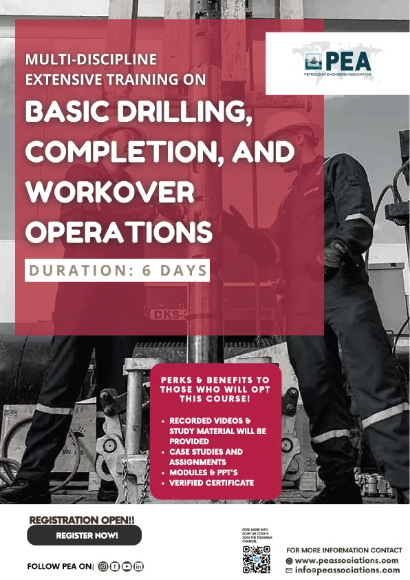
Basic Drilling, Completion, and Workover Operations - PEA-DLFC27
| Code | Date | Time | Duration | Location | Currency | Team of 10 Per Person | Team of 7 Per Person | Early Bird Fee Per Person | Normal Fee Per Person |
|---|---|---|---|---|---|---|---|---|---|
| PEA-DLFC27 | 15 - 19 Mar 2027 | 7 PM Indian Time | 3 Hours Per Day |
Zoom Online |
USD |
750 |
850 |
1000 |
1500 |
The classes will be online via zoom from Monday to Saturday with 3 Hours / Day.
Boost your team's skills and your budget! Enjoy group discounts for collaborative learning. Send an inquiry to info@peassociations.com.
Basic Drilling, Completion, and Workover Operations
This course provides participants with a clear understanding of the fundamental principles and practical aspects of drilling, completion, and workover operations. It is designed for professionals who are new to the industry or those seeking to strengthen their knowledge of well construction and maintenance processes.
Description
The Basic Drilling, Completion, and Workover Operations course offers a complete overview of how oil and gas wells are drilled, completed, and maintained throughout their life cycle. Participants will gain insight into the equipment, techniques, and operational steps involved in each phase of well development.
The course covers drilling systems, rig components, mud circulation, casing and cementing operations, well completion techniques, and workover/intervention methods used to restore or enhance well productivity. Practical case studies and illustrations are used to simplify complex engineering concepts, helping participants build a solid foundation for future technical growth in drilling and production operations.
Drilling, completion, and workover operations form the core of successful oil and gas field development. Understanding these processes is essential for professionals involved in planning, executing, or supporting field operations.
This course introduces participants to the basic engineering concepts, operational procedures, and safety considerations associated with well construction and maintenance. By combining theory with practical examples, it provides a strong knowledge base for engineers, field personnel, and technical staff who wish to understand how wells are drilled, completed, and maintained efficiently and safely.
Understand the key stages of drilling, completion, and workover operations.
Identify major drilling rig components and their functions.
Describe the purpose and process of casing, cementing, and mud circulation.
Explain various well completion techniques and their applications.
Recognize different workover operations and their role in maintaining well productivity.
Appreciate the importance of safety, cost control, and environmental considerations in field operations.
The course uses a blend of interactive lectures, visual presentations, and group discussions. Real-world examples, field videos, and case studies are used to reinforce learning. Participants are encouraged to engage in Q&A sessions and problem-solving exercises to connect theory with actual field practices.
Builds a knowledgeable workforce with a strong foundation in drilling and production operations.
Improves team communication and coordination between drilling, completion, and workover departments.
Enhances safety awareness and operational efficiency.
Reduces operational risks through better understanding of well design and maintenance principles.
Strengthen fundamental technical knowledge of well construction and maintenance.
Build confidence in understanding drilling and completion processes.
Develop a clearer perspective on how different operations interact throughout a well’s life cycle.
Improve readiness for more advanced technical or supervisory roles in drilling and production.
Newly recruited engineers and technicians
Drilling and Production Engineers
Field and Rig Personnel
Geologists, Petrophysicists, and Reservoir Engineers
HSE and Project Support Staff
𝗧𝗵𝗲 𝘄𝗲𝗹𝗹 𝗰𝗼𝗻𝘀𝘁𝗿𝘂𝗰𝘁𝗶𝗼𝗻 𝗽𝗿𝗼𝗰𝗲𝘀𝘀 & 𝗿𝗶𝗴 𝘀𝘆𝘀𝘁𝗲𝗺𝘀
Introduction
Drilling process overview
Pressures
Rigs & Rig Systems
Drilling string components.
𝗗𝗿𝗶𝗹𝗹𝗶𝗻𝗴 𝗳𝗹𝘂𝗶𝗱𝘀 𝗮𝗻𝗱 𝗵𝘆𝗱𝗿𝗮𝘂𝗹𝗶𝗰𝘀
Functions of drilling fluids
Composition of different type of fluids
Hydraulics
Rheology
𝗖𝗮𝘀𝗶𝗻𝗴 & 𝗰𝗲𝗺𝗲𝗻𝘁𝗶𝗻𝗴
Casing Types and Functions
Casing Properties
Casing Design Fundamentals
Cement purpose and additives
Primary and secondary Cementing
𝗗𝗿𝗶𝗹𝗹𝗶𝗻𝗴 𝗽𝗿𝗼𝗯𝗹𝗲𝗺𝘀
Well kicks.
Stuck pipe
Lost circulation.
Drill string Plugging
Washout & Twist off.
𝗗𝗶𝗿𝗲𝗰𝘁𝗶𝗼𝗻𝗮𝗹 𝗱𝗿𝗶𝗹𝗹𝗶𝗻𝗴, 𝗠𝗪𝗗, 𝗟𝗪𝗗 𝗮𝗻𝗱 𝗘𝗹𝗲𝗰𝘁𝗿𝗶𝗰 𝗟𝗼𝗴𝗴𝗶𝗻𝗴 𝗮𝗻𝗱 𝗖𝗼𝗿𝗶𝗻𝗴 𝗢𝗽𝗲𝗿𝗮𝘁𝗶𝗼𝗻
Directional Drilling applications
Well Profile types
Basic definitions & Deflection tools
Survey tools
LWD vs Electric logging.
Cores and coring.
𝗪𝗲𝗹𝗹𝗵𝗲𝗮𝗱, 𝗫-𝗠𝗮𝘀𝘀 𝗧𝗿𝗲𝗲, 𝗰𝗼𝗺𝗽𝗹𝗲𝘁𝗶𝗼𝗻 𝗮𝗻𝗱 𝘄𝗼𝗿𝗸 𝗼𝘃𝗲𝗿
Wellhead and X-mass tree
Perforation operations
Completions equipment
Work over operations
On successful completion of this training course, PEA Certificate will be awarded to the delegates.
Our lead instructor for this comprehensive multi-discipline training is a seasoned industry expert with extensive experience across the entire well construction and maintenance lifecycle. With a robust background in both field operations and engineering design, he brings deep practical knowledge to every session, covering critical topics ranging from rig systems and drilling fluid rheology to complex casing design and directional drilling applications. His teaching methodology focuses on bridging the gap between fundamental science and real-world scenarios, utilizing detailed case studies to help participants master drilling problems, well control, and post-completion workover strategies. Whether training field supervisors or cross-disciplinary engineers, his operational insights ensure a thorough understanding of the technology and procedures required to drill and maintain oil and gas wells safely and efficiently.
Frequently Asked Questions
All course bookings made through PEA are strictly non-refundable. By registering for a course, you acknowledge and accept that all fees are payable in full and are not subject to refund under any circumstances, including changes in personal or professional commitments or partial attendance.
PEA reserves the right to make reasonable adjustments to course content, trainers, or schedules where necessary, without entitling delegates to a refund. Comprehensive details of each course — including objectives, target audience, and content — are clearly outlined before enrolment, and it is the responsibility of the delegate to ensure the course's suitability prior to booking.
For any inquiries related to cancellations or bookings, please contact our support team, who will be happy to assist you.
