
Master the Essential Surface Equipment for Safe and Efficient Drilling Operations
Surface Equipment Facilities
Practical Knowledge to Optimize Operations, Safety, and Efficiency



Surface Equipment Facilities
Have Questions ?
Surface Equipment Facilities - SWT26
| Code | Date | Time | Duration | Location | Currency | Team of 10 Per Person | Team of 7 Per Person | Early Bird Fee Per Person | Normal Fee Per Person |
|---|---|---|---|---|---|---|---|---|---|
| SWT26 | 02 - 06 Mar 2026 | 9 PM Indian Time |
4 Hours Per Day
|
Zoom Online
|
USD
|
3000
|
3500
|
4000
|
4500
|
Boost your team's skills and your budget! Enjoy group discounts for collaborative learning. Send an inquiry to info@peassociations.com.
Surface Equipment Facilities
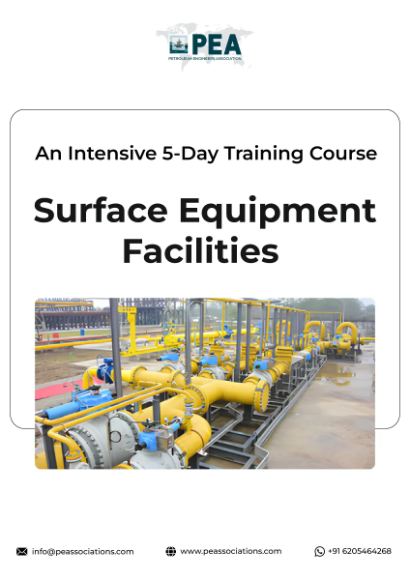
This course provides participants with a solid understanding of surface equipment facilities in the oil and gas industry. From design principles to operation and maintenance, it covers the critical systems that ensure safe and efficient production.
Description
Surface equipment is the backbone of any drilling operation. This course provides in-depth training on the various surface systems, from rig equipment to well control and fluid management, that are critical to safe and efficient drilling. Through a combination of theoretical learning and hands-on practice, participants will develop a strong understanding of how to operate, maintain, and optimize surface equipment to enhance overall drilling performance, reduce downtime, and lower costs.
Efficient and safe drilling operations depend on the seamless functioning of surface equipment facilities. From drilling rigs and well control systems to fluid management and automated systems, each component plays a vital role in ensuring smooth operations. As the oil and gas industry continues to evolve, understanding and optimizing surface equipment is crucial to staying competitive and minimizing operational costs. This course provides professionals with the knowledge and skills needed to operate and maintain these essential systems efficiently.
Understand the different types of surface equipment used in drilling operations.
Operate and maintain key surface systems, including drilling rigs, well control equipment, and fluid systems.
Identify common challenges in surface equipment operations and apply solutions to improve performance.
Optimize surface equipment for efficiency, safety, and cost reduction.
Troubleshoot and resolve operational issues to reduce downtime and enhance wellsite performance.
Implement best practices in surface equipment maintenance and safety protocols.
- Instructor-Led Sessions: Learn the core principles and operations of surface equipment from industry experts.
- Interactive Demonstrations: Hands-on sessions with actual surface equipment to enhance practical knowledge.
- Case Studies & Simulations: Analyze real-world scenarios to understand common challenges and how to address them.
- Group Discussions & Problem Solving: Engage with peers in problem-solving exercises to gain insights into operational issues and solutions.
- Practical Assessments: Evaluate your understanding through assessments that focus on real-life drilling situations.
Enhanced Operational Efficiency: Improved management and optimization of surface equipment, reducing downtime and increasing productivity.
Cost Savings: By minimizing equipment failure and optimizing performance, organizations can significantly reduce operational costs.
Improved Safety: Participants will understand how to properly operate and maintain surface equipment, ensuring safe operations and reducing the risk of incidents.
Greater Competitiveness: Organizations will stay ahead of industry trends by adopting the latest techniques in surface equipment optimization, improving overall performance.
Increase Skillset: Gain a deeper understanding of surface equipment and its role in drilling operations, making you an expert in the field.
Boost Career Prospects: Enhance your professional profile with new competencies, opening doors for career advancement.
Problem-Solving Ability: Learn how to address and troubleshoot operational issues, making you an invaluable asset to any team.
Confidence in Operations: Develop confidence in managing and optimizing surface equipment, which will improve both your performance and decision-making on the job.
Drilling Engineers
Operations Managers
Field Engineers
Maintenance Technician
Project Managers
Safety Officers
Module 1: Introduction to Surface Production Systems
Overview of the Value Chain: From reservoir to refinery.
General Layout: Typical configurations of onshore vs. offshore facilities.
Fluid Properties: Characterizing wellbore fluids (oil, gas, water, and impurities).
System Requirements: Understanding pressure, temperature, and flow rate constraints.
Module 2: Manifolds and Gathering Systems
Wellheads and X-mas Trees: Components and safety valves.
Gathering Lines: Design considerations for flowlines and manifolds.
Header Systems: Production headers vs. test headers.
Pigging Operations: Equipment for line cleaning and inspection.
Module 3: Separation Systems
Fundamentals of Phase Separation: Gravity, centrifugal, and impingement.
Separator Types: Horizontal, vertical, and spherical vessels.
Stage Separation: Optimizing pressure levels for maximum liquid recovery.
Internal Components: Mist extractors, diverters, and vortex breakers.
Module 4: Oil Treatment and Storage
Emulsion Treatment: Breaking down oil-water emulsions (Heat, Chemical, Electrical).
Dehydration & Desalting: Removing salts and residual water to meet export specs.
Stabilization: Reducing Reid Vapor Pressure (RVP) for safe transport.
Storage Tanks: Fixed-roof vs. floating-roof tank design and safety.
Module 5: Gas Processing and Compression
Gas Dehydration: Glycol (TEG) dehydration and molecular sieves.
Contaminant Removal: Sweetening processes (removing $H_2S$ and $CO_2$).
Compression Stations: Centrifugal vs. Reciprocating compressors.
NGL Recovery: Basics of natural gas liquid extraction.
Module 6: Produced Water Management
Water Quality Standards: Environmental regulations for discharge or reinjection.
Treatment Equipment: Hydrocyclones, Skimmer tanks, and Induced Gas Flotation (IGF).
Filtration: Media filters and membrane technology.
Module 7: Utility and Safety Systems
Flare and Vent Systems: Pressure relief valves (PRVs) and emergency blowdown.
Power Generation: Fuel gas systems and electrical distribution.
Chemical Injection: Corrosion inhibitors, scale inhibitors, and biocides.
Instrumentation & Control: Overview of SCADA, DCS, and SIS.
Frequently Asked Questions
All course bookings made through PEA are strictly non-refundable. By registering for a course, you acknowledge and accept that all fees are payable in full and are not subject to refund under any circumstances, including changes in personal or professional commitments or partial attendance.
PEA reserves the right to make reasonable adjustments to course content, trainers, or schedules where necessary, without entitling delegates to a refund. Comprehensive details of each course — including objectives, target audience, and content — are clearly outlined before enrolment, and it is the responsibility of the delegate to ensure the course's suitability prior to booking.
For any inquiries related to cancellations or bookings, please contact our support team, who will be happy to assist you.
