loader

Loading...

loader
+91 6205464268 info@peassociations.com
  • About Us
  • Contact Us
  • Membership
logo
Log in Membership
  • Our expertise
  • Upcoming Public Courses
  • Upcoming events
    • Upcoming events
    • Workshops
    • Webinars
  • Company
    • Company
    • About us
    • Membership
    • Meet Our Team
    • Gallery
    • Blogs & Articles
    • Testimonials
    • Download
    • Certificate
  • e-Learning
  • Contact Us
  • Quiz
Press Enter To See All Search Results
Search results for:
    LOG IN
    Subscribe To Our Newsletter
    Disciplines
    All

    PEA Visual Guides

    Petroleum Economics and Fiscal Regimes
    Premium  icon
    Download

    Petroleum Economics and Fiscal Regimes

    This fifty-part poster series explains how oil and gas projects are valued and how governments and companies share the money, one topic per sheet. Part 1 covers the basics: value across the field life cycle, time value of money, nominal and real terms, WACC and discount rate selection, price benchmarks and netbacks, price decks, production forecasts, CAPEX and OPEX, abandonment costs, depreciation methods, building a project cash flow model, economic limit and incremental economics. Part 2 covers investment metrics and risk: NPV, IRR and its limits, payback and maximum cash exposure, profitability index, unit technical cost and breakeven price, sensitivity and tornado charts, scenario analysis, chance of success, EMV and decision trees, value of information, Monte Carlo simulation, real options and the stage-gate process to FID. Part 3 covers fiscal regimes: concessionary, contractual and hybrid systems, government take, royalty, bonuses and rentals, corporate income tax, ring-fencing, resource rent and windfall taxes, fiscal incentives, production sharing contracts, cost oil and profit oil, R-factor sliding scales, state participation, domestic market obligation, service contracts, effective royalty rate and fiscal progressivity. Part 4 covers commercial agreements and valuation: working interest and JOAs, farm-in and carry deals, gas sales agreements and LNG netback, carbon pricing, asset valuation for M&A and portfolio management. It closes with the full economic and fiscal evaluation workflow.
    Metering, Allocation and Custody Transfer
    Premium  icon
    Download

    Metering, Allocation and Custody Transfer

    This fifty-part poster series explains how oil and gas are measured, shared between owners and handed over at the point of sale, one topic per sheet. It starts with the basics: fiscal, allocation and operational metering classes, the API MPMS, AGA, ISO and OIML standards, reference conditions and unit conversions, the crude quantity hierarchy from TOV to NSV, measurement uncertainty, uncertainty budgets, meter performance, flow conditioning, CTL and CPL corrections, density and secondary instruments. The liquid section covers positive displacement, turbine, Coriolis and ultrasonic meters, meter provers, meter factor and proving calculations, master meter proving, crude sampling, sediment and water, LACT units, tank gauging and calibration, marine custody transfer, the vessel experience factor and liquid metering station design. The gas section takes in orifice meters under AGA 3 and ISO 5167, installation errors, ultrasonic and turbine gas meters, venturi and cone meters, AGA 8 and GERG-2008, gas sampling and chromatography, calorific value and energy, wet gas metering, gas station design and LNG custody transfer. The last section is about allocation and assurance. It covers allocation agreements, pro-rata, by-difference, uncertainty-based and component allocation, well testing, multiphase and virtual flow metering, flow computers and audit trails, mismeasurement corrections, loss control and unaccounted-for gas, and metering audits. The series ends with the full workflow from wellhead to custody transfer invoice.
    Hydrocarbon Resource Volume Estimation and Classification (SPE-PRMS)
    Premium  icon
    Download

    Hydrocarbon Resource Volume Estimation and Classification (SPE-PRMS)

    This fifty-part poster series explains reserves, resources and the SPE Petroleum Resources Management System, one topic per sheet. It opens with the framework: the resource classification system, reserves categories 1P, 2P and 3P, resource maturation, developed versus undeveloped reserves, contingent and prospective resources, the PIIP terminology tree, chance of discovery versus development, and what changed from PRMS 2007 to 2018. It then covers the estimation methods: volumetrics (STOIIP and GIIP), material balance and its gas variants, decline curve analysis and its pitfalls, EUR and economic limit, recovery factors by drive mechanism, Monte Carlo simulation, low, best and high scenarios, S-curves and tornado charts, analogs, type curves, and the role of seismic, well tests, petrophysics and fluid properties in volume estimates. The reporting section takes in SEC proved reserves rules and the five-year rule, entitlement under PSCs, fiscal terms, price decks, revisions and reconciliation, auditing and certification, reserves in M&A, disclosure red flags and ten common booking mistakes. It also covers unconventional resources, gas from wellhead to sales point, associated gas and NGL booking, gas sales contracts and SPE SRMS for CO2 storage, and closes with a sheet on the full reserves reporting workflow.
    The Complete Oil and Gas Value Chain
    Download

    The Complete Oil and Gas Value Chain

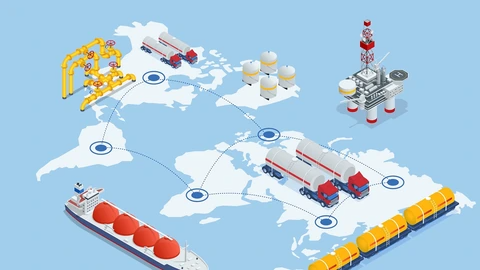
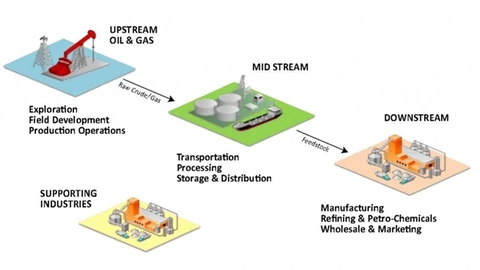
    This fifty-part poster series follows a barrel of oil from the source rock that made it to the dispenser that sells it. It opens with the industry and the subsurface — the value chain at a glance, where oil and gas come from, the petroleum system, sedimentary basins, trap types, what makes a rock a reservoir, reservoir fluids, conventional versus unconventional resources, and resources and reserves. It then covers exploration and appraisal, from the exploration workflow and seismic acquisition, processing and interpretation through prospect volumes, risk, licences and petroleum contracts. Drilling and well construction follows with the rig and its systems, the rotary drilling process, drilling fluids and well control, casing and cementing, directional and horizontal drilling, offshore units, formation evaluation and well testing. The production section runs from field development planning and well completion through stimulation, how a well flows, wellheads and Christmas trees, drive mechanisms, artificial lift, secondary and enhanced oil recovery, surface facilities, gas processing, offshore production systems and well intervention. It closes with midstream — pipelines, tankers, terminals, LNG and crude price benchmarks — and downstream, covering the refinery, crude distillation, conversion units, product blending, petrochemicals, distribution and retail, economics, safety and regulation, emissions and CCUS, and a final sheet tracing one barrel from rock to pump.
    Showing 1–4 of 4 profiles
    logo
    GET IN TOUCH

    PETROLEUM ENGINEERS ASSOCIATION
    JHARKHAND, INDIA

    Contact : +91 6205464268
    Email: info@peassociations.com

    Tax Registration Number:
    20DIGPA7260B1Z1

    COMPANY
    About Us Contact Us Articles Download Certificate
    Become an instructor One on one mentorship Gallery Testimonials Feedback
    logo
    Payment Terms Privacy Policy Terms of Use Sitemap Cookie Preferences Security
    © 2026 Petroleum Engineers Association. All Right Reserved.
    Design & Developed By Bitstreaks Company Logo
    WhatsApp Whatsapp icon
    Let us know how we can assist you? logo
    Let us know how we can assist you? ✖

    PEA uses cookies and other tracking technologies to improve your browsing experience for the following purposes: to enable basic functionality of the website, to provide a better experience on the website, to measure your interest in our products and services and to personalize marketing interactions, to deliver ads that are more relevant to you.

    Change my preferences