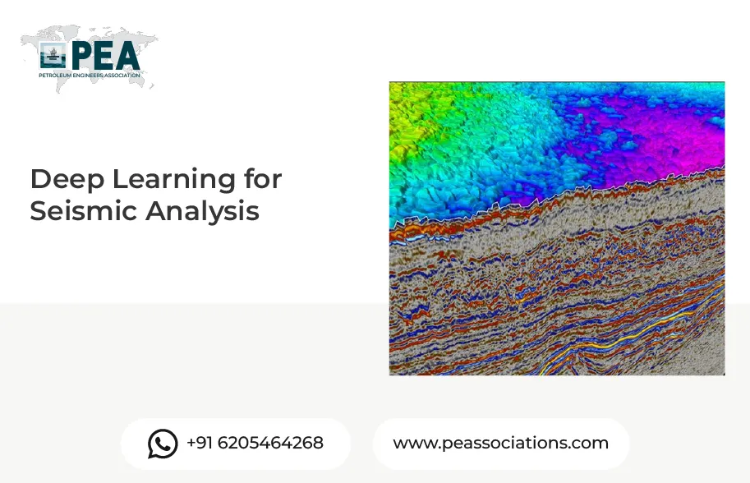
Deep Learning for Seismic Analysis
Premium Webinar
For PEA Members Only
This webinar explores how deep learning techniques are revolutionizing seismic data interpretation in oil and gas. Participants will learn how advanced neural networks improve accuracy in fault detection, reservoir characterization, and subsurface imaging, enabling faster and more reliable decision-making.
Webinar Objectives
• Introduce the fundamentals of deep learning in seismic workflows.
• Demonstrate applications in fault detection, facies classification, and imaging.
• Highlight advantages over traditional seismic interpretation methods.
• Discuss challenges, data requirements, and integration into existing geophysical processes.
About the Presenter
The session is led by a domain expert with extensive experience in geophysics and machine learning. The presenter combines practical seismic knowledge with advanced data science expertise to help participants understand both the technical and applied aspects of deep learning in seismic analysis.
Register Now
View More
Time : 9 PM Indian Time | Duration : 90 Minutes
Premium Webinar
For PEA Members Only
What Can PTA Tell You About Your Reservoir?
Pressure Transient Analysis (PTA) is a powerful tool for reservoir characterization — and it can tell you far more than permeability, reservoir contact, and skin factor. But to unlock its advanced capabilities, the analyst needs a solid grasp of the diagnostic features of pressure and derivative responses: how they relate to flow regimes, and how the static and dynamic features of a reservoir generate those regimes at different stages of depletion. Without that context, history matching pressure responses or fitting straight lines to portions of the data may return parameter estimates while missing the bigger picture entirely.This webinar makes the case for PTA as a reservoir characterization tool, shows its proper and improper use through worked examples, and highlights just how underused it remains in practice.Slides & Material — Copyright: All content in this session is copyrighted by Prof. Erdal Ozkan. Access to the recording and slides is provided exclusively through this platform. Any unauthorized use, reproduction, or distribution outside the portal is strictly prohibited and may result in legal action under applicable laws.Recordings and certificates will be issued within one business day of the event.