Well Stimulation Webinar - Acidizing
Premium Webinar
For PEA Members Only

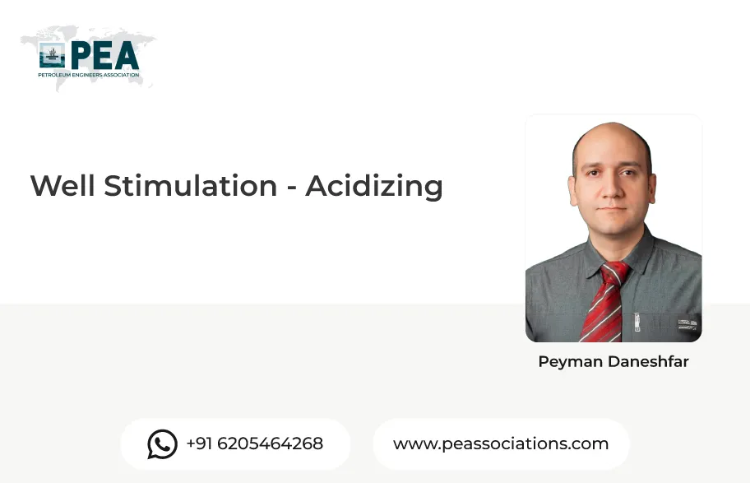
This webinar provides a targeted deep-dive into the chemistry and engineering of Well Stimulation. It is designed to equip attendees with the fundamental mechanics of formation damage and the operational execution of acidizing treatments—ranging from traditional reservoirs to specialized geothermal applications.
Webinar Objectives
Analyze Reservoir Mechanics: Master the fundamentals of formation damage and the mathematical role of the Skin Factor in well performance.
Optimize Treatment Design: Evaluate distinct strategies for Matrix Acidizing in both Carbonate and Sandstone environments.
Bridge Stimulation Techniques: Gain a technical introduction to Acid Fracturing and its link to hydraulic fracturing methods.
Mitigate Operational Risk: Identify treatment-induced damages and the role of chemical additives and diversion techniques in field success.
Explore Emerging Energy: Understand the specialized concepts of Geothermal well acidizing for sustainable energy production.
About the Presenter
Peyman Daneshfar
Stimulation/Field Technical Supervisor & Well Stimulation Consultant
Peyman is a seasoned industry expert with extensive field experience as a Technical Supervisor and Consultant. Holding a Master’s degree in Petroleum Engineering, his academic and professional background is deeply rooted in complex reservoir challenges, including Asphaltene Deposition during production and CO2 Injection processes. He brings a unique blend of theoretical depth and practical field insights to every session.
Register Now
View More




Time : 9 PM Indian Time | Duration : 2 Hours


Premium Webinar
For PEA Members Only
Advanced Multi Wells Analysis & Formation Evaluation
This webinar delivers a concise and practical overview of advanced techniques for multi-well data analysis and formation evaluation. Participants will gain insights into integrating geological, petrophysical, and production data to better understand reservoir characteristics and performance. The session emphasizes data-driven approaches for improved reservoir interpretation, well placement, and production optimization.