

Uncover the Geochemical Signatures that Drive Successful Hydrocarbon Exploration
Application of Organic Geochemistry in Petroleum Exploration
Learn How Organic Geochemistry Helps Identify Source Rocks, Evaluate Maturity, and Predict Hydrocarbon Potential



Application of Organic Geochemistry in Petroleum Exploration
Have Questions ?
Application of Organic Geochemistry in Petroleum Exploration - PEA-OGPE26
| Code | Date | Time | Duration | Location | Currency | Team of 10 Per Person | Team of 7 Per Person | Early Bird Fee Per Person | Normal Fee Per Person |
|---|---|---|---|---|---|---|---|---|---|
| PEA-OGPE26 | 17 - 21 Aug 2026 | 7 PM Indian Time |
4 Hours Per Day
|
Zoom Online
|
USD
|
1500
|
1850
|
2500
|
2850
|
The classes will be conducted online via Zoom from Monday to Friday, for 4 hours per day excluding breaks.
Boost your team's skills and your budget! Enjoy group discounts for collaborative learning. Send an inquiry to info@peassociations.com.
Application of Organic Geochemistry in Petroleum Exploration
This course provides an in-depth understanding of how organic geochemistry is applied in petroleum exploration to evaluate source rocks, determine hydrocarbon generation potential, and establish correlations between oils and their source rocks. Participants will learn geochemical techniques and data interpretation methods for exploration decision-making.
Description
Organic geochemistry plays a crucial role in modern petroleum exploration by helping geoscientists understand the origin, composition, and evolution of organic matter in sedimentary basins. The Application of Organic Geochemistry in Petroleum Exploration course equips participants with the essential knowledge to analyze and interpret geochemical data for identifying source rocks, assessing maturity levels, and predicting hydrocarbon type and quantity.
The course covers key concepts such as kerogen classification, total organic carbon (TOC) analysis, Rock-Eval pyrolysis, biomarker interpretation, and isotopic studies. Participants will also learn how to integrate geochemical data with geological and geophysical information to improve exploration success rates.
Through case studies and real-world examples, the course demonstrates how geochemical tools support basin modeling, source-to-reservoir correlation, and risk reduction in exploration projects.
Organic geochemistry bridges the gap between geology and geophysics by revealing the chemical history of hydrocarbons within sedimentary basins. It helps exploration professionals answer critical questions: Where did the hydrocarbons originate? When were they generated? How did they migrate and accumulate?
This course introduces participants to the principles, analytical techniques, and interpretation workflows used in petroleum geochemistry. It emphasizes practical applications that help exploration teams identify prospective areas, reduce uncertainty, and optimize drilling strategies.
Understand the fundamentals of organic geochemistry and its relevance in exploration.
Identify and evaluate potential source rocks using TOC and Rock-Eval data.
Determine organic matter type and thermal maturity.
Interpret biomarker and isotopic data for oil-source rock correlation.
Integrate geochemical data with geological and geophysical information.
Apply geochemical insights to basin modeling and hydrocarbon system analysis.
Use geochemical tools to reduce exploration risk and improve prospect ranking.
The course combines interactive lectures, data interpretation exercises, and real-world case studies. Participants will analyze sample datasets, interpret Rock-Eval and biomarker results, and discuss integration of geochemical data into exploration workflows. The methodology ensures a strong balance between theory and practical application.
Improved understanding of source rock evaluation and hydrocarbon potential.
Enhanced exploration efficiency through geochemical data integration.
Reduced exploration risk and improved prospect selection.
Strengthened collaboration between geochemists, geologists, and geophysicists.
Increased technical capability in petroleum system evaluation.
Develop strong analytical and interpretive skills in petroleum geochemistry.
Gain confidence in evaluating source rock quality and maturity.
Learn how to apply geochemical data in real exploration projects.
Enhance technical and multidisciplinary competencies.
Strengthen professional profile in exploration geoscience.
Exploration Geologists and Geochemists
Petroleum Geologists and Basin Modelers
Reservoir and Production Engineers
Petrophysicists and Geoscience Data Analysts
Introduction to Petroleum Geochemistry and Geochemical Evaluation of Source Rocks
Introduction
Basic concepts, source rock/kerogen formation, depositional settings
Samples, preparation, and analysis
Source rock interpretation and pitfalls
Source rock kinetics – Conversion of kerogen to hydrocarbons (kerogen type versus nature, quality, and volumes of generated hydrocarbons)
Data interpretation
Maturity evaluation Introduction
Basic definitions and concepts
Methods of maturity measurements
Advantages and problems of each method and their interpretive pitfalls
Geochemical Evaluation of Hydrocarbons (source rocks and fluids)
Sample preparation – Solvent extraction and fractionation
Gas Chromatography – n-alkanes and isoprenoids for organic matter, oil and condensate
Interpretive pitfalls
Gas Chromatography-Mass Spectrometry (GC-MS) – biomarkers and diamondoids
Stable Carbon Isotopes: Bulk Carbon Isotopes (IR-MS) and Gas Chromatography-Isotope Ratio Mass
Spectrometry (GC-IRMS) for compound specific isotope analysis (CSIA)
Interpretive pitfalls
Geochemical Evaluation of Hydrocarbons (source rock and fluids)
Gas Chromatography-Mass Spectrometry (GC-MS): Biomarker’s analysis and interpretation
Bulk Carbon Isotopes (IR-MS) and Gas Chromatography-Isotope Ratio Mass Spectrometry (GC-IRMS): isotope’s analysis and interpretation
Geochemical Evaluation of Hydrocarbon and Non-Hydrocarbon Gases
Gas Chromatography (GC): compositional analysis and interpretation
Gas Chromatography-Isotope Ratio Mass Spectrometry (GC-IR-MS): isotopes analysis and interpretation
Gas evaluation – Hydrocarbon gas: compositional analysis and interpretation
Gas evaluation – non-Hydrocarbon gases: compositional analysis and interpretation
Analytical and interpretational pitfalls
Physical & Chemical properties of crude oils
Physical properties (API gravity, viscosity, Pour Point)
Chemical properties (Sulphur content, asphaltenes content, metals content, wax content, Total acid number)
Data interpretation
On successful completion of this training course, PEA Certificate will be awarded to the delegates.
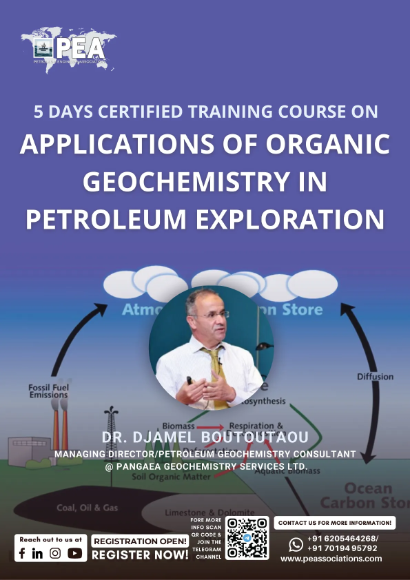
Dr. Boutoutaou is a petroleum geochemist with 32 years of professional experience, specialising in exploration and production development strategies with excellent geochemical interpretation and integration skills of all types of geochemical data including source rocks and fluids (oil, condensate, and gas).
He started his career as a petroleum geochemist, working for Sonatrach, focusing on the major Paleozoic basins across the Saharan platform in Algeria.
More recent experiences portray excellent industry knowledge, encompassing best practice techniques and an astute approach to a variety of single and multi-disciplinary projects, worldwide, including the North Sea UK and Norway, Gulf of Mexico, the North and South Atlantic margins, North and East Africa, the Middle East and the Far East (Pakistan, India, Thailand, Mongolia, Australia, and New Zealand). This was a result of 15 years working as a Senior and Chief Petroleum Geochemist for one of the market leaders in the sector, Fugro-Robertson, and CGG Robertson.
He has developed and maintained top quality and competitive geochemistry business whilst working for Fugro-Robertson and CGG Robertson. He oversaw the petroleum geochemistry department and was responsible for sustaining business development, project management, development of workflows, innovation, data quality control (QC), mentoring and training staff, project supervision, and technical/peer review for all the geochemical projects.
He holds MSc and PhD degrees in Petroleum Geochemistry and went to the University of Newcastle Upon Tyne, United Kingdom. He has several publications and has made several oral presentations at internal and international meetings.
Frequently Asked Questions
All course bookings made through PEA are strictly non-refundable. By registering for a course, you acknowledge and accept that all fees are payable in full and are not subject to refund under any circumstances, including changes in personal or professional commitments or partial attendance.
PEA reserves the right to make reasonable adjustments to course content, trainers, or schedules where necessary, without entitling delegates to a refund. Comprehensive details of each course — including objectives, target audience, and content — are clearly outlined before enrolment, and it is the responsibility of the delegate to ensure the course's suitability prior to booking.
For any inquiries related to cancellations or bookings, please contact our support team, who will be happy to assist you.
