
Leverage Python to Unlock Smarter Oil & Gas Production Workflows
Applied Production Optimization using Python
Learn how to analyze, visualize, and optimize production data with Python applied directly to real oilfield challenges.



Applied Production Optimization using Python
Have Questions ?
Applied Production Optimization using Python - EL-PYRP-PEA
| Code | Duration | Currency | Fee Per Person |
|---|---|---|---|
| EL-PYRP-PEA | 15 Hours |
USD |
500 |
This is a self-paced, on-demand e-learning course. Upon enrollment, all course videos and materials will be delivered to your email within 12 hours. A certificate will be issued upon successful completion of the required quizzes and assignments.
Boost your team's skills and your budget! Enjoy group discounts for collaborative learning. Send an inquiry to info@peassociations.com.
Applied Production Optimization Using Python
This course equips oil and gas professionals with the programming and analytical skills needed to apply Python for production optimization, data management, and decision support.
Description
Data-driven workflows are transforming production optimization in the oil and gas industry. This course introduces Python as a powerful tool to analyze, forecast, and visualize production performance. Participants will learn how to handle field datasets, implement machine learning models, evaluate well behaviour, and build interactive dashboards. Designed with real industry datasets, the program bridges engineering fundamentals with modern programming practices, enabling professionals to improve efficiency, enhance surveillance, and make informed operational decisions
Oilfield operations increasingly rely on digital tools to enhance productivity and reduce downtime. Python has become the preferred programming language for engineers due to its flexibility, libraries, and ability to handle complex production data. This course provides a structured path from Python basics to advanced applications such as water cut forecasting, pipeline hydraulics, and interactive dashboards, ensuring participants gain both programming proficiency and production engineering insight.
• Develop Python coding skills tailored for subsurface and production workflows.
• Manipulate, filter, and visualize production datasets effectively.
• Apply machine learning models to production forecasting and diagnostics.
• Build automated reporting pipelines for surveillance and decision support.
• Create interactive dashboards for real-time production monitoring.
• Faster, more accurate production analysis through automation.
• Improved decision-making with data-driven tools and dashboards.
• Reduced operational risk by forecasting water cut, liquid loading, and wellbore integrity.
• Standardized and efficient reporting across teams and assets.
• Gain confidence in coding and applying Python to oil and gas problems.
• Reduce reliance on manual spreadsheets by building automated workflows.
• Improve ability to analyze well behavior and optimize artificial lift.
• Strengthen employability with sought-after data and programming skills.
Reservoir Engineers
Production Engineers
Drilling and Workover Engineers
Geologists and Petrophysicist
Chemical Engineers
Video 0: Before Starting – Installing Software
Used Libraries: Anaconda Package
Objective: Helps learners set up Python, IDEs, and essential packages for energy data workflows. Prepares a fully functional coding environment for E&P data analysis.
Video 1: Python Basics [Numeric Types]
Used Libraries: Built-in Python
Objective: Covers essential number handling: integers, floats, and arithmetic for engineering calculations. Used in handling pressure, rate, and temperature data from SCADA/loggers.
Video 2: Python Basics [String Type]
Used Libraries: Built-in Python
Objective: Explores how to work with strings: slicing, formatting, and indexing. Helpful in parsing LAS files, report headers, and log descriptions.
Video 3: Python Basics [Containers - List]
Used Libraries: Built-in Python, Matplotlib
Objective: Introduces Python lists for storing and manipulating production data series. Efficiently organizes historical data like daily oil or water rates.
Video 4: Python Basics [NumPy – Vector Math]
Used Libraries: NumPy, Matplotlib
Objective: Teaches vectorized math using NumPy for large data calculations. Used in mass calculations like cumulative production and GOR/WOR trends.
Video 5: Working with Oil and Gas Data
Used Libraries: Pandas, NumPy, VS Code
Objective: Demonstrates loading, cleaning, and exploring petroleum production data. Foundational skill for building smart dashboards and analytics tools.
Video 6: Python Visualization [Static]
Used Libraries: Matplotlib, Seaborn
Objective: Teaches how to generate plots to visualize production trends. Used to build charts for daily rates, decline, and surveillance.
Video 7: Liquid Loading Evaluation
Used Libraries: Pandas, NumPy, Matplotlib
Objective: Explains the evaluation of gas well liquid loading using Python logic. Assists engineers in deliquification diagnostics and plunger lift analysis.
Video 8: Water Cut Analysis and Forecasting
Used Libraries: Pandas, NumPy, Matplotlib, Scikit-learn
Objective: Models water production and predicts future water behavior. Key for managing produced water, lift optimization, and surface facility impact.
Video 9: Python Basics – User Defined Functions
Used Libraries: Built-in Python
Objective: Introduces functions for reusable, modular code development. Enables writing reusable scripts for calculations like EUR or reports.
Video 10: Unconventional Oil Type Well
Used Libraries: Pandas, NumPy, Matplotlib
Objective: Teaches time-series analysis for tight/shale wells. Important for evaluating frac efficiency, production trends, and well performance.
Video 11: Fetkovitch IPR (Curve Fitting)
Used Libraries: Pandas, NumPy, SciPy, Matplotlib
Objective: Implements inflow curve fitting with the Fetkovitch method. Supports reservoir modeling and artificial lift selection.
Video 12: Interactive Production Dashboard
Used Libraries: Plotly, Streamlit, Pandas, NumPy
Objective: Builds interactive visual tools using Streamlit and Plotly. Empowers real-time decision-making and team-wide surveillance.
Video 13: Python Basics [For Loops]
Used Libraries: Built-in Python
Objective: Explains loop structures for iterative data analysis. Used for looping across multiple wells or data files in automated workflows.
Video 14: Pipeline Hydraulics Dashboard
Used Libraries: Streamlit, Plotly, Pandas, NumPy
Objective: Shows how to calculate and visualize pressure drop and flow regimes. Critical for monitoring pipeline performance and choke management.
Video 15: Wellbore Gradient [Base Case]
Used Libraries: Pandas, NumPy, Matplotlib
Objective: Calculates pressure profiles along the wellbore length. Used in ESP design, tubing sizing, and nodal analysis.
Video 16: Python Basics [If Statement]
Used Libraries: Built-in Python
Objective: Teaches condition-based decision logic in Python. Used for alerts, conditional formatting in reports, and QA/QC rules.
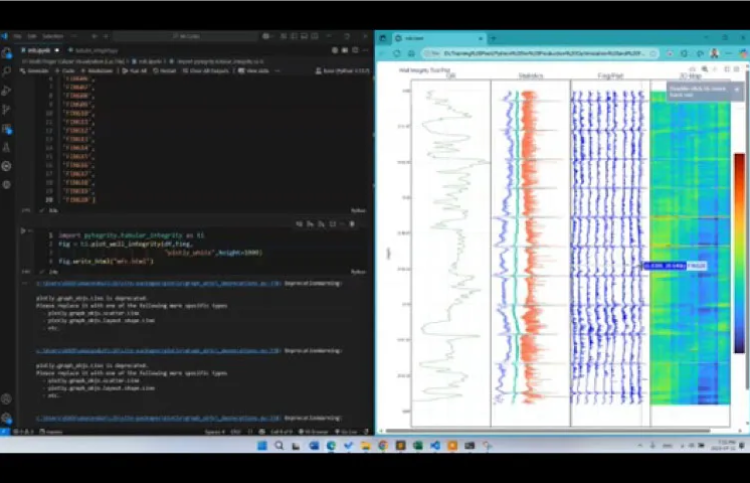
Video 17: Multi-Finger Caliper
Used Libraries: Pandas, Matplotlib, NumPy
Objective: Explains data interpretation from MFC tools for tubing/casing analysis. Helps engineers assess integrity and prioritize workovers.
Video 18: Remaining Wall Thickness
Used Libraries: Pandas, NumPy, Matplotlib, SciPy
Objective: Analyzes thickness data to assess corrosion/erosion. Essential for integrity management and predicting failures.
Video 19: Automated Production Reporting
Used Libraries: Pandas, Matplotlib, ReportLab, PDF, VS Code
Objective: Builds an automated reporting pipeline for daily/monthly summaries. Reduces manual reporting time and ensures standardized output.
On successful completion of this training course, PEA Certificate will be awarded to the delegates
This course has been meticulously developed by a seasoned PEA expert renowned in the oil and gas industry. With extensive hands-on experience and a proven track record in delivering innovative solutions, our trainer brings a wealth of technical expertise, deep industry insight, and a commitment to excellence. Learners can trust that they are gaining knowledge from a leading authority whose dedication to professional development ensures you receive only the highest-quality training to elevate your skills and career prospects.