
From Petroleum Data to Working ML Models
Machine Learning Workflows for Reservoir and Production Engineers
A self-paced e-learning programme that walks you through ten end-to-end machine learning projects on real reservoir, production, drilling, and well log data.



Machine Learning Workflows for Reservoir and Production Engineers
Have Questions ?
Machine Learning Workflows for Reservoir and Production Engineers - PEA-EL-RES-102
| Code | Duration | Currency | Fee Per Person |
|---|---|---|---|
| PEA-EL-RES-102 |
20 Hours
|
USD
|
1000
|
This is a self-paced, on-demand e-learning course. Upon enrollment, all course videos will be delivered to your email within 12 hours. A certificate will be issued upon successful completion of the required quizzes and assignments.
Boost your team's skills and your budget! Enjoy group discounts for collaborative learning. Send an inquiry to info@peassociations.com.
Machine Learning Workflows for Reservoir and Production Engineers
A self-paced e-learning course on applying Python and machine learning to reservoir and production engineering. Covers integrated production modeling, PVT, core analysis, and ten hands-on machine learning projects on real petroleum data. No prior coding experience required.
Description
This course connects core petroleum engineering — IPR/VLP, nodal analysis, PVT, core analysis, and reservoir surveillance — with Python and machine learning workflows you can actually use at work.
You start with the engineering fundamentals, then move into Python programming, data handling, and ten guided machine learning projects. Each project uses real petroleum industry data and covers a specific problem: drilling optimization, pump intake pressure estimation, decline curve analysis, permeability prediction from logs, rock typing, scale formation, and production forecasting through time series.
The course is fully on-demand. You get video recordings and the datasets used in every project, and you progress at your own pace.
Machine learning is now part of routine work in reservoir and production engineering — for forecasting, log interpretation, rock typing, flow assurance, and operations optimization. The challenge for most engineers is bridging the gap between domain knowledge and the coding skills needed to apply these tools.
This course is built for that gap. It teaches the engineering context first, then walks you through Python and ten machine learning projects on petroleum data. By the end, you can build, train, and use models on your own field problems.
By the end of this course, you will be able to:
Describe an integrated production system from reservoir to surface
Carry out nodal analysis using IPR and VLP models
Interpret PVT lab experiments and apply the results to reservoir work
Analyze production data for surveillance, water breakthrough, and waterflood performance
Set up Python and Jupyter Notebook and use the main libraries for E&P
Clean, transform, and prepare real petroleum datasets for modeling
Build regression models for oil properties, pump intake pressure, and flow rate
Apply classification methods for rock typing, flow units, and scale formation
Use time series models for production forecasting
Run decline curve analysis and well logging permeability prediction with ML
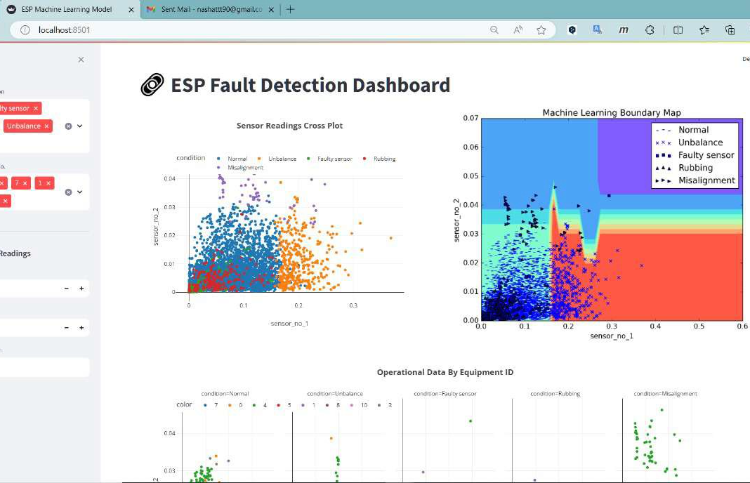
Build simple dashboards that take input data and return model output
This is a self-paced e-learning course. You get on-demand video recordings and the petroleum datasets used in every project. Each module follows the same structure: short theory, code walkthrough, and a guided exercise on real data.
The ten machine learning projects are the core of the course. Each one is a complete workflow — from raw data to trained model to result. You can revisit recordings as often as needed and work through the material at your own pace. Free Python tools are recommended for setup; no commercial software is required to follow along.
A team that can apply ML to surveillance, forecasting, and operations
Faster turnaround on log interpretation, rock typing, and flow assurance studies
Better decisions through data-driven models rather than rules of thumb alone
Reduced reliance on external consultants for routine ML work
Stronger in-house capability for production forecasting and optimization
Practical, transferable workflows the team can build on for new projects
Combine your engineering knowledge with practical ML skills employers are now hiring for
Learn Python from zero using petroleum data, not generic examples
Walk away with ten completed machine learning projects you can show at work
Build models for forecasting, log interpretation, and rock typing on your own
Gain confidence to take on data-driven projects in your team
Add a strong, modern skill set to your engineering profile
Reservoir, production, and petroleum engineers who want to automate work, handle large datasets, and make data-driven decisions
Drilling engineers working with high-volume operational data
Technical managers leading teams that use or plan to use ML tools
Petroleum engineering students and researchers building applied skills for the job market
Geoscientists and petrophysicists working alongside reservoir teams
Module 1 — Integrated Production Modeling
Integrated production system. Field development stages. Reservoir-to-surface modeling and optimization. Pressure loss in the wellbore. Reservoir fluid and rock systems. IPR models. VLP models. System nodal analysis.
Module 2 — Reservoir Fluids and PVT
Applications of PVT data. Reservoir fluid sampling and downhole fluid analyzers. Sample quality control. Hydrocarbon phase behavior. Reservoir fluid classification. PVT lab experiments: constant composition expansion, differential vaporization, separator tests, constant volume depletion.
Module 3 — Reservoir Rocks and Core Analysis
Coring objectives and methods. Core analysis workflow. Lab techniques. Screening, sampling, and preparation. Permeability measurement. Conventional and special core analysis.
Module 4 — Production Data Analysis and Reservoir Surveillance
Reservoir performance analysis. Remaining reserves estimation. Water breakthrough diagnostics. Water injection diagnostics. Waterflood surveillance. Case studies.
Module 5 — Machine Learning and Computing
Machine learning vs. traditional computing. History of computers and the AI shift. Impact on petroleum engineering. Overview of programming languages and where Python fits.
Module 6 — Machine Learning Applications in the Petroleum Industry
Artificial neural networks: architectures, types, training, validation. Industry applications. Case studies across petroleum engineering. Generalized ML workflows. Supervised vs. unsupervised learning.
Module 7 — Python Fundamentals and Dashboard Creation
Setting up Anaconda. Python basics in Jupyter Notebook. Python libraries for E&P. Data visualization. Project 1: dashboard for nodal analysis and VLP calculations.
Module 8 — Data Analysis and Transformation
Working with petroleum data files and formats. Data cleaning and preprocessing. Handling missing values. Data transformation. Project 2: drilling data optimization. Project 3: pump intake pressure estimation using regression. Project 4: flow rate estimation from pump intake pressure. Building a simple model dashboard for live inputs and outputs.
Module 9 — Machine Learning Projects: Regression
Regression methods. Project 5: oil property estimation (FVF, viscosity). Introduction to classification methods. Project 6: decline curve analysis and prediction. Project 7: well logging analysis dashboard with core-calibrated permeability prediction.
Module 10 — Classification and Time Series Projects
Project 8: rock typing and hydraulic flow unit prediction. Project 9: flow assurance and scale formation prediction using classification. Project 10: production performance forecasting using time series models.
On successful completion of this training course, PEA Certificate will be awarded to the delegates.
This course has been meticulously developed by a seasoned PEA expert renowned in the oil and gas industry. With extensive hands-on experience and a proven track record in delivering innovative solutions, our trainer brings a wealth of technical expertise, deep industry insight, and a commitment to excellence. Learners can trust that they are gaining knowledge from a leading authority whose dedication to professional development ensures you receive only the highest-quality training to elevate your skills and career prospects.