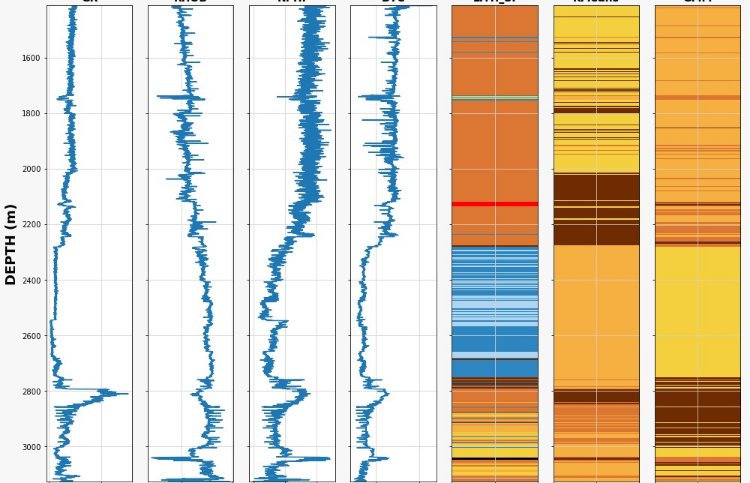

Predict Missing Logs and Petrophysical Properties From Real Data
Machine Learning for Petrophysics and Well Log Analysis
A self-paced e-learning course on applying Python and machine learning to well logs, core data, and petrophysical interpretation.



Machine Learning for Petrophysics and Well Log Analysis
Have Questions ?
Machine Learning for Petrophysics and Well Log Analysis -
| Duration | Currency | Fee Per Person |
|---|---|---|
30 Hours |
USD |
1000 |
This is a self-paced, on-demand e-learning course. Upon enrollment, all course videos will be delivered to your email within 12 hours. A certificate will be issued upon successful completion of the required quizzes and assignments.
Boost your team's skills and your budget! Enjoy group discounts for collaborative learning. Send an inquiry to info@peassociations.com.
Machine Learning for Petrophysics and Well Log Analysis
A self-paced e-learning course on using Python and machine learning to predict missing well logs and key petrophysical properties — including permeability, water saturation, FZI, lithology, and rock types. Covers regression, classification, clustering, neural networks, and deep learning, with practical projects on real well log and core datasets. No prior coding experience required.
Description
This course shows you how to use machine learning to fill the gaps in well log and core data that every petrophysicist runs into. Many wells in a field do not have sonic, neutron, or density logs. Core data is rarely available across all wells. Permeability, irreducible water saturation, cementation exponent, and rock type are often missing where you need them most.
You start with Python basics — variables, data types, loops, functions, NumPy, and Pandas — and then move into the full machine learning workflow: data preprocessing, model training, evaluation, and tuning. From there, you work through every major family of models: linear and polynomial regression, logistic regression, support vector machines, decision trees, random forest, gradient boosting, neural networks, self-organizing maps, K-means clustering, and deep learning.
Each model is applied to a real petrophysical problem — predicting permeability, shear slowness, compressional slowness, water saturation, FZI, rock types, lithology, and lithofacies. The course also covers how to build interactive petrophysical dashboards in Streamlit and an introduction to deep learning with TensorFlow and PyTorch.
The course is fully on-demand. You get video recordings and the datasets used in every project, and you progress at your own pace.
Petrophysical interpretation depends on a complete log suite and good core coverage — but in real fields, that data is almost never complete. Machine learning gives petrophysicists a practical way to predict missing logs, estimate properties from limited data, and classify rock types and lithology at scale.
This course is built for engineers and geoscientists who want to apply machine learning to their own log and core data. It teaches Python from scratch, walks through every major machine learning algorithm used in the industry, and applies each one to a real petrophysical problem. By the end, you can build, train, and use models on your own field data — and present the results through interactive dashboards.
By the end of this course, you will be able to:
Understand Python fundamentals and write clean code for petrophysical work. Apply regression algorithms to predict permeability, FZI, irreducible water saturation, cementation exponent, and initial water saturation. Apply classification algorithms to identify rock types, lithology, and lithofacies. Use clustering methods like K-means and self-organizing maps for rock type analysis. Train and evaluate neural networks and deep learning models on well log data. Build interactive petrophysical dashboards in Streamlit. Use machine learning models on your own field data with confidence.
This is a fully self-paced e-learning course. You receive video recordings of every module and the datasets used in every practical project. Each topic follows the same structure: short theory, code walkthrough, and a guided project on real well log or core data.
You can revisit recordings as often as needed and progress at your own pace. Free Python tools and libraries are recommended for setup. No commercial software is required to follow along, and no software licenses or slide decks are shared as part of the course.
Teams gain the ability to extract more value from existing well log and core data, reduce dependence on costly new data acquisition, and improve the quality of static models, reservoir characterization, and field development decisions. Predicted logs and properties feed directly into petrophysical studies, rock typing, saturation height modeling, rock physics, core-log integration, and facies analysis — supporting better, faster, and more consistent results across the asset.
You finish the course with a working knowledge of Python and machine learning applied to your own discipline. You can predict missing logs, estimate properties where core data is unavailable, classify rock types, and build dashboards to present your results. These are skills that move you from manual interpretation to automated, data-driven workflows — and add real weight to your CV in a market that increasingly expects them.
Petrophysicists, reservoir engineers, geomodelers, development and exploration geologists, well log and core analysts, well site geologists, mud logging engineers, drilling and completion engineers, and geoscience or engineering students who want to apply machine learning to real well log and core data. Suitable for anyone working in or planning to work in the oil and gas industry. No prior Python experience needed.
Module 1 — Python Foundations
Variables, integers, floats, and strings. Conditionals, booleans, loops, and iteration. Functions, lists, tuples, and dictionaries. Working with Jupyter Notebook and GitHub. Importing data into Python.
Module 2 — NumPy and Pandas for Petrophysical Data
Creating and reshaping NumPy arrays. Array flattening, sorting, searching, and splitting. Reading and describing well log and core data with Pandas. Cleaning and transforming tabular data.
Module 3 — Data Preprocessing and Model Evaluation
Normalization and splitting of data. Plotting with Matplotlib. Gradient descent. Bias and variance. Model evaluation using mean square error, confusion matrix, and K-fold cross validation.
Module 4 — Linear and Logistic Models
Linear regression and multiple linear regression. Polynomial regression. Logistic regression. Practical projects on predicting permeability, water saturation, FZI, shear slowness, and badhole flags.
Module 5 — Support Vector Machines
Support vector regression. Support vector classifier. Grid search, sensitivity, and specificity. Practical projects on predicting permeability, compressional slowness, and rock typing.
Module 6 — Tree-Based Models
Decision trees, random forest, and gradient boosting. Practical projects on predicting permeability, compressional slowness, and rock typing.
Module 7 — Neural Networks
Neural network regression and classification. Practical projects on predicting permeability, initial water saturation, and lithology.
Module 8 — Unsupervised Learning for Rock Types
Self-organizing maps for rock type classification. K-means clustering for rock types and lithology.
Module 9 — Petrophysical Dashboards With Streamlit
Quick recap of petrophysical analysis in Python. Setting up a Streamlit project. Loading and visualizing well log and core data interactively. Adding widgets to explore datasets dynamically. Building an interactive porosity and permeability dashboard. Deploying Streamlit apps.
Module 10 — Deep Learning for Petrophysics
When and why to use deep learning on petrophysical problems. Multilayer perceptrons and convolutional networks. Data preparation and feature engineering for well logs and core data. Building a deep learning model with TensorFlow, Keras, or PyTorch to predict permeability and water saturation. Training, validation, learning curves, and result interpretation.
On successful completion of this training course, PEA Certificate will be awarded to the delegates.
This course has been meticulously developed by a seasoned PEA expert renowned in the oil and gas industry. With extensive hands-on experience and a proven track record in delivering innovative solutions, our trainer brings a wealth of technical expertise, deep industry insight, and a commitment to excellence. Learners can trust that they are gaining knowledge from a leading authority whose dedication to professional development ensures you receive only the highest-quality training to elevate your skills and career prospects.