

Understand What Your Reservoir Is Really Worth
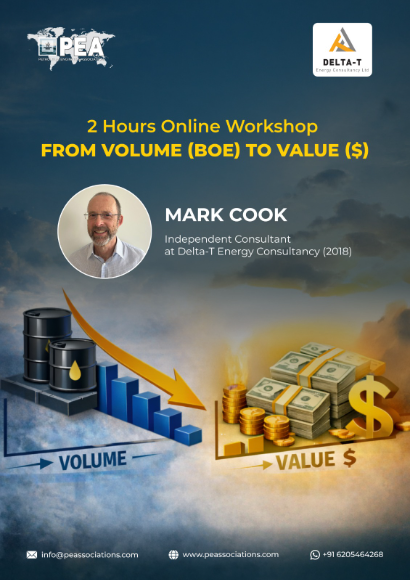
From Volume (BOE) to Value ($)
A 2-Hour Online Workshop in Petroleum Economics



From Volume (BOE) to Value ($)
Have Questions ?
From Volume (BOE) to Value ($) - PE101
| Code | Date | Time | Duration | Location | Currency | Team of 10 Per Person | Team of 7 Per Person | Early Bird Fee Per Person | Normal Fee Per Person |
|---|---|---|---|---|---|---|---|---|---|
| PE101 | 13 - 13 Jul 2026 | 9 PM Indian Time |
2 Hours
|
Zoom Online
|
USD
|
100
|
125
|
150
|
250
|
The Session will be via zoom for 2 hours with a short coffee break on 13th July 2026 from 9 PM Indian Time / 4:30 PM UK Time Onwards.
Boost your team's skills and your budget! Enjoy group discounts for collaborative learning. Send an inquiry to info@peassociations.com.
From Voume to Value
A focused 2-hour online workshop that teaches oil and gas professionals how to evaluate the financial worth of a hydrocarbon asset — moving from production volumes to sound investment decisions — using real Excel models and practical industry frameworks.
Description
A 2-hour live online workshop covering the fundamentals of petroleum economics — from production volumes to financial valuation — using real Excel models guided by SPE Distinguished Lecturer and published author Mark Cook.
Every barrel of oil or cubic foot of gas has a volume — but volume alone does not determine whether a project gets funded, developed, or shut down. What matters is value: the financial return that a reservoir generates over its producing life.
This workshop bridges the gap between subsurface engineering and commercial decision-making. In just two hours, you will build a complete economic model in Excel, learn how investment decisions are evaluated at the highest levels of the industry, and develop the confidence to speak the language of value — from the wellhead to the boardroom.
Led by Mark Cook, one of the industry's most respected voices in petroleum economics, this session distills over 40 years of hands-on experience into a practical, immediately applicable framework.
Identify and apply the core inputs required to build an economic evaluation — production profile, oil price, capital expenditure, operating expenditure, and fiscal terms
Construct a tax-and-royalty cashflow model in Excel and calculate key metrics including payback period, economic life, and maximum financial exposure
Apply discounting principles to a net cashflow and interpret NPV (Net Present Value) and IRR (Internal Rate of Return)
Understand capital efficiency and unit cost indicators used to compare projects and allocate investment
Distinguish between the two primary global fiscal systems — concessions and Production Sharing Contracts (PSCs) — and model a PSC in Excel
Conduct sensitivity analysis to test project robustness under different price and cost scenarios
Understand the Stage Gate process and the basis on which a Final Investment Decision (FID) is made
This workshop is delivered entirely online and combines structured teaching with live demonstrations. Each 30-minute block pairs a concept with a hands-on Excel exercise, so participants are building and running models throughout the session — not just listening to theory.
Companies that send their technical staff through this workshop can expect:
Faster, better-informed project evaluations — engineers and geoscientists who understand the economics behind their technical work reduce the time needed to reach investment decisions
Stronger cross-functional collaboration — when technical teams and commercial teams share a common framework, communication improves and rework decreases
Reduced commercial risk — professionals who can identify financial red flags early — poor payback, negative NPV, unfavourable fiscal terms — help organisations avoid costly commitments
Consistent use of industry-standard tools — Excel-based cashflow and PSC models used in this workshop align with practices at major international operators
Participants who complete this workshop will:
Gain commercial credibility — the ability to evaluate a project economically is one of the most valued and least common skills in the technical workforce
Broaden their career scope — professionals who combine technical depth with financial literacy are better positioned for senior roles, commercial assignments, and advisory work
Build practical tools — the Excel models built during the session are yours to keep and adapt for your own work
Develop confidence in high-stakes discussions — from FID reviews to partner negotiations, you will be equipped to contribute meaningfully to financial conversations
This workshop is designed for professionals working in or supporting the upstream oil and gas sector who want to develop or strengthen their understanding of petroleum economics. It is particularly relevant for:
Reservoir engineers and geoscientists moving into project evaluation or development roles
Production and facilities engineers involved in field development planning
Technical professionals preparing for commercial, advisory, or managerial positions
Asset managers and project managers responsible for investment decisions
Finance and commercial professionals seeking to better understand the technical basis of economic models
New entrants to the industry who want a structured introduction to upstream economics
No prior background in economics or finance is required. A working knowledge of Excel is helpful.
Block 1 — What Goes Into an Economic Evaluation (0–30 min)
Introduction to the five building blocks of any upstream economic model: production profile, commodity price, capital expenditure (Capex), operating expenditure (Opex), and the fiscal system. Live construction of a tax-and-royalty cashflow model in Excel. Calculation of payback period, economic life, and maximum capital exposure.
Block 2 — The Time Value of Money (30–60 min)
Why a dollar today is worth more than a dollar tomorrow. The principles of discounting, the weighted average cost of capital, and how companies set their discount rates. Application to a net cashflow model to calculate NPV and IRR. Interpreting what these numbers mean for project viability.
Break (15 min)
Block 3 — Efficiency, Fiscal Systems and PSCs (60–90 min)
Capital efficiency ratios and unit cost indicators: how they are used to rank and compare projects. An overview of the two dominant global fiscal frameworks — concessions (royalty/tax) and Production Sharing Contracts. Key differences in how governments and companies share revenues. Live construction of a PSC model in Excel.
Block 4 — Decisions Under Uncertainty (90–120 min)
Sensitivity analysis: how to test a project's financial performance against changes in price, cost, and production. The Stage Gate process used by major operators to govern project progression. The basis for a Final Investment Decision (FID) and the key indicators that influence it. Summary and Q&A.
All participants who attend the full workshop will receive a jointly signed digital Certificate of Completion, issued by Mark Cook (Delta-T Energy Consultancy Ltd) and Petroleum Engineers Association (ISO 9001:2015 Certified), suitable for your professional portfolio and LinkedIn profile.
Mark Cook — BSc Chemical Engineering (University of Nottingham), MBA (Henley Management College)
Mark Cook has spent over 40 years at the intersection of reservoir engineering and commercial decision-making. He began his career with Shell International in 1981, working as a reservoir engineer on field development projects in the United Kingdom, Oman, Tanzania, and the Netherlands. He was involved in equity negotiations and production operations across multiple assets before leaving Shell in 1992 to co-found TRACS International, one of the upstream industry's leading training and consultancy organisations. Over the following 26 years, he built the TRACS business as both a Petroleum Engineer and Managing Director.
Since 2018, Mark has worked as an independent consultant and trainer through Delta-T Energy Consultancy, based in Dublin, Ireland.
He runs the SPE Short Course in Field Development Economics and has served as an SPE Distinguished Lecturer on the subject of Risk Analysis. He is a guest lecturer at Heriot-Watt University and the University of Aberdeen. He is co-author of Hydrocarbon Exploration and Production (Jahn, Cook & Graham, Elsevier) and the sole author of Petroleum Economics and Risk Analysis, published by Elsevier in January 2021 — available in both print and e-book.
Mark's training courses span Early Development, Business & Commercial Evaluation, Uncertainty & Risk, and Reservoir Engineering, and have been delivered to professionals at national oil companies, international operators, and independent exploration companies worldwide.
Frequently Asked Questions
All course bookings made through PEA are strictly non-refundable. By registering for a course, you acknowledge and accept that all fees are payable in full and are not subject to refund under any circumstances, including changes in personal or professional commitments or partial attendance.
PEA reserves the right to make reasonable adjustments to course content, trainers, or schedules where necessary, without entitling delegates to a refund. Comprehensive details of each course — including objectives, target audience, and content — are clearly outlined before enrolment, and it is the responsibility of the delegate to ensure the course's suitability prior to booking.
For any inquiries related to cancellations or bookings, please contact our support team, who will be happy to assist you.