

Practical Data Science for Modern Upstream Operations
Petroleum Data Analytics: A Data-Driven Approach
Learn to analyze data, build predictive models, and make more informed decisions with Python and machine learning
Secure your spot now!
Duration
5 Days



Petroleum Data Analytics: A Data-Driven Approach
Have Questions ?
Petroleum Data Analytics: A Data-Driven Approach - PDA26
Boost your team's skills and your budget! Enjoy group discounts for collaborative learning. Send an inquiry to info@peassociations.com.
Petroleum Data Analytics
A practical, 20-hour online program that teaches oil and gas professionals how to use Python and machine learning to analyze field data, build predictive models, and improve operational decisions.
Description
This program provides a practical introduction to Petroleum Data Analytics. It is designed to help upstream professionals move beyond traditional analysis by leveraging Python and machine learning.
Over 20 hours of live, instructor-led training, you will learn to work with real oil and gas datasets. The curriculum covers everything from the fundamentals of Python programming to the application of machine learning models for tasks like production forecasting and anomaly detection. You will learn by doing, using hands-on exercises to build skills you can apply immediately.
In today's upstream industry, data is abundant, but actionable insights are not. The ability to analyze production data, detect events, and predict future performance is a critical skill.
This training program bridges the gap between traditional petroleum engineering and modern data science. It provides a clear, structured path to using Python and machine learning on your own data. Led by an instructor with over a decade of experience in production, flow assurance, and Python programming, this course emphasizes practical application. You will work with real datasets and build models that support business intelligence and better decision-making across the asset lifecycle.
Write and understand foundational Python code for data analysis.
Manipulate, clean, and visualize production and reservoir data using Pandas.
Apply machine learning techniques such as clustering, classification, and regression.
Build and evaluate predictive models for production forecasting and event detection.
Use time series analysis to identify trends and forecast future performance.
Work confidently with real oil and gas datasets to solve practical problems.
Live Instructor-Led Sessions: The training is delivered online, allowing for direct interaction with the instructor.
Dataset-Driven Workflows: Each module uses real oil and gas data to solve industry-relevant problems.
Practical Application: You will build models and analyze data in every session.
Continuous Support: Daily access to video recordings and comprehensive study materials reinforce learning and provide reference for future use.
This training delivers tangible value by building in-house data analytics capabilities. Teams will be able to:
Reduce reliance on external consultants for data analysis and modeling.
Improve decision-making with data-backed insights.
Identify operational inefficiencies and potential problems earlier through anomaly detection.
Optimize production strategies using predictive models for forecasting.
Foster a culture of innovation by equipping engineers with modern data science tools.
For the individual, this program builds a highly sought-after skill set that is relevant across the upstream value chain. Participants will:
Add a powerful new skillset to their professional toolkit.
Bridge the gap between engineering and data science, increasing their value to any team.
Gain the confidence to tackle data analysis projects independently.
Learn from a practitioner with deep domain knowledge, not just a theoretical trainer.
Receive a portfolio of work from the practical exercises, demonstrating their new capabilities.
This program is designed for technical professionals and students across the upstream value chain who want to add data analytics and machine learning to their toolkit. This includes:
Reservoir Engineers
Production Engineers
Chemical Engineers
Drilling Engineers
Geologists and Petrophysicists
AL and Workover Engineers
Undergraduate Students
Prerequisites: No prior programming experience is required. You will need a working laptop running Windows 10, macOS, or a GNU/Linux distribution.
Module 01: Python Foundations for Data Analytics
Topics: Introduction to Python, data types and structures, data visualization with Pandas, data cleaning and transformation.
Hands-On: Reading oil and gas data, Excel-to-Python connection, filtering data by wells, organizing data with time-series.
Outcome: A foundational understanding of Python for data manipulation and preparation.
Module 02: Production Engineering
2.1 Clustering & Anomaly Detection: Group similar data points, identify outliers in production data.
2.2 Classification: Predict ESP operational problems, classify flow regime types.
2.3 Regression Analysis: Train models to behave like industry software, predict hydrocarbon properties.
2.4 Time Series Analysis: Forecast production decline, predict water cut, and move beyond traditional Decline Curve Analysis.
Module 03: Reservoir Engineering
3.1 Python & Data Science Foundations: A deeper dive into Python for data science, reinforcing core skills with reservoir data.
3.2 Unsupervised Learning: Cluster petrophysical data and detect anomalies in production.
3.3 Supervised Learning: Classify formation layers and predict events like asphaltene deposition.
3.4 Regression Analysis: Predict reservoir pressures and petrophysical properties.
3.5 Time Series Analysis & Forecasting: Predict oil decline, forecast reservoir pressure, and analyze multi-well data.
On successful completion of this training course, PEA Certificate will be awarded to the delegates
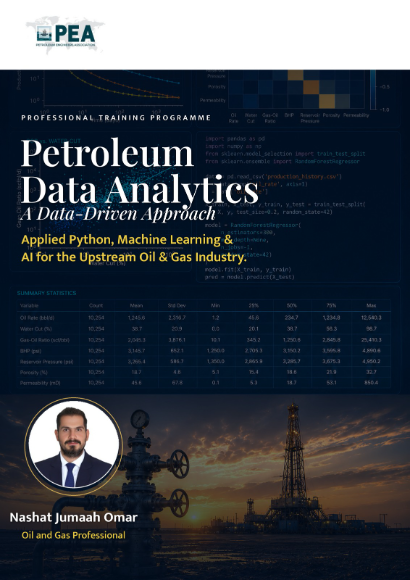
Mr. Nashat J. Omar With over 12 years of specialized experience in petroleum engineering, focus on production and flow assurance brings valuable expertise to the energy sector.
He possess a strong command of Python and C#, which empowers him to create efficient data management solutions and streamline workflows.
His collaborative nature and adaptability enable him to thrive in multidisciplinary settings, where he consistently contributes to success through innovative problem-solving.
He is dedicated to continuous learning and staying ahead of industry advancements, ensuring that he can enhance operational efficiency and guarantee robust flow assurance.
Frequently Asked Questions
All course bookings made through PEA are strictly non-refundable. By registering for a course, you acknowledge and accept that all fees are payable in full and are not subject to refund under any circumstances, including changes in personal or professional commitments or partial attendance.
PEA reserves the right to make reasonable adjustments to course content, trainers, or schedules where necessary, without entitling delegates to a refund. Comprehensive details of each course — including objectives, target audience, and content — are clearly outlined before enrolment, and it is the responsibility of the delegate to ensure the course's suitability prior to booking.
For any inquiries related to cancellations or bookings, please contact our support team, who will be happy to assist you.
