

Comprehensive digital technologies from real-time monitoring to autonomous operations for modern upstream assets
The Digital Oilfield
SCADA, IoT, AI/ML, and Generative AI Technologies for Upstream Digital Transformation



The Digital Oilfield
Have Questions ?
The Digital Oilfield - DIGOF26
Boost your team's skills and your budget! Enjoy group discounts for collaborative learning. Send an inquiry to info@peassociations.com.
The Digital Oilfield
This intensive 20-hour online course provides operations
professionals with a comprehensive understanding of Digital Oilfield
technologies, from foundational SCADA and IoT systems to cutting-edge
Generative AI and Agentic AI applications. The course emphasizes practical
implementation, business value realization, and hands-on experience with modern
digital tools.
Description
The Digital Oilfield course addresses the complete spectrum of digital transformation in upstream operations. This course examines the technology stack from field devices through enterprise analytics and AI-driven decision systems. Participants will gain understanding of architecture design, data management, and value quantification frameworks. The curriculum covers Industrial IoT sensors, real-time monitoring, machine learning for production optimization and predictive maintenance, Large Language Models for operational intelligence, and Agentic AI for autonomous workflows. Participants will examine case studies from Shell, Equinor, BP, Saudi Aramco, and Chevron, gaining insights into enterprise-scale digital deployment.
Digital transformation has emerged as a critical imperative for upstream operations, driven by cost pressures, safety requirements, and environmental commitments. The Digital Oilfield integrates sensors, automation, connectivity, analytics, and artificial intelligence to optimize the upstream value chain. Modern operations are evolving from manual readings toward autonomous surveillance and AI-driven optimization. This course provides participants with the technical foundation and implementation strategies necessary to navigate digital transformation successfully.
Upon completion of this course, participants will be able to:
• Understand the architecture and components of modern Digital Oilfield systems
• Design and evaluate real-time monitoring solutions using SCADA, IoT, and edge computing
• Apply AI/ML techniques for production optimization, predictive maintenance, and anomaly detection
• Leverage Large Language Models (LLMs) for operational intelligence and decision support
• Build Agentic AI systems for autonomous monitoring and control workflows
• Implement RAG systems for technical knowledge management
• Quantify and communicate business value of digital transformation initiatives
• Develop a digital transformation roadmap for upstream operations
The course combines technical presentations, live demonstrations, case study analysis, and collaborative exercises. Participants engage with AI dashboards, RAG-enabled chatbots, and multi-agent systems through demonstrations. Technical concepts are reinforced through design exercises, model development, and roadmap creation. The methodology emphasizes implementation considerations and organizational change management. Industry case studies provide real-world context and lessons learned.
Organizations sending participants to this course will benefit from:
Enhanced production efficiency through real-time optimization and AI-driven decision support
Reduced operating costs via automation, remote operations, and predictive maintenance
Improved safety performance through real-time monitoring and early warning systems
Strengthened competitive position through advanced digital capabilities
Better capital deployment through structured ROI frameworks and phased strategies
Enhanced collaboration between IT, OT, operations, and engineering teams
Accelerated digital maturity through comprehensive technology understanding
Improved environmental performance via emissions monitoring and operational optimization
Participants will experience significant professional development including:
Comprehensive knowledge of digital oilfield technologies
Enhanced strategic thinking for evaluating technology investments
Improved technical fluency spanning SCADA, IoT, edge computing, ML, and Generative AI
Expanded career opportunities in digital transformation and AI implementation roles
Strengthened ability to communicate business value to executive leadership
Professional credibility through demonstrated expertise in this strategic domain
Broader industry perspective through exposure to best practices
Enhanced problem-solving skills applicable to operational and digital challenges
This course is specifically designed for:
Operations engineers responsible for production surveillance and optimization
Production technologists involved in well performance and artificial lift
Digital transformation team members leading digitalization initiatives
Facility engineers engaged in automation and control systems
Process engineers applying analytics to production operations
Technical managers overseeing operations or digital programs
Asset managers requiring understanding of digital capabilities
IT professionals supporting operational technology systems
Project engineers involved in digital technology implementation
Professionals seeking comprehensive foundation in digital oilfield technologies
DAY 01: Digital Oilfield Fundamentals
Architecture, Components, and Data Infrastructure for Modern Upstream Operations
Module 1.1: The Digital Oilfield Journey
Evolution from manual readings to SCADA to AI-driven operations
Key milestones: SCADA systems (1980s), real-time centers (2000s), cloud adoption (2010s), AI/ML era (2020s)
Industry drivers: cost pressure, talent shortage, safety, ESG commitments
Module 1.2: Digital Oilfield Architecture
Five architecture layers: Field Devices, Control Systems, SCADA/DCS, Operations, Enterprise
Data infrastructure: Historians (OSIsoft PI, Honeywell PHD, AspenTech), data lakes, edge computing
Integration patterns: OPC-UA, REST APIs, Kafka, MQTT
Module 1.3: Data Management in Digital Oilfield
Data quality dimensions: accuracy, completeness, timeliness, consistency
Real-time data challenges: high-frequency data, compression, gaps and outliers
IT/OT convergence, security, and access control
Demo: Digital Oilfield Architecture Visualization - Real-time data flow from field to enterprise
Exercise: Data Architecture Assessment - Review architecture, identify bottlenecks, propose improvements
Case Study: Shell's Digital Transformation - IAM program, real-time centers, 5-10% production uplift
DAY 02: Real-Time Monitoring & IoT
SCADA Systems, Sensor Technologies, and Edge Computing for Upstream Operations
Module 2.1: Modern SCADA for Upstream
SCADA components: RTUs, PLCs, communication networks, master station, HMI
Modern trends: cloud-based architectures, mobile access, remote operations
Cybersecurity: IEC 62443, NIST frameworks
Module 2.2: Sensor Technologies & IIoT
Measurement technologies: pressure, temperature, flow, multiphase meters
Wireless sensors: WirelessHART, ISA100.11a, LoRaWAN
Advanced sensing: fiber optics (DTS, DAS), smart completions, condition monitoring
Module 2.3: Edge Computing for Upstream
Edge vs. fog vs. cloud processing strategies
Edge platforms: AWS IoT Greengrass, Azure IoT Edge, AVEVA Edge
Use cases: real-time protection, local ML inference, data filtering, offline operation
Containerization: Docker, Kubernetes for IoT
Demo: SCADA Simulator - Real-time data acquisition, alarm management, remote control
Exercise: Monitoring System Design - Design solution for remote well pad including sensors, communication, edge processing
Case Study: Equinor's Johan Sverdrup - 30,000+ sensors, integrated operations, 70% reduction in offshore personnel
DAY 03: AI/ML for Digital Operations
Machine Learning Applications for Production Optimization and Predictive Maintenance
Module 3.1: AI/ML Overview for Operations
Supervised/unsupervised learning, time-series forecasting (LSTM, Prophet)
Feature engineering from SCADA and historian data
Model validation: train/test split, cross-validation, backtesting
Module 3.2: Production Optimization with AI
Virtual Flow Metering, well test optimization, choke optimization
Gas lift and ESP optimization using ML
Model architectures: XGBoost, neural networks, hybrid physics-ML
Human-in-the-loop vs. closed-loop control
Module 3.3: Predictive Maintenance
Maturity levels: reactive, preventive, condition-based, predictive, prescriptive
ML techniques: Remaining Useful Life estimation, anomaly detection (Isolation Forest, Autoencoders)
Failure classification and root cause analysis with explainable AI (SHAP)
Demo: AI Production Optimization Dashboard - Virtual flow meter, production forecast, optimization recommendations
Exercise: Building Anomaly Detection Model - Load data, preprocess, train Isolation Forest, evaluate performance
Case Study: BP's APEX Platform - Predictive maintenance across 20,000+ equipment, $100M+ annual value
DAY 04: Generative AI & Agentic AI Applications
Large Language Models, RAG Systems, and Autonomous Agents for Digital Oilfield
Module 4.1: LLMs in the Digital Oilfield
LLM capabilities: natural language interfaces, automated reporting, troubleshooting, code generation
Foundation models: GPT-4, Claude, Gemini, Llama, Mistral
API integration for enterprise systems
Module 4.2: Prompt Engineering & RAG
Prompt techniques: zero-shot, few-shot, chain-of-thought reasoning
RAG architecture: document ingestion, chunking, embedding models, vector databases
Semantic search and response synthesis
Module 4.3: Agentic AI for Digital Oilfield
Agent architecture: perception, reasoning, action, memory
Tool use: database queries, API calls, calculations
Applications: production surveillance, maintenance planning, regulatory compliance, operations assistance
Safety: human-in-the-loop, guardrails, audit trails
Demo: Operations Chatbot with RAG - Query manuals, analyze alarms, generate reports
Demo: Multi-Agent Production Monitoring - Surveillance agent, diagnostic agent, recommendation agent with human approval
Exercise: Designing Operations Agent - Define purpose, tools, interaction flow, safety constraints
Case Study: SLB's Lumi AI Platform - Domain-specific assistant, Delfi integration, RAG over knowledge base
DAY 05: Integration & Business Value
Digital Transformation Strategy, ROI Quantification, and Implementation Roadmap
Module 5.1: Quantifying Digital Value
Value drivers: production uplift, cost reduction, safety, environmental, efficiency
ROI framework: baseline, KPIs, benefit categories, cost elements
Payback period, NPV analysis, risk-adjusted returns
Module 5.2: Implementation Strategy
Four-phase approach: Foundation (data infrastructure), Optimization (analytics), Automation (AI/ML), Autonomy (Agentic AI)
Success factors: executive sponsorship, cross-functional teams, agile delivery, scalable architecture
Change management and workforce development
Demo: Digital Value Dashboard - Real-time value tracking, KPI performance, ROI projections
Exercise: Digital Transformation Roadmap - Assess maturity, identify opportunities, design plan, estimate costs/benefits
Case Study: Aramco's 4IRC - AI/ML across 500+ assets, digital twin for Ghawar, $1B+ annual value
Case Study: Chevron's Digital Journey - Azure platform, AI Center of Excellence, predictive maintenance
Course Wrap-up - Key takeaways, resources, certification process
On successful completion of this training course, PEA Certificate will be awarded to the delegates.
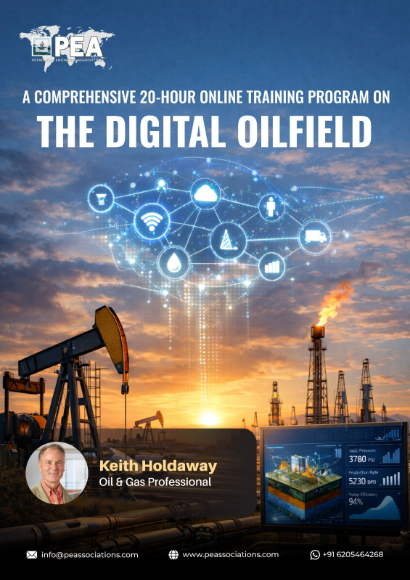
Keith Holdaway - Geophysicist with 15 years in seismic data processing and interpretation, 27+ years in software development at SAS Institute. He specializes in data analytics for Exploration and Production, delivering AI solutions bridging upstream geosciences and technology.
Frequently Asked Questions
All course bookings made through PEA are strictly non-refundable. By registering for a course, you acknowledge and accept that all fees are payable in full and are not subject to refund under any circumstances, including changes in personal or professional commitments or partial attendance.
PEA reserves the right to make reasonable adjustments to course content, trainers, or schedules where necessary, without entitling delegates to a refund. Comprehensive details of each course — including objectives, target audience, and content — are clearly outlined before enrolment, and it is the responsibility of the delegate to ensure the course's suitability prior to booking.
For any inquiries related to cancellations or bookings, please contact our support team, who will be happy to assist you.
