How Pressure Vessels Fail: Mechanisms, Case Studies, and Engineering Strategies for Prevention
Premium Webinar
For PEA Members Only

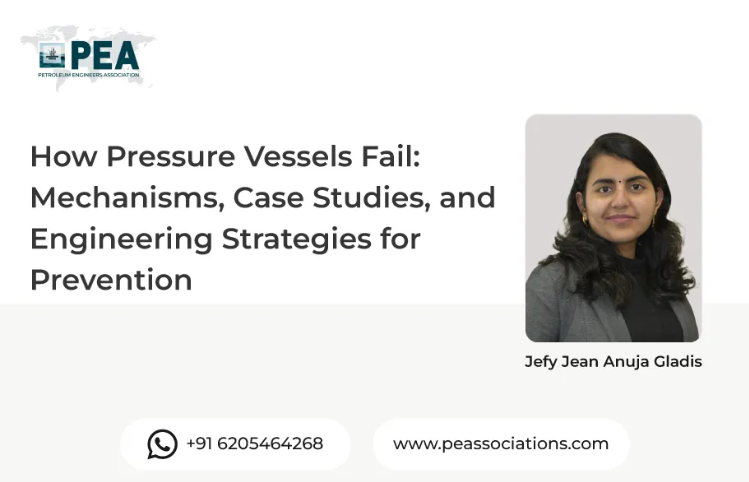
Pressure vessel failures rarely happen the way textbooks describe them. Codes tell you how to design — but not how vessels actually fail in the field under real operating conditions, real materials, and real human decisions.
This live webinar, led by Chemical Engineer Jefy Jean Anuja Gladis, moves beyond code-based design into mechanism-driven failure analysis. Drawing on her experience in the German process engineering industry and a background shaped at Cornell University, Jefy will walk engineers through the stress systems, failure modes, and inspection blind spots that sit behind most incidents in chemical plants — and equip you with a practical framework to answer: given this vessel, operating condition, and material, what is most likely to fail, how, and when?
Webinar Objectives
Define what "failure" really means beyond rupture — including leakage, deformation, and fitness-for-service loss.
Identify the stress systems and failure drivers acting on pressure vessels in real operating conditions.
Recognize the major failure modes — fatigue, creep, brittle fracture, corrosion, and stress-driven mechanisms.
Select appropriate inspection and detection techniques matched to each failure mode.
Apply engineering prevention strategies grounded in real-world case studies and lessons from past incidents.
About the Presenter
Register Now
View More




Time : 9:30 PM Indian Time | Duration : 60 Minutes


Premium Webinar
For PEA Members Only
Rock Physics Integration: from Petrophysics to Simulation
Join our 90-minute webinar on Rock Physics Integration: from Petrophysics to Simulation, where we will explore how rock physics connects petrophysical data, seismic response, geomechanics, and reservoir simulation in one integrated workflow. The session explains how elastic properties such as Vp/Vs and elastic moduli can be related to reservoir properties like porosity, saturation, pressure, laminations, and fractures to support a more reliable subsurface model.This webinar is designed for geoscience and reservoir professionals who want to understand how multidisciplinary data can be combined to improve interpretation, modeling, and prediction. It will show how rock physics helps align well, core, seismic, and reservoir engineering information to build a more complete three-dimensional understanding of the subsurface.