


An Interactive 5-Day Training Course
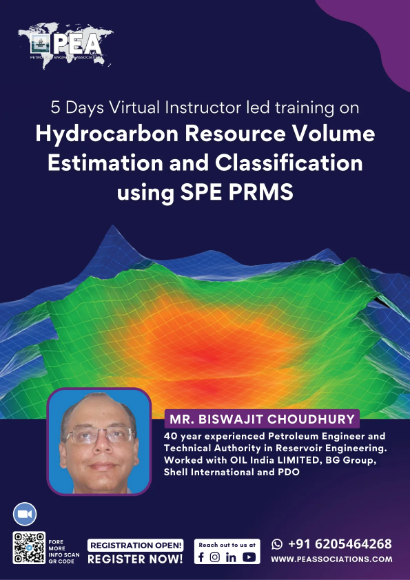
Hydrocarbon Resource Volume Estimation and Classification Using SPE-PRMS
Learn to Estimate, Classify, and Report Hydrocarbon Volumes with Confidence and Consistency
Secure your spot now!



Hydrocarbon Resource Volume Estimation and Classification Using SPE-PRMS
Have Questions ?
Hydrocarbon Resource Volume Estimation and Classification Using SPE-PRMS - PRMS26
| Code | Date | Duration | Location | Currency | Early Bird Fee Per Person |
|---|---|---|---|---|---|
| PRMS26 | 16 - 20 Nov 2026 | 10 Hours |
Online |
USD |
1000 |
Classes will be held online via Zoom, Monday to Friday, 2 hours per day, including two short breaks.
Boost your team's skills and your budget! Enjoy group discounts for collaborative learning. Send an inquiry to info@peassociations.com.
Hydrocarbon Resource Volume Estimation and Classification Using SPE-PRMS
This course provides comprehensive training on hydrocarbon resource volume estimation and classification following the SPE Petroleum Resources Management System (PRMS) framework. Participants will learn how to apply PRMS guidelines to estimate, categorize, and communicate oil and gas resources consistently across exploration and production projects.
Description
The Hydrocarbon Resource Volume Estimation and Classification Using SPE-PRMS course equips professionals with the knowledge and tools to evaluate and classify petroleum resources in alignment with international standards. It covers the principles of volumetric estimation, uncertainty management, and reporting methods used to support investment decisions and corporate disclosures.
Participants will explore the key concepts of reserves, contingent resources, and prospective resources, understanding how each category is defined and quantified under the PRMS framework. The course also emphasizes the integration of geological, geophysical, and engineering data to ensure robust and defensible resource estimates.
Practical exercises and case studies provide hands-on experience in resource evaluation, risk assessment, and classification workflows, enabling participants to apply these concepts effectively in their organizations.
Demo Class
Accurate estimation and classification of hydrocarbon volumes are critical for effective resource management, investment appraisal, and portfolio reporting. The SPE Petroleum Resources Management System (PRMS) provides a globally recognized standard for categorizing petroleum quantities based on technical, commercial, and economic criteria.
This course introduces participants to the structure and logic of PRMS, helping them understand how to apply it to real-world exploration and production scenarios. It bridges technical resource evaluation with business decision-making and regulatory compliance.
By the end of this course, participants will be able to:
Understand the principles and structure of the SPE-PRMS framework.
Estimate hydrocarbon volumes using geological and engineering data.
Differentiate between reserves, contingent, and prospective resources.
Apply PRMS criteria for resource classification and project maturity.
Quantify uncertainty and risk in resource estimation.
Prepare and communicate resource evaluation results in compliance with PRMS standards.
Align technical assessments with business and investment requirements
The course combines lectures, interactive discussions, and practical exercises. Participants will work through case studies involving real-world datasets to perform volumetric calculations, resource categorization, and uncertainty analysis. Emphasis is placed on applying PRMS principles to exploration, appraisal, and development projects for both conventional and unconventional resources.
Improved consistency and reliability in resource estimation and reporting.
Enhanced decision-making based on standardized PRMS classifications.
Reduced project and portfolio uncertainty through structured evaluation.
Strengthened integration between technical, financial, and management teams.
Greater compliance with global resource reporting standards.
Develop strong competency in PRMS-based resource evaluation.
Gain confidence in interpreting and applying classification frameworks.
Improve ability to communicate resource estimates to management and regulators.
Strengthen technical and analytical skills in reservoir and resource assessment.
Increase career value in exploration, reservoir, and asset management roles.
Reservoir and Petroleum Engineers
Geologists and Geophysicists
Petroleum Economists and Asset Evaluators
Project and Portfolio Managers
Definition of Hydrocarbon Resource
Importance of Estimation and Classification of Hydrocarbon
Resource Volume
SPE PRMS – Basic Features
Classification of Hydrocarbon Resource Volume in SPE PRMS
Hydrocarbon Resource Volume Maturation
Hydrocarbon Reserves – Developed and Undeveloped Reserves
SEC Proved Reserves Requirements
Significance of Reserves Replacement Ratio (RRR), (1P/2P)EUR and Reserves to Production Ratio (R/P)
Industry Examples on challenges related to hydrocarbon resource estimation and Classification.
Numerical Problems related to hydrocarbon resource estimation and maturation
Quiz
On successful completion of this training course, PEA Certificate will be awarded to the delegates.
Biswajit Choudhury is a Reservoir Engineer with about 40 years of experience in oil and gas industry. During his long career he has worked for Oil India Limited, BG Group, Shell International and Petroleum Development Oman. He was the technical authority in Reservoir Engineering function in Shell International and Petroleum Development Oman. Biswajit has presented several technical papers in international conferences and has 12 publications in international journals.
Currently as a Freelance Reservoir Engineering Consultant, he is associated with IMC Limited and Petroleum Engineering association (PEA). He delivers several technical courses both online and in face-to-face mode and is a guest faculty at IIT (ISM) Dhanbad and IIT (Madras). Biswajit has BS and MS degree in Petroleum Engineering from IIT (ISM) Dhanbad.
Frequently Asked Questions
All course bookings made through PEA are strictly non-refundable. By registering for a course, you acknowledge and accept that all fees are payable in full and are not subject to refund under any circumstances, including changes in personal or professional commitments or partial attendance.
PEA reserves the right to make reasonable adjustments to course content, trainers, or schedules where necessary, without entitling delegates to a refund. Comprehensive details of each course — including objectives, target audience, and content — are clearly outlined before enrolment, and it is the responsibility of the delegate to ensure the course's suitability prior to booking.
For any inquiries related to cancellations or bookings, please contact our support team, who will be happy to assist you.
