


Maximize Reservoir Efficiency Through Advanced Analysis and Monitoring
Reservoir Performance Analysis & Surveillance
Empowering Oil and Gas Professionals with Cutting-Edge Techniques in Reservoir Management



Reservoir Performance Analysis & Surveillance
Have Questions ?
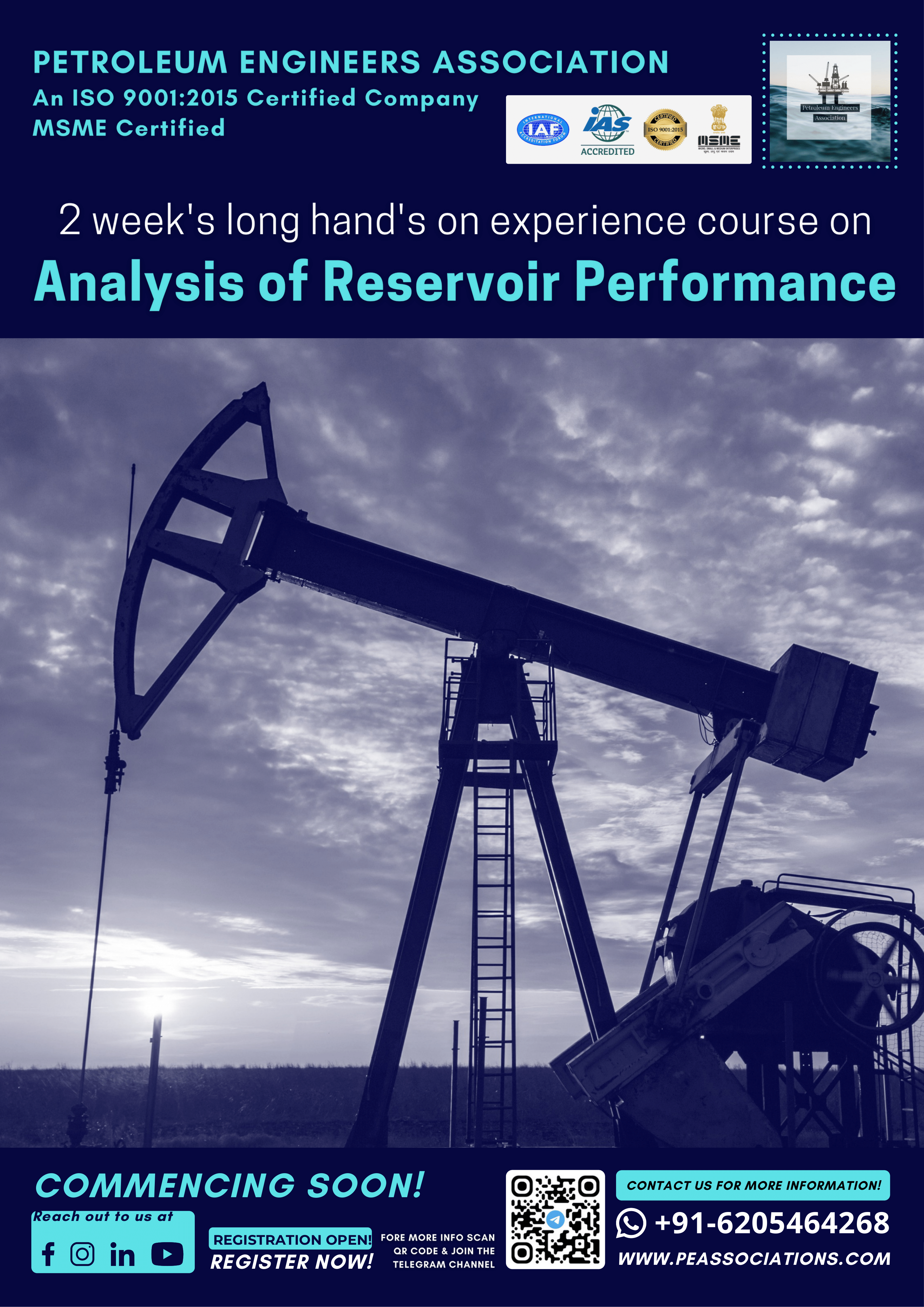
Reservoir Performance Analysis & Surveillance - RPA26
| Code | Date | Time | Duration | Location | Currency | Team of 10 Per Person | Team of 7 Per Person | Early Bird Fee Per Person | Normal Fee Per Person |
|---|---|---|---|---|---|---|---|---|---|
| RPA26 | 09 - 20 Nov 2026 | 10:30 PM Indian Time | 3 Hours Per Day |
Online |
USD |
2500 |
2850 |
3000 |
3500 |
Boost your team's skills and your budget! Enjoy group discounts for collaborative learning. Send an inquiry to info@peassociations.com.
Reservoir Performance Analysis & Surveillance
Description
The Reservoir Performance Analysis & Surveillance course is designed to provide a comprehensive understanding of the techniques and methods used in analyzing and monitoring the performance of oil and gas reservoirs. The course covers various aspects of reservoir engineering, data analysis, and surveillance techniques to optimize reservoir production and maximize hydrocarbon recovery.
During the course, participants will learn about the fundamental concepts of reservoir engineering, including reservoir characterization, fluid flow in porous media, and reservoir simulation. They will also explore different reservoir performance analysis techniques, such as decline curve analysis, material balance calculations, and production forecasting.
Demo Class
Understanding and improving reservoir performance is crucial for maximizing hydrocarbon recovery while minimizing operational challenges. This course delves into key concepts, tools, and techniques used in modern reservoir analysis and surveillance. By bridging theory with practical applications, participants will develop a robust framework for effective reservoir management.
Understand the fundamentals of reservoir performance analysis and surveillance.
Learn advanced monitoring techniques for assessing reservoir conditions.
Evaluate key performance indicators to optimize production.
Develop strategies for managing declining reservoir performance.
Gain proficiency in using industry-standard tools and software for reservoir surveillance.
The course combines interactive lectures, group discussions, and hands-on exercises using real-world case studies. Participants will engage in problem-solving sessions and utilize software tools to analyze and interpret reservoir data.
Improved reservoir productivity and recovery rates.
Enhanced decision-making based on accurate performance analysis.
Reduced operational risks through proactive surveillance.
Strengthened technical capacity within teams for reservoir management.
Gain expertise in reservoir performance evaluation and optimization.
Master tools and techniques to address real-world reservoir challenges.
Boost career prospects with advanced technical knowledge.
Expand professional networks through interactions with industry peers.
Reservoir Engineers
Production Engineers
Petroleum Engineers
Geoscientists
Day 1 — Foundations
Introduction
Workflows and Key Features
Analysis Reservoir Engineering Tools
Workspace Definition
Day 2 — Data Import
Definitions for File Extensions
Import Data to the Workspace
Case Studies and Examples
Day 3 — Project & Database Setup
Project Administration
Database Fundamentals
Data Tables
Edit Schema Tables
Day 4 — Data Logic & Calculations
Data Guidelines
Calculated Variables and System Functions
Data Dictionary
Case Studies and Examples
Day 5 — Mapping
Analytical Mapping
Estimating and Displaying Drainage Radius Maps
Plotting Settings
Day 6 — Filtering & Reporting
Data Filtering and Categories
Analysis Reporting
Case Studies and Examples
Day 7 — Production Forecasting (Empirical)
Production Forecasting Tools
Forecasting Flow Models
Empirical Method (Arps Approach)
Day 8 — Production Forecasting (Analytical)
Analytical Method (Fetkovich Type Curve)
Forecast Schedules
Calculated Phase Forecast
Saving Forecasts
Determination of STOIIP and Remaining Reserves
Case Studies and Examples
Day 9 — Reservoir Diagnostics
Reservoir Performance Analysis
Determination of Potential Remaining Reserves
Water Breakthrough Diagnostic (Chan) Plotting
After-Before-Compare (ABC) Plotting
Day 10 — Water Injection & Waterflooding
Water Injection Diagnostics using Hall Plot
Waterflooding Surveillance Analysis
Case Studies and Examples
Applications Covered
Linking dynamic data to corporate/public databases
Well, reservoir, and field surveillance and production performance analysis
Forecasting, reserve estimation, depletion planning
Candidate recognition
Mapping and trend analysis
Waterflooding optimization and pattern analysis
EOR project management
On successful completion of this training course, PEA Certificate will be awarded to the delegates
Your Expert trainer is a highly accomplished Reservoir Engineering Team Leader possessing over 14 years of experience in the energy sector. He has a proven track record of success in reservoir management, characterization, and production optimization.
Reservoir Engineering: Leading and mentoring teams, conducting comprehensive reservoir evaluations, and developing strategies to maximize hydrocarbon recovery.
Data Analysis and Interpretation: Analyzing production data, material balance, RFT/MDT data, and pressure transients to optimize reservoir performance and identify opportunities for enhanced recovery.
Software Proficiency: Utilizing industry-standard software such as Techlog, Volumetric, DCA, MBE, OFM, and KAPPA for reservoir simulation, analysis, and hydrocarbon estimation.
Training and Development: Designing and delivering training courses on key reservoir engineering topics, including waterflooding, PVT analysis, and reservoir simulation.
Trainer has deep understanding of reservoir engineering principles, coupled with his strong analytical and problem-solving skills, make him a valuable asset. He consistently delivers technical solutions that drive efficiency and improve the performance of E&P portfolios.
Frequently Asked Questions
All course bookings made through PEA are strictly non-refundable. By registering for a course, you acknowledge and accept that all fees are payable in full and are not subject to refund under any circumstances, including changes in personal or professional commitments or partial attendance.
PEA reserves the right to make reasonable adjustments to course content, trainers, or schedules where necessary, without entitling delegates to a refund. Comprehensive details of each course — including objectives, target audience, and content — are clearly outlined before enrolment, and it is the responsibility of the delegate to ensure the course's suitability prior to booking.
For any inquiries related to cancellations or bookings, please contact our support team, who will be happy to assist you.
