

Leveraging your reflection seismic data: advanced seismic techniques
Premium Workshop
For PEA Members Only

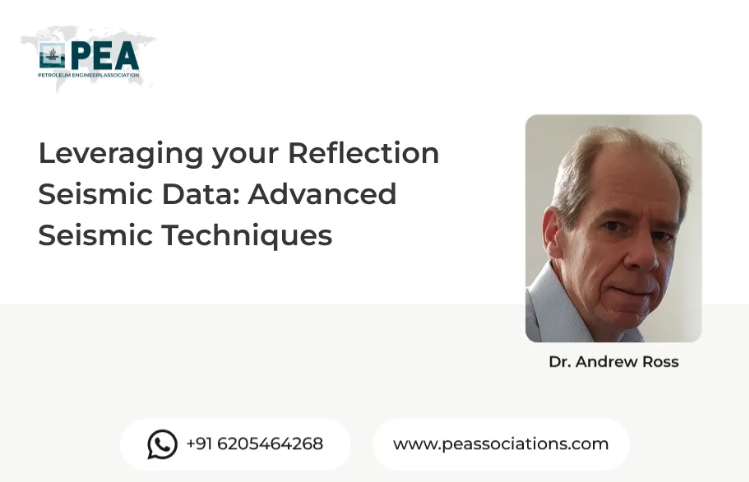
Most companies use only a fraction of the information locked inside their reflection seismic data. This workshop covers the advanced techniques that unlock the rest.
Over five hours, Dr. Andrew Ross walks through how modern seismic methods go beyond structural mapping into true reservoir characterization. The session covers seismic attributes — what they measure, which ones to trust, and how to use them for reservoir delineation; AVO analysis — the physics behind amplitude variation with offset and how it identifies fluids and lithology; and seismic inversion — turning reflection data into rock property volumes for quantitative interpretation. Along the way, he highlights the common pitfalls where these techniques mislead, and shows real examples of how they reduced risk on actual exploration and development decisions.
The session is entirely theory and case-study based — no software required. Participants leave with a clear understanding of what each technique can and cannot do, and how to ask the right questions of their seismic data and their service providers.
This workshop is ideal for geoscientists, reservoir engineers, and technical managers who work with seismic data and want to understand advanced interpretation methods without getting buried in software workflows.
Workshop Objectives
By the end of this workshop, participants will be able to:
Understand how advanced seismic techniques reveal reservoir properties, fluid content, and lithology that standard interpretation misses
Know what seismic attributes actually measure, which ones to trust, and how to apply them for reservoir delineation
Understand the physics behind AVO analysis and how it distinguishes fluids and lithology
See how seismic inversion converts reflection data into rock property volumes for quantitative interpretation
Recognize the common pitfalls of each technique and avoid over-interpreting seismic data
Ask the right questions of their data and their service providers — regardless of which software platform their team uses
About the Presenter
Dr. Andrew Ross is a consultant geophysicist based in Copenhagen with over 30 years of experience in reflection seismic interpretation, AVO, inversion, and quantitative interpretation.
He spent nearly a decade at Schlumberger supporting inversion and quantitative interpretation projects across the North Sea, Russia, India, China, Brazil, and Malaysia. Since 2015 he has run his own consulting practice and serves as a trainer for Schlumberger NExT, where he has delivered more than 100 courses on AVO and inversion, seismic interpretation, seismic attributes, and reservoir geophysics.
Andrew holds a PhD in Geophysics from Cornell University, an MSc in Exploration Geophysics from Imperial College London, and a BA in Physics from Oxford University. His research on deep seismic bright spots in Tibet was published in Science, and he holds a patent in multicomponent seismic inversion of VSP data. He began his career as an exploration geophysicist with Amerada Hess in London.



Premium Workshop
For PEA Members Only
Excel in Production Engineering
Most production engineering calculations don't need expensive software — they need Excel used well. This live 2-hour beginner workshop shows you how to build the core tools of well performance analysis directly in a spreadsheet. You'll create working models for inflow performance, nodal analysis, and decline curves from scratch, using nothing but Microsoft Excel — so you understand what's happening under the hood instead of treating commercial software as a black box.