Machine Learning for Drilling Engineering with Python
Premium Workshop
For PEA Members Only

Drilling generates huge amounts of data — but most of it sits unused. This hands-on workshop shows you how to turn that data into better decisions using Python and machine learning.
Over the sessions, you'll work with real drilling datasets to build models that predict problems before they happen — stuck pipe, ROP optimization, bit wear, formation changes, and more. No heavy math theory. You write code, run it on actual data, and see the results.
By the end, you'll have working Python scripts you can adapt to your own field data, plus a clear understanding of where ML adds value in drilling and where it doesn't.
Built for drilling engineers, not data scientists. If you can read a drilling report, you can follow this course.
Workshop Objectives
Load, clean, and explore drilling data in Python
Build prediction models for rate of penetration (ROP)
Detect and flag drilling problems early (stuck pipe, kicks, vibration)
Use real-time data to support drilling decisions
Read model results and know when to trust them
Take the code back to your team and put it to work
About the Presenter
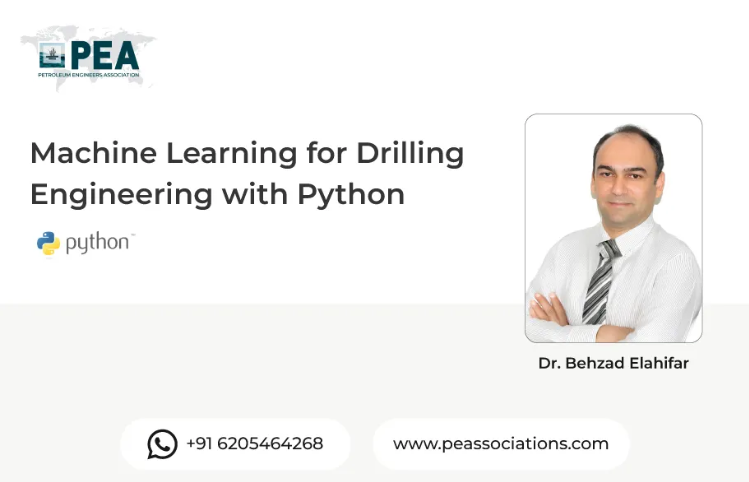
Dr. Behzad Elahifar – Associate Professor, NTNU
With over 20 years of experience in the oil and gas industry, Dr. Behzad Elahifar brings extensive expertise in drilling engineering, digitalization, and automation. He holds a Ph.D. in Drilling Engineering from the University of Leoben, an MEng in Petroleum Well Engineering from Curtin University, and a BSc in Drilling Engineering from the Petroleum University of Technology.
He began his career as a Drilling Supervisor with NIOC and PPZ, before moving into specialized roles with leading international companies. As a Drilling Engineer with Advanced Drilling Solutions (TDE) and later as Project Manager / MPD Specialist with Enhanced Drilling, he designed and executed managed pressure drilling and cementing operations across the North Sea, Barents Sea, Gulf of Mexico, Caspian Sea, and Norwegian Continental Shelf. He then served as Project Manager at NOV (National Oilwell Varco), working with Wired Drill Pipe and real-time downhole communication systems.
For more than a decade, Dr. Elahifar has combined industry consulting with academic leadership. As a Drilling Instructor and Researcher at the University of Leoben and now as an Associate Professor in the Department of Geoscience and Petroleum at NTNU, he has developed and delivered training courses and university modules for students and professionals worldwide. In the last several years, he has focused heavily on technical consulting and course instruction, leading programs on:
Python and data analytics for drilling engineers
Machine learning applications for drilling optimization and risk prediction
Managed Pressure Drilling (MPD), Controlled Mud Level (CML), and Managed Pressure Cementing (MPC)
Real-time downhole issue detection and digital twins
Plug & Abandonment (P&A) optimization, including innovative bismuth-alloy sealing solutions
Dr. Elahifar’s two decades of hands-on field experience, advanced degrees, and background working for major service companies, operators, and academia make him a highly skilled petroleum engineering consultant and trainer, uniquely positioned to bridge traditional drilling practice with the latest digital and AI-driven technologies





Premium Workshop
For PEA Members Only
Leveraging your reflection seismic data: advanced seismic techniques
Most companies use only a fraction of the information locked inside their reflection seismic data. This workshop covers the advanced techniques that unlock the rest.Over five hours, Dr. Andrew Ross walks through how modern seismic methods go beyond structural mapping into true reservoir characterization. The session covers seismic attributes — what they measure, which ones to trust, and how to use them for reservoir delineation; AVO analysis — the physics behind amplitude variation with offset and how it identifies fluids and lithology; and seismic inversion — turning reflection data into rock property volumes for quantitative interpretation. Along the way, he highlights the common pitfalls where these techniques mislead, and shows real examples of how they reduced risk on actual exploration and development decisions.The session is entirely theory and case-study based — no software required. Participants leave with a clear understanding of what each technique can and cannot do, and how to ask the right questions of their seismic data and their service providers.This workshop is ideal for geoscientists, reservoir engineers, and technical managers who work with seismic data and want to understand advanced interpretation methods without getting buried in software workflows.