
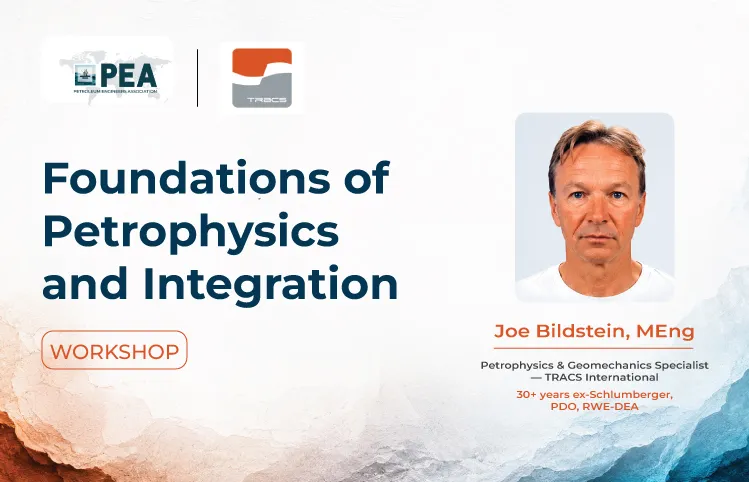
Foundations of Petrophysics and Integration
Premium Workshop
For PEA Members Only

Petrophysics sits at the center of every subsurface decision — but it only delivers value when it's properly integrated with geology, reservoir engineering, and drilling. This 4-hour live workshop takes you through the full petrophysics workflow: from how data is acquired downhole, to how logs and core are evaluated, to how petrophysical inputs feed into reservoir models. You'll learn how a petrophysicist actually works inside a subsurface team — what data to trust, how to handle uncertainty, and how to turn raw measurements into decisions that hold up. Whether you're a geoscientist, reservoir engineer, or early-career petrophysicist, you'll leave with a clear picture of how the discipline works end to end.
Workshop Objectives
By the end of this workshop, participants will be able to:
Understand the role of the petrophysicist within a petroleum engineering subsurface team
Explain the downhole data acquisition environment and its effect on measurement quality
Evaluate wireline, LWD, and advanced logging data with confidence
Use cased hole data for well & reservoir surveillance and management (WRSM)
Plan core data acquisition and apply core results in formation evaluation
Handle uncertainty systematically in petrophysical interpretation
Prepare petrophysical inputs for model building and upscaling
Apply facies and saturation-height modeling concepts in reservoir characterization
About the Presenter
Joe Bildstein, MEng, is Principal Petrophysicist Consultant at TRACS International with over 30 years of experience in petrophysics and geomechanics. He spent 17 years at Petroleum Development Oman (PDO) as Lead Petrophysicist and Graduate Coach, where he led formation evaluation for clastic and carbonate oil and gas fields, built pore pressure and fracture gradient models, served as SME for cement bond and corrosion logging, and coached PDO's graduate development program from 2016 to 2024. Before PDO, he was Senior Petrophysicist at RWE-DEA (Hamburg & London), working reservoirs across the North Sea, Libya, Egypt, and Germany, and spent nine years with Schlumberger across Venezuela, the USA, Saudi Arabia, Yemen, and Austria. He holds a Master of Petroleum Engineering from the Technical University of Clausthal, Germany, has published with SPE, SPWLA, and EAGE, and was named Best Speaker at the SPWLA regional conference in Muscat. He has trained subsurface staff up to master level throughout his career.







Premium Workshop
For PEA Members Only
Reservoir Engineering & Well Testing in Excel The Hands-On Bootcamp
This hands-on bootcamp is designed for petroleum engineers who want to move beyond theory and actually build reservoir engineering and well testing models from scratch — in Microsoft Excel. Over two intensive days, participants work through 10 real-world projects covering the full spectrum of reservoir characterisation and well performance analysis. No black boxes, no third-party software — every model is built cell by cell, so you understand exactly what's happening under the hood. Exclusively available to PEA Members.