


An Interactive 5-Day Training Course
Advanced Directional Drilling & BHA Design
BHA Design and Steering Control
Secure your spot now!
Duration
5 Days
Price
$ 3,500
Starting From
26 Apr 2027



Advanced Directional Drilling & BHA Design
Have Questions ?
Advanced Directional Drilling & BHA Design - DC-ADD-PEA27
| Code | Date | Time | Duration | Location | Currency | Early Bird Fee Per Person |
|---|---|---|---|---|---|---|
| DC-ADD-PEA27 | 26 - 30 Apr 2027 | 10 AM CST | 4 Hours / Day |
Online |
USD |
3500 |
Need this for a group? We deliver the same course in-house — face-to-face at your location or online — tailored to your assets and team level. Contact info@peassociations.com
Boost your team's skills and your budget! Enjoy group discounts for collaborative learning. Send an inquiry to info@peassociations.com.
Advanced Directional Drilling & BHA Design
This course covers advanced directional drilling and bottomhole assembly design. Participants study BHA mechanics and modelling, steering tool selection and performance, bit and BHA interaction, torque and drag analysis, vibration management, hole quality, complex trajectory design, performance drilling and the diagnosis of directional problems.
Description
Advanced directional work is about control and performance: holding a tight trajectory in difficult formations, maximising rate of penetration while steering, keeping torque and drag within limits on long wells and producing hole quality good enough to run casing and completions without trouble.
This course covers that ground. It starts with bottomhole assembly mechanics and the modelling used to predict build, drop and walk tendencies, then covers steering tool selection, comparing steerable motors and rotary steerable systems in performance, cost and application. It covers bit and bottomhole assembly interaction, bit selection for directional work and steerability, torque and drag analysis and the friction factors behind it, and vibration mechanisms and their mitigation. The course then covers hole quality, tortuosity and their measurement, complex trajectory design including three-dimensional profiles and designer wells, performance drilling practice for directional sections, and the diagnosis of directional problems from drilling and survey data.
Directional performance is the product of tool, bit, formation and parameters. A bottomhole assembly that builds reliably in one formation will drop in another; a bit that steers well may drill slowly; parameters that maximise rate of penetration may destroy tool face control. The engineering is in finding the combination that delivers both trajectory and performance.
Torque and drag is what eventually limits reach. Friction accumulates with hole angle, length and tortuosity, and when drag exceeds the string's ability to transfer weight, or torque exceeds the top drive, the well stops. Modelling torque and drag during planning, and tracking the real friction factors against the model while drilling, is what tells the team whether the well will reach its planned depth.
Hole quality is the output that matters downstream. Micro-doglegs, spiralling and ledges from poor steering create running problems, casing wear, fatigue and poor cement jobs, and they do not show up in the survey, which smooths everything between stations. Measuring and managing hole quality is therefore part of directional work rather than an afterthought.
By the end of this training, participants will be able to:
- Model bottomhole assembly behaviour and predict build, drop and walk tendencies.
- Design bottomhole assemblies for specified directional performance.
- Select steering tools and compare their performance and cost.
- Assess bit and bottomhole assembly interaction and select bits for directional work.
- Perform torque and drag analysis and calibrate friction factors.
- Predict and manage reach limits for long wells.
- Identify vibration mechanisms and apply mitigation.
- Assess hole quality and tortuosity and manage their causes.
- Design complex three-dimensional trajectories.
- Diagnose directional problems from drilling, survey and tool data.
The course is instructor-led and analysis-based, for engineers with directional experience. Participants design bottomhole assemblies, run torque and drag analyses and diagnose directional problems from real well data, including surveys, parameter logs and tool performance records. Field cases cover wells that lost trajectory control and wells that reached reach limits. Participants are encouraged to bring their own wells for discussion.
Organisations sending participants to this training will:
- Improve directional control and reduce correction runs.
- Extend reach on long and extended reach wells.
- Improve rate of penetration while maintaining trajectory.
- Improve hole quality and reduce downstream running problems.
- Diagnose and resolve directional performance problems faster.
Participants will:
- Be able to design bottomhole assemblies for directional objectives.
- Be able to run and interpret torque and drag analysis.
- Understand vibration and its effect on directional tools.
- Be able to assess and improve hole quality.
- Be able to diagnose directional problems from field data.
- Drilling engineers with directional experience
- Directional drilling specialists and coordinators
- Rig site supervisors
- Service company directional engineers
- Well planners working on complex wells
- Drilling performance engineers
Module 1: BHA Mechanics
- Beam bending and side force at the bit
- Stabiliser placement effects
- Build, drop and walk tendency prediction
- BHA modelling methods and their accuracy
- Formation anisotropy effects
Module 2: BHA Design
- Designing for build, hold and drop sections
- Stiffness and gauge considerations
- Near bit stabilisation
- BHA design for horizontal sections
- Contingency and backup assemblies
Module 3: Steering Tool Selection
- Steerable motor performance
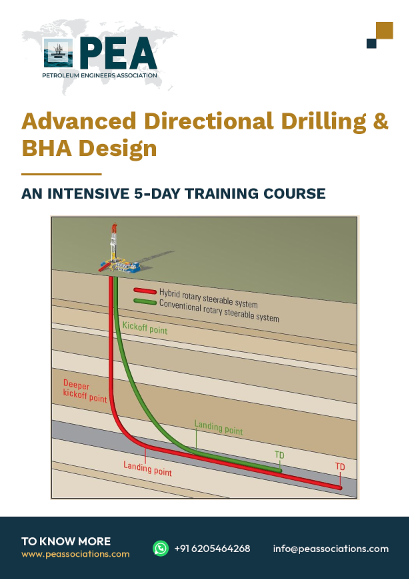
- Rotary steerable systems: push, point and hybrid
- Comparative performance and cost
- Reliability and failure rates
- Tool selection by section and formation
Module 4: Bits for Directional Drilling
- Bit design features affecting steerability
- Side cutting and gauge length
- Bit selection for motors and rotary steerable systems
- Depth of cut control
- Bit and BHA interaction
Module 5: Torque and Drag Analysis
- Soft string and stiff string models
- Friction factor calibration from field data
- Tripping, rotating and sliding analysis
- Weight transfer and buckling limits
- Interpreting trends during drilling
Module 6: Reach and Limits
- Reach limitation mechanisms
- Extended reach considerations
- Casing running and completion limits
- Hydraulics limits in long wells
- Design iteration to extend reach
Module 7: Vibration Management
- Stick-slip, whirl and axial vibration
- Effect on directional tools and bits
- Measurement and detection
- Parameter and BHA based mitigation
- Downhole vibration tools
Module 8: Hole Quality and Tortuosity
- Micro-doglegs and spiralling
- Measuring hole quality
- Causes of poor hole quality
- Consequences for casing, cement and completions
- Practices that improve hole quality
Module 9: Complex Trajectories and Troubleshooting
- Three-dimensional and designer well profiles
- Multiple target wells
- Diagnosing loss of directional control
- Tool failure diagnosis
- Correction planning and cost
- Post-well directional performance review
Upon successful completion of this training course, delegates will be awarded an official Certificate of Completion issued by the Petroleum Engineers Association (PEA), an ISO 9001:2015 certified training organization. The certificate carries 10 Credits and formally records the total learning hours completed.
Each certificate is signed by the Course Facilitator and the CEO of the Petroleum Engineers Association, and serves as verifiable proof of professional training that delegates can present to employers and professional bodies worldwide.
Frequently Asked Questions
All course bookings made through PEA are strictly non-refundable. By registering for a course, you acknowledge and accept that all fees are payable in full and are not subject to refund under any circumstances, including changes in personal or professional commitments or partial attendance.
PEA reserves the right to make reasonable adjustments to course content, trainers, or schedules where necessary, without entitling delegates to a refund. Comprehensive details of each course — including objectives, target audience, and content — are clearly outlined before enrolment, and it is the responsibility of the delegate to ensure the course's suitability prior to booking.
For any inquiries related to cancellations or bookings, please contact our support team, who will be happy to assist you.
