


An Interactive 5-Day Training Course
Remedial & Squeeze Cementing
Fixing Cement After the Job
Secure your spot now!
Duration
5 Days
Price
$ 3,500
Starting From
12 Apr 2027



Remedial & Squeeze Cementing
Have Questions ?
Remedial & Squeeze Cementing - DC-RSC-PEA27
| Code | Date | Time | Duration | Location | Currency | Early Bird Fee Per Person |
|---|---|---|---|---|---|---|
| DC-RSC-PEA27 | 12 - 16 Apr 2027 | 10 AM CST | 4 Hours / Day |
Online |
USD |
3500 |
Need this for a group? We deliver the same course in-house — face-to-face at your location or online — tailored to your assets and team level. Contact info@peassociations.com
Boost your team's skills and your budget! Enjoy group discounts for collaborative learning. Send an inquiry to info@peassociations.com.
Remedial & Squeeze Cementing
This course covers remedial and squeeze cementing. Participants study the diagnosis of isolation problems, squeeze objectives and mechanics, high pressure and low pressure squeezes, hesitation and running squeezes, slurry design for squeezes, tools and placement methods, perforating and injectivity testing, execution and evaluation, plus alternative remedial methods.
Description
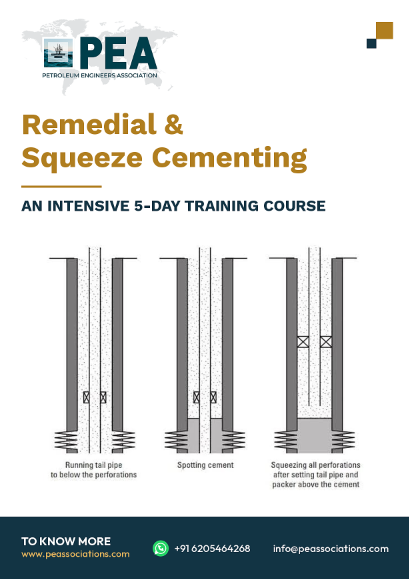
When primary cement fails to isolate, the options are to live with it, to squeeze cement into the problem area or to use an alternative sealing method. Squeeze cementing is the standard remedy and the one most often performed badly, because success depends on understanding where the cement needs to go and how it will get there, not simply on pumping cement against pressure.
This course covers diagnosis, design and execution. It starts with identifying and locating isolation failures using logs, pressure tests and production evidence, then covers squeeze mechanics: filter cake build-up against permeable formations, dehydration, and the difference between squeezing into perforations, channels and voids. It covers high pressure and low pressure squeeze techniques, hesitation and running squeeze procedures, slurry design for squeeze work, tools including packers, retainers and bridge plugs, and placement methods such as bradenhead and tool-supported squeezes. The course then covers perforating and injectivity testing before the job, execution and pressure interpretation, post-job evaluation, and alternative remedial methods including resins, sealants and mechanical options.
A squeeze succeeds when cement dehydrates against a permeable face and builds a filter cake that seals. That requires a path to the problem area, an injection point, and filtration into the formation or the channel. Squeezing against an impermeable zone just pressures up the wellbore and achieves nothing, which is why injectivity testing before the job matters so much.
Pressure response during the job tells the engineer what is happening. A gradual pressure climb with declining rate shows cake building and dehydration; a sudden pressure rise shows blockage at the perforations; no pressure rise at all shows the cement going somewhere unintended. Reading that response and deciding whether to continue, hesitate or stop is the core operational skill.
Many squeezes fail because the diagnosis was wrong. Sustained casing pressure from a tubing leak will not be cured by squeezing the casing shoe; communication behind a liner may not be reachable through the perforations chosen; a micro-annulus seen on a bond log may not be a flow path at all. Diagnosis before design is where this course starts.
By the end of this training, participants will be able to:
- Diagnose isolation failures and locate the flow path.
- Interpret logs, pressure tests and production evidence for remedial planning.
- Explain squeeze mechanics, dehydration and filter cake build-up.
- Design high pressure and low pressure squeeze treatments.
- Select hesitation, running or walking squeeze procedures.
- Design slurries for squeeze applications.
- Select tools and placement methods, including retainers, packers and bradenhead squeezes.
- Plan perforating and injectivity testing before the job.
- Execute and interpret squeeze operations from pressure response.
- Evaluate results and select alternative remedial methods where squeezing is unsuitable.
The course is instructor-led and case-based. Participants diagnose isolation problems from logs, pressure data and well histories, design squeeze treatments and interpret execution pressure records. Both successful and failed squeezes are examined, with the reasons. Participants are encouraged to bring their own remedial problems for discussion.
Organisations sending participants to this training will:
- Diagnose isolation problems correctly before spending on remedial work.
- Improve squeeze success rates and reduce repeat jobs.
- Reduce rig time spent on unsuccessful remedial cementing.
- Resolve sustained casing pressure and integrity anomalies.
- Support abandonment requirements with effective isolation repairs.
Participants will:
- Be able to diagnose where and why isolation has failed.
- Understand squeeze mechanics and design.
- Be able to select tools, slurries and placement methods.
- Be able to interpret squeeze pressure response in real time.
- Know when alternative methods are a better choice.
- Drilling and well engineers
- Well intervention and workover engineers
- Well integrity engineers
- Completion engineers
- Cementing service company engineers
- Rig site supervisors
Module 1: Diagnosing Isolation Failures
- Symptoms: annulus pressure, communication and production evidence
- Cement evaluation log interpretation for remedial planning
- Pressure and temperature survey evidence
- Locating the flow path
- Problems squeezing cannot fix
Module 2: Squeeze Mechanics
- Dehydration and filter cake formation
- Squeezing into perforations, channels and voids
- Formation permeability requirements
- Fracture squeeze versus matrix squeeze
- Final squeeze pressure and its meaning
Module 3: Squeeze Techniques
- High pressure squeeze
- Low pressure squeeze
- Hesitation squeeze
- Running and walking squeeze
- Selecting the technique for the problem
Module 4: Slurry Design for Squeezes
- Slurry properties for squeeze work
- Fluid loss control requirements
- Thickening time and safety margin
- Particle size and penetration
- Contingency and clean-up planning
Module 5: Tools and Placement
- Cement retainers and packers
- Bridge plugs and isolation
- Bradenhead squeeze
- Coiled tubing placement
- Tool selection and setting depth
Module 6: Preparation and Injectivity Testing
- Perforating for remedial work
- Wellbore clean-out and preparation
- Injectivity testing and interpretation
- Breakdown and acid pre-treatments
- Deciding whether to proceed
Module 7: Execution
- Job procedure and sequence
- Pressure response interpretation during the job
- Hesitation cycles and decision points
- Reversing out and clean-up
- Waiting on cement and testing
Module 8: Evaluation
- Pressure testing after the squeeze
- Logging evaluation
- Production or annulus pressure response
- Deciding whether to repeat
- Documentation and records
Module 9: Alternative Remedial Methods
- Resin and sealant systems
- Microfine cements
- Mechanical options: patches, liners and plugs
- Through-tubing remedial options
- Selecting between methods on cost and probability of success
Upon successful completion of this training course, delegates will be awarded an official Certificate of Completion issued by the Petroleum Engineers Association (PEA), an ISO 9001:2015 certified training organization. The certificate carries 10 Credits and formally records the total learning hours completed.
Each certificate is signed by the Course Facilitator and the CEO of the Petroleum Engineers Association, and serves as verifiable proof of professional training that delegates can present to employers and professional bodies worldwide.
Frequently Asked Questions
All course bookings made through PEA are strictly non-refundable. By registering for a course, you acknowledge and accept that all fees are payable in full and are not subject to refund under any circumstances, including changes in personal or professional commitments or partial attendance.
PEA reserves the right to make reasonable adjustments to course content, trainers, or schedules where necessary, without entitling delegates to a refund. Comprehensive details of each course — including objectives, target audience, and content — are clearly outlined before enrolment, and it is the responsibility of the delegate to ensure the course's suitability prior to booking.
For any inquiries related to cancellations or bookings, please contact our support team, who will be happy to assist you.
