


An Interactive 5-Day Training Course
Solids Control & Drilling Waste Management
Removing Solids, Managing Waste
Secure your spot now!
Duration
5 Days
Price
$ 3,000
Starting From
22 Mar 2027



Solids Control & Drilling Waste Management
Have Questions ?
Solids Control & Drilling Waste Management - DC-SCW-PEA27
| Code | Date | Time | Duration | Location | Currency | Early Bird Fee Per Person |
|---|---|---|---|---|---|---|
| DC-SCW-PEA27 | 22 - 26 Mar 2027 | 10 AM CST | 4 Hours / Day |
Online |
USD |
3000 |
Need this for a group? We deliver the same course in-house — face-to-face at your location or online — tailored to your assets and team level. Contact info@peassociations.com
Boost your team's skills and your budget! Enjoy group discounts for collaborative learning. Send an inquiry to info@peassociations.com.
Solids Control & Drilling Waste Management
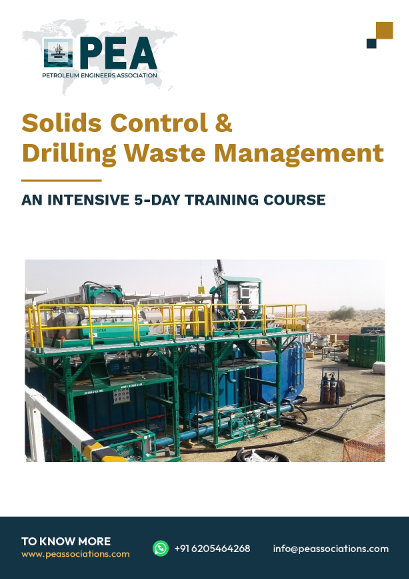
This course covers solids control equipment and drilling waste management. Participants study solids types and their effects, shale shakers and screen selection, hydrocyclones, centrifuges, degassers, equipment arrangement and performance evaluation, dilution economics, waste streams, treatment technologies, disposal routes and regulatory requirements.
Description
Drilled solids degrade every property of a drilling fluid. They raise plastic viscosity and equivalent circulating density, reduce rate of penetration, increase wear on pumps and bits, thicken filter cake and increase the risk of differential sticking. Solids control equipment removes them mechanically; dilution removes them expensively. The balance between the two determines both fluid cost and drilling performance.
This course covers both the equipment and the waste. It starts with solids types, sizes and their effects, then covers each stage of the equipment train: shale shakers and screen selection, desanders and desilters, mud cleaners, centrifuges and degassers, with performance evaluation and configuration for each. It covers equipment arrangement, flow routing and common operating errors, and the economics of removal versus dilution. The second half covers drilling waste streams, cuttings handling and transfer, treatment technologies including thermal and mechanical methods, disposal routes, discharge regulations and waste tracking and reporting.
The first principle of solids control is that a solid removed once is cheaper than a solid ground finer and removed later. Every pass through the bit and the pumps breaks cuttings into smaller particles, and once they are below the removal range of the equipment the only way out is dilution. That is why shaker screens are the most important piece of the train, and why running the finest screen that will handle the flow matters so much.
Equipment is often undersized, poorly arranged or bypassed. Shakers blinded by fine solids, hydrocyclones fed from the wrong compartment, centrifuges run on the wrong feed rate and tanks that allow fluid to bypass the train entirely are all common. Performance evaluation, by measuring what solids come out and what stays in the system, is what identifies these.
Waste is the other half of the problem and is increasingly the more expensive one. Cuttings volumes, oil on cuttings limits, transport, treatment and disposal costs now shape fluid selection and solids control design. Regulations differ by jurisdiction and offshore discharge is tightly controlled, so planning waste handling belongs in the well plan rather than in the clean-up afterwards.
By the end of this training, participants will be able to:
- Identify drilled solids types and sizes and explain their effects on fluid and performance.
- Select shale shaker screens and configure shakers for the flow and fluid.
- Configure and operate desanders, desilters and mud cleaners.
- Operate centrifuges for barite recovery and fine solids removal.
- Arrange solids control equipment and flow routing correctly.
- Evaluate solids control efficiency and diagnose underperformance.
- Compare removal and dilution economics.
- Identify drilling waste streams and their handling requirements.
- Select cuttings treatment and disposal technologies.
- Apply discharge regulations, waste tracking and reporting requirements.
The course is instructor-led. Equipment is covered with drawings, specifications and performance data, and participants evaluate solids control efficiency from real mud and solids data. Waste handling is covered with treatment technology comparisons, cost data and regulatory frameworks. Participants are encouraged to bring their own equipment arrangements and waste problems for discussion.
Organisations sending participants to this training will:
- Reduce drilled solids in the fluid and improve drilling performance.
- Reduce dilution volumes, fluid cost and waste generation.
- Improve solids control equipment configuration and operation.
- Meet discharge and waste regulations reliably.
- Reduce the cost of cuttings treatment and disposal.
Participants will:
- Understand how each piece of solids control equipment works.
- Be able to select screens and configure the equipment train.
- Be able to evaluate solids control efficiency.
- Understand removal versus dilution economics.
- Understand waste treatment and disposal options and requirements.
- Drilling fluids and mud engineers
- Drilling engineers
- Rig site supervisors
- Solids control and waste management service staff
- HSE and environmental staff supporting drilling
- Rig crew responsible for solids control equipment
Module 1: Drilled Solids
- Solids types, sizes and specific gravity
- Low gravity and high gravity solids
- Effects on rheology, filtration and performance
- Degradation of solids during circulation
- Target solids levels
Module 2: Shale Shakers
- Shaker types and motion
- Screen mesh, cut points and conductance
- Screen selection and blinding
- Flow distribution and loading
- Shaker operation and common errors
Module 3: Hydrocyclones
- Desanders and desilters
- Cut point and operating pressure
- Feed and discharge arrangement
- Underflow assessment
- Common operating faults
Module 4: Mud Cleaners and Centrifuges
- Mud cleaner function and application
- Centrifuge operation and settings
- Barite recovery
- Fine solids removal and dewatering
- Feed rate and chemical addition
Module 5: Degassers and Gas Handling
- Vacuum and atmospheric degassers
- Mud gas separators
- Gas cut mud handling
- Safety considerations
Module 6: Equipment Arrangement and Operation
- Tank arrangement and flow routing
- Sequence of removal stages
- Bypass risks and compartment design
- Equipment sizing for flow rate
- Maintenance and screen inventory
Module 7: Performance Evaluation and Economics
- Measuring solids removal efficiency
- Solids balance calculations
- Dilution volume and cost
- Removal versus dilution comparison
- Setting performance targets
Module 8: Drilling Waste Streams
- Cuttings volumes and characteristics
- Waste fluid streams
- Oil on cuttings
- Water-based and oil-based waste differences
- Waste minimisation at source
Module 9: Treatment, Disposal and Compliance
- Cuttings handling and transfer systems
- Thermal desorption and mechanical treatment
- Bioremediation and land treatment
- Cuttings re-injection overview
- Discharge limits and offshore regulations
- Waste tracking, documentation and reporting
Upon successful completion of this training course, delegates will be awarded an official Certificate of Completion issued by the Petroleum Engineers Association (PEA), an ISO 9001:2015 certified training organization. The certificate carries 10 Credits and formally records the total learning hours completed.
Each certificate is signed by the Course Facilitator and the CEO of the Petroleum Engineers Association, and serves as verifiable proof of professional training that delegates can present to employers and professional bodies worldwide.
Frequently Asked Questions
All course bookings made through PEA are strictly non-refundable. By registering for a course, you acknowledge and accept that all fees are payable in full and are not subject to refund under any circumstances, including changes in personal or professional commitments or partial attendance.
PEA reserves the right to make reasonable adjustments to course content, trainers, or schedules where necessary, without entitling delegates to a refund. Comprehensive details of each course — including objectives, target audience, and content — are clearly outlined before enrolment, and it is the responsibility of the delegate to ensure the course's suitability prior to booking.
For any inquiries related to cancellations or bookings, please contact our support team, who will be happy to assist you.
