


An Interactive 5-Day Training Course
Horizontal & Extended Reach Drilling (ERD)
Drilling Long Horizontal Wells
Secure your spot now!
Duration
5 Days
Price
$ 3,500
Starting From
03 May 2027



Horizontal & Extended Reach Drilling (ERD)
Have Questions ?
Horizontal & Extended Reach Drilling (ERD) - DC-ERD-PEA27
| Code | Date | Time | Duration | Location | Currency | Early Bird Fee Per Person |
|---|---|---|---|---|---|---|
| DC-ERD-PEA27 | 03 - 07 May 2027 | 10 AM CST | 4 Hours / Day |
Online |
USD |
3500 |
Need this for a group? We deliver the same course in-house — face-to-face at your location or online — tailored to your assets and team level. Contact info@peassociations.com
Boost your team's skills and your budget! Enjoy group discounts for collaborative learning. Send an inquiry to info@peassociations.com.
Horizontal & Extended Reach Drilling (ERD)
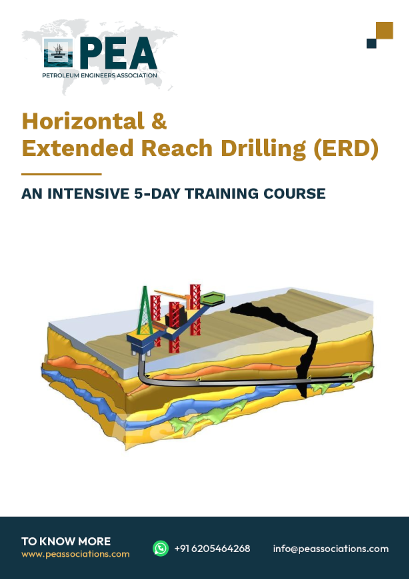
This course covers horizontal and extended reach drilling. Participants study ERD feasibility and planning, trajectory design, torque and drag management, hole cleaning in high angle wells, drilling fluids and hydraulics, casing and completion running, friction reduction, equipment requirements, operational practice and the limits of reach.
Description
Extended reach wells place targets kilometres from the surface location and horizontal wells expose long sections of reservoir. Both push drilling to its mechanical limits: torque and drag rise, hole cleaning becomes difficult, weight transfer to the bit becomes marginal and running casing and completions becomes the critical operation rather than a routine one.
This course covers the discipline end to end. It starts with ERD feasibility assessment and the limits that govern it, then covers trajectory design for extended reach, including profile selection and tortuosity control. It covers torque and drag modelling and management, hole cleaning in high angle sections, drilling fluid and hydraulics design for long wells, and friction reduction through lubricants, mechanical devices and rotation practice. The course then covers casing and completion running in long horizontal sections, including flotation and lubrication techniques, rig and equipment requirements, operational practice at the rig, and the diagnosis of the problems that stop extended reach wells short of their targets.
Reach is limited by friction. As angle and length increase, the string lies on the low side and drag consumes the weight that should reach the bit. At some point the string buckles rather than transmits weight, and the well stops advancing regardless of how much hook load is available. Every ERD decision, from trajectory smoothness to lubricant selection to rotation practice, exists to delay that point.
Hole cleaning is the other hard constraint. Above about fifty degrees cuttings settle into beds on the low side that will not move without rotation and adequate flow, and a bed that forms will cause pack-offs, high torque and stuck pipe. Flow rate, rheology, rotation and pipe movement all matter, and the practice of wiper trips and sweeps has to be planned rather than improvised.
The final operation is usually the hardest. Running casing or a completion into a long horizontal section means pushing pipe with no weight available and high friction, and many ERD wells that drill successfully have trouble at this stage. Flotation, lubricants, rotation while running and careful hole conditioning are what make it work.
By the end of this training, participants will be able to:
- Assess extended reach feasibility and identify the limiting constraints.
- Design trajectories for horizontal and extended reach wells.
- Model torque and drag and manage it through design and practice.
- Design hole cleaning for high angle and horizontal sections.
- Design drilling fluids and hydraulics for long wells.
- Apply friction reduction methods, including lubricants and mechanical devices.
- Plan casing and completion running in long horizontal sections.
- Apply flotation and lubrication techniques for running strings.
- Specify rig and equipment requirements for extended reach wells.
- Diagnose and respond to the problems that limit reach.
The course is instructor-led. Participants assess feasibility and design an extended reach well, running torque and drag analysis and hole cleaning calculations, then plan the casing running operation. Field cases include record extended reach wells and wells that fell short of target, with the reasons. Participants are encouraged to bring their own wells for discussion.
Organisations sending participants to this training will:
- Extend drilling reach and access targets from existing locations.
- Reduce stuck pipe and hole cleaning problems in high angle wells.
- Improve casing and completion running success in long sections.
- Improve ERD feasibility assessment before committing to a well plan.
- Reduce non-productive time in horizontal and extended reach drilling.
Participants will:
- Understand what limits reach and how to extend it.
- Be able to design trajectories and analyse torque and drag for ERD.
- Be able to design hole cleaning and hydraulics for high angle wells.
- Be able to plan casing and completion running in long sections.
- Be able to diagnose problems in extended reach operations.
- Drilling engineers
- Well planners and directional specialists
- Rig site supervisors
- Completion engineers running strings in horizontal wells
- Drilling fluids engineers supporting ERD
- Operations and performance engineers
Module 1: Extended Reach Concepts
- Definitions and reach ratios
- Applications and value of ERD
- Limits: torque, drag, hydraulics and hole cleaning
- Feasibility assessment process
Module 2: Trajectory Design for ERD
- Profile selection
- Build rate and tangent angle choices
- Tortuosity control and its importance
- Target accuracy requirements
- Design iteration against torque and drag
Module 3: Torque and Drag Management
- Modelling for ERD wells
- Friction factor expectations by fluid type
- Weight transfer and buckling limits
- Rotating versus sliding strategy
- Monitoring and calibrating during drilling
Module 4: Hole Cleaning in High Angle Wells
- Cuttings bed formation and removal
- Flow rate, rotation and rheology requirements
- Wiper trips and sweeps
- Indicators of poor hole cleaning
- Managing cuttings loading on shakers
Module 5: Fluids and Hydraulics for Long Wells
- Fluid selection for ERD
- Rheology targets for hole cleaning and friction
- Pressure losses and pump limits
- Equivalent circulating density management
- Lubricity and fluid-related friction
Module 6: Friction Reduction
- Lubricants and their effectiveness
- Mechanical friction reduction devices
- Non-rotating protectors
- Rotation practice
- Effect of hole quality on friction
Module 7: Running Casing and Completions
- Running loads and buckling
- Flotation techniques
- Lubricants and centraliser selection
- Rotating and reciprocating while running
- Contingency if the string stops short
Module 8: Rig and Equipment Requirements
- Top drive torque and hook load requirements
- Pump capacity
- Solids control capacity
- Pipe handling and tubular inspection
- Rig selection for ERD
Module 9: Operations and Troubleshooting
- Operational practice in ERD wells
- Drilling parameters and connection practice
- Stuck pipe risk and prevention
- Diagnosing loss of weight transfer
- Wells that fell short of target and why
Upon successful completion of this training course, delegates will be awarded an official Certificate of Completion issued by the Petroleum Engineers Association (PEA), an ISO 9001:2015 certified training organization. The certificate carries 10 Credits and formally records the total learning hours completed.
Each certificate is signed by the Course Facilitator and the CEO of the Petroleum Engineers Association, and serves as verifiable proof of professional training that delegates can present to employers and professional bodies worldwide.
Frequently Asked Questions
All course bookings made through PEA are strictly non-refundable. By registering for a course, you acknowledge and accept that all fees are payable in full and are not subject to refund under any circumstances, including changes in personal or professional commitments or partial attendance.
PEA reserves the right to make reasonable adjustments to course content, trainers, or schedules where necessary, without entitling delegates to a refund. Comprehensive details of each course — including objectives, target audience, and content — are clearly outlined before enrolment, and it is the responsibility of the delegate to ensure the course's suitability prior to booking.
For any inquiries related to cancellations or bookings, please contact our support team, who will be happy to assist you.
