


An Interactive 5-Day Training Course
Drillstring & Drill Pipe Failure Analysis
Why Drillstrings Fail
Secure your spot now!
Duration
5 Days
Price
$ 3,500
Starting From
01 Feb 2027



Drillstring & Drill Pipe Failure Analysis
Have Questions ?
Drillstring & Drill Pipe Failure Analysis - DC-DSF-PEA27
| Code | Date | Time | Duration | Location | Currency | Early Bird Fee Per Person |
|---|---|---|---|---|---|---|
| DC-DSF-PEA27 | 01 - 05 Feb 2027 | 10 AM CST | 4 Hours / Day |
Online |
USD |
3500 |
Need this for a group? We deliver the same course in-house — face-to-face at your location or online — tailored to your assets and team level. Contact info@peassociations.com
Boost your team's skills and your budget! Enjoy group discounts for collaborative learning. Send an inquiry to info@peassociations.com.
Drillstring & Drill Pipe Failure Analysis
This course covers the analysis and prevention of drillstring failures. Participants study failure mechanisms including fatigue, corrosion, overload and wear, drillstring loading and vibration, evidence collection and fracture surface interpretation, metallurgical and laboratory analysis, failure investigation method, prevention through design and practice, and failure data management.
Description
A drillstring failure costs rig time, fishing operations and sometimes the hole. Most failures are not sudden or mysterious: they are fatigue cracks that grew over many hours of rotation, washouts that started at corrosion pits or slip marks, or overloads that occurred because the string was pulled beyond its rating. Each leaves evidence that identifies what happened.
This course teaches how to read that evidence and how to prevent recurrence. It starts with drillstring loading, including tension, torsion, bending and dynamic loads, and the vibration mechanisms that drive fatigue. It then covers the failure mechanisms in detail: fatigue, corrosion fatigue, overload, wear, galling and hydrogen embrittlement in sour environments. The investigation sections cover evidence collection and preservation, fracture surface interpretation, dimensional and metallurgical examination, and laboratory methods. The course then covers investigation method, linking failures to operating conditions through drilling data, and prevention through drillstring design, dogleg management, inspection, handling and operating practice.
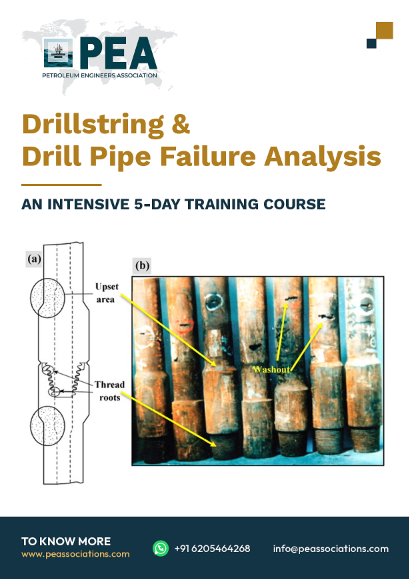
A fatigue fracture surface tells most of the story. Beach marks show the crack grew over time; the initiation point shows where it started, which is usually a corrosion pit, a slip mark, a hardbanding edge or an internal defect; and the size of the final fast fracture zone shows how highly loaded the pipe was when it finally parted. A twisted-off connection with a clean shear surface tells a different story entirely.
Linking the failure to conditions requires drilling data. Where in the hole was the failure point when the string was rotating? What dogleg severity did it pass through, how many hours did it rotate there, what torque and vibration levels were recorded? These questions turn a metallurgical finding into an operational cause that can be acted on.
Prevention is mostly design and practice: limiting dogleg severity, placing the string so that highly stressed components are not in the worst locations, managing vibration, inspecting to the right category at the right interval, controlling internal corrosion and handling pipe properly. This course covers investigation and prevention as one subject.
By the end of this training, participants will be able to:
- Analyse drillstring loading, including tension, torsion, bending and dynamic loads.
- Explain vibration mechanisms and their role in fatigue.
- Identify failure mechanisms including fatigue, corrosion fatigue, overload and wear.
- Collect and preserve evidence from a drillstring failure.
- Interpret fracture surfaces and identify initiation points.
- Specify dimensional, metallurgical and laboratory examination.
- Link failures to operating conditions using drilling data.
- Conduct a structured failure investigation and reach a defensible cause.
- Apply prevention measures through design, inspection and practice.
- Manage failure data and track reliability improvement.
The course is instructor-led and evidence-based. Participants work through real failure cases with photographs of fracture surfaces, inspection reports, drilling data and laboratory results, reaching a cause and a prevention plan for each. Metallurgy is explained at the level an engineer needs to interpret a report rather than write one. Participants are encouraged to bring their own failures for discussion.
Organisations sending participants to this training will:
- Identify the real causes of drillstring failures rather than the apparent ones.
- Reduce failure frequency through targeted prevention.
- Improve inspection category and interval decisions using failure evidence.
- Reduce fishing operations and lost hole.
- Build a failure database that drives reliability improvement.
Participants will:
- Understand how and why drillstrings fail.
- Be able to read a fracture surface and identify the mechanism.
- Be able to run a structured drillstring failure investigation.
- Be able to link failures to drilling conditions.
- Be able to specify prevention measures that work.
- Drilling engineers
- Rig site supervisors
- Tubular inspection and service company personnel
- Materials and integrity engineers
- Drilling contractors' technical staff
- Operations staff dealing with repeat failures
Module 1: Drillstring Loading
- Tension, torsion and bending
- Buckling and compression
- Dynamic loads
- Load distribution along the string
- Critical locations in the string
Module 2: Vibration and Its Effects
- Axial, torsional and lateral vibration
- Stick-slip and whirl
- Resonance and bottomhole assembly behaviour
- Vibration measurement
- Link between vibration and fatigue
Module 3: Failure Mechanisms
- Fatigue and corrosion fatigue
- Overload and ductile failure
- Wear and erosion
- Galling and thread damage
- Sulphide stress cracking and hydrogen embrittlement
- Manufacturing and material defects
Module 4: Evidence Collection
- Securing failed components
- Documenting the failure location and conditions
- Avoiding damage to fracture surfaces
- Collecting drilling data and records
- Chain of custody
Module 5: Fracture Surface Interpretation
- Beach marks and crack propagation
- Initiation sites and their causes
- Fast fracture zones
- Torsional and tensile failure appearance
- Washout development and appearance
Module 6: Laboratory Examination
- Dimensional and hardness checks
- Chemical composition verification
- Metallography and microstructure
- Fractography
- Interpreting a laboratory report
Module 7: Linking Failure to Operations
- Drilling data review
- Dogleg severity and rotating hours
- Torque, weight and vibration records
- Inspection and handling history
- Reconstructing the failure sequence
Module 8: Investigation Method
- Investigation structure and team
- Hypothesis development and testing
- Distinguishing cause from contributing factors
- Reporting findings
- Common investigation errors
Module 9: Prevention and Reliability Management
- Drillstring design to limit fatigue
- Dogleg severity management
- Vibration mitigation practice
- Inspection category and interval selection
- Internal corrosion control
- Handling and make-up practice
- Failure databases and reliability tracking
Upon successful completion of this training course, delegates will be awarded an official Certificate of Completion issued by the Petroleum Engineers Association (PEA), an ISO 9001:2015 certified training organization. The certificate carries 10 Credits and formally records the total learning hours completed.
Each certificate is signed by the Course Facilitator and the CEO of the Petroleum Engineers Association, and serves as verifiable proof of professional training that delegates can present to employers and professional bodies worldwide.
Frequently Asked Questions
All course bookings made through PEA are strictly non-refundable. By registering for a course, you acknowledge and accept that all fees are payable in full and are not subject to refund under any circumstances, including changes in personal or professional commitments or partial attendance.
PEA reserves the right to make reasonable adjustments to course content, trainers, or schedules where necessary, without entitling delegates to a refund. Comprehensive details of each course — including objectives, target audience, and content — are clearly outlined before enrolment, and it is the responsibility of the delegate to ensure the course's suitability prior to booking.
For any inquiries related to cancellations or bookings, please contact our support team, who will be happy to assist you.
