


An Interactive 5-Day Training Course
Liner Hangers & Liner Cementing
Running and Cementing Liners
Secure your spot now!
Duration
5 Days
Price
$ 3,500
Starting From
19 Apr 2027



Liner Hangers & Liner Cementing
Have Questions ?
Liner Hangers & Liner Cementing - DC-LNR-PEA27
| Code | Date | Time | Duration | Location | Currency | Early Bird Fee Per Person |
|---|---|---|---|---|---|---|
| DC-LNR-PEA27 | 19 - 23 Apr 2027 | 10 AM CST | 4 Hours / Day |
Online |
USD |
3500 |
Need this for a group? We deliver the same course in-house — face-to-face at your location or online — tailored to your assets and team level. Contact info@peassociations.com
Boost your team's skills and your budget! Enjoy group discounts for collaborative learning. Send an inquiry to info@peassociations.com.
Liner Hangers & Liner Cementing
This course covers liner systems and liner cementing. Participants study liner applications and design, hanger types and setting mechanisms, running tools and procedures, liner top packers, cementing design for liners, displacement and plug systems, liner top isolation and testing, tie-backs, common problems and failure modes.
Description
Liners are run instead of full casing strings to save cost, reduce load on the wellhead and allow smaller hole sizes to be reached. They are hung off inside the previous string rather than at surface, which creates a liner lap that must be sealed and tested, and they are cemented in a narrow annulus with limited clearance and high displacement risk.
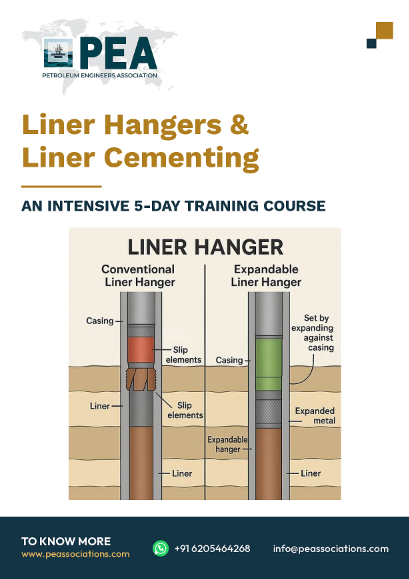
This course covers the whole operation. It starts with liner applications, design considerations, and the selection of liner size, length and overlap, then covers hanger types, including mechanical, hydraulic, expandable and rotating hangers, and their setting mechanisms. It covers running tools, setting procedures and the sequence of operations at the rig, liner top packers and polished bore receptacles. The cementing sections cover slurry design for liners, narrow annulus displacement, rotation and reciprocation while cementing, plug and displacement systems, and liner top cement management. The course closes with liner top isolation, testing, tie-back strings, and the problems and failure modes that occur in liner operations.
The liner lap is the critical point. Cement must reach the top of the liner and seal the overlap, or the liner top packer must do it, and the result must be pressure tested. A liner top that leaks is a direct path from the open hole into the previous casing annulus, and remediating it later is awkward and expensive.
Cementing a liner is harder than cementing casing. The annulus is narrow, the clearance between liner and hole is small, equivalent circulating density is higher, and the string is suspended inside the previous casing rather than landed at surface. Losses during the job are common, rotation while cementing is often the difference between success and failure, and the volumes involved leave little margin for error.
Running problems are the other risk. A liner that will not reach bottom, a hanger that sets prematurely, a running tool that will not release, or a liner that becomes stuck part way, each turns a routine operation into a fishing job inside a string that must then be repaired or sidetracked. This course covers the design and the operational practice that prevent them.
By the end of this training, participants will be able to:
- Explain liner applications and the reasons for running liners.
- Design liner size, length, overlap and setting depth.
- Select liner hanger types and setting mechanisms for the application.
- Specify running tools and plan setting and release procedures.
- Select liner top packers and polished bore receptacles.
- Design cement slurries and volumes for liner cementing.
- Design displacement for narrow annuli, including rotation and reciprocation.
- Specify plug and displacement systems for liners.
- Plan liner top isolation, clean-out and pressure testing.
- Plan tie-back strings and diagnose common liner problems and failures.
The course is instructor-led. Liner systems are covered with cutaway drawings, tool specifications and running procedures, and participants plan complete liner running and cementing operations for given wells. Field cases include liner top failures, stuck liners and running tool problems, with their causes. Participants are encouraged to bring their own liner operations for discussion.
Organisations sending participants to this training will:
- Improve liner running and cementing success rates.
- Reduce liner top leaks and the remedial work they cause.
- Reduce stuck liner and running tool incidents.
- Improve technical oversight of liner service providers.
- Support well integrity with properly sealed and tested liner laps.
Participants will:
- Understand liner systems and hanger mechanisms.
- Be able to design a liner and its cement job.
- Be able to plan and supervise liner running operations.
- Be able to plan liner top isolation and testing.
- Be able to diagnose and respond to liner problems.
- Drilling and well engineers
- Completion engineers
- Rig site supervisors and company representatives
- Liner and cementing service company staff
- Well integrity engineers
- Graduate engineers in well engineering
Module 1: Liner Applications and Design
- Why liners are used
- Drilling, production and tie-back liners
- Size, length and overlap selection
- Setting depth and hanger placement
- Design loads on liners
Module 2: Liner Hangers
- Mechanical and hydraulic set hangers
- Expandable hangers
- Rotating and non-rotating hangers
- Slip design and load capacity
- Hanger selection criteria
Module 3: Running Tools and Procedures
- Running tool types and release mechanisms
- Make-up and handling
- Running procedures and precautions
- Setting the hanger
- Releasing and confirming release
Module 4: Liner Top Packers and Receptacles
- Liner top packer types and setting
- Polished bore receptacles
- Seal assemblies and tie-back preparation
- Packer testing
Module 5: Cement Design for Liners
- Slurry design for narrow annuli
- Volume and excess calculation
- Equivalent circulating density management
- Losses and lightweight options
- Top of cement objectives at the liner top
Module 6: Displacement in Narrow Annuli
- Standoff and centralisation in liners
- Flow rate and displacement efficiency
- Rotation and reciprocation while cementing
- Spacer design for liners
- Common displacement failures
Module 7: Plugs and Displacement Systems
- Liner wiper plugs and pump down plugs
- Darts and plug landing
- Displacement volume control
- Confirming plug landing
- Over-displacement risk
Module 8: Liner Top Isolation and Testing
- Cleaning out the liner top
- Pressure testing the lap
- Inflow testing
- Remedial options for a leaking liner top
- Documentation of the test
Module 9: Tie-Backs and Problems
- Tie-back string design and running
- Seal assembly selection
- Stuck liners and partial runs
- Premature hanger setting
- Running tool release failures
- Recovery options and contingency planning
Upon successful completion of this training course, delegates will be awarded an official Certificate of Completion issued by the Petroleum Engineers Association (PEA), an ISO 9001:2015 certified training organization. The certificate carries 10 Credits and formally records the total learning hours completed.
Each certificate is signed by the Course Facilitator and the CEO of the Petroleum Engineers Association, and serves as verifiable proof of professional training that delegates can present to employers and professional bodies worldwide.
Frequently Asked Questions
All course bookings made through PEA are strictly non-refundable. By registering for a course, you acknowledge and accept that all fees are payable in full and are not subject to refund under any circumstances, including changes in personal or professional commitments or partial attendance.
PEA reserves the right to make reasonable adjustments to course content, trainers, or schedules where necessary, without entitling delegates to a refund. Comprehensive details of each course — including objectives, target audience, and content — are clearly outlined before enrolment, and it is the responsibility of the delegate to ensure the course's suitability prior to booking.
For any inquiries related to cancellations or bookings, please contact our support team, who will be happy to assist you.
