


An Interactive 5-Day Training Course
Wellhead & Christmas Tree Systems
Surface Pressure Control Equipment
Secure your spot now!
Duration
5 Days
Price
$ 3,000
Starting From
22 Feb 2027



Wellhead & Christmas Tree Systems
Have Questions ?
Wellhead & Christmas Tree Systems - DC-WHX-PEA27
| Code | Date | Time | Duration | Location | Currency | Early Bird Fee Per Person |
|---|---|---|---|---|---|---|
| DC-WHX-PEA27 | 22 - 26 Feb 2027 | 10 AM CST | 4 Hours / Day |
Online |
USD |
3000 |
Need this for a group? We deliver the same course in-house — face-to-face at your location or online — tailored to your assets and team level. Contact info@peassociations.com
Boost your team's skills and your budget! Enjoy group discounts for collaborative learning. Send an inquiry to info@peassociations.com.
Wellhead & Christmas Tree Systems
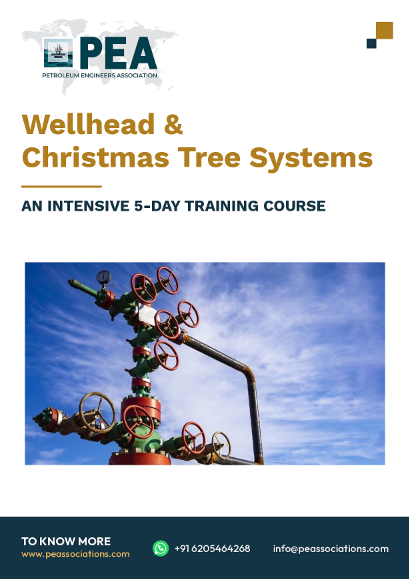
This course covers wellhead and Christmas tree systems. Participants study wellhead functions and configurations, casing and tubing heads and hangers, seals and sealing principles, pressure ratings and material classes, valves and actuators, tree configurations for surface and subsea wells, installation and testing, maintenance and integrity, and failure modes.
Description
The wellhead supports and seals every casing and tubing string, provides access to each annulus and carries the Christmas tree that controls flow. It is the one piece of well equipment that stays in place and under pressure for the entire life of the well, and it is a barrier element in every well integrity scheme.
This course covers the equipment in detail. It starts with wellhead functions and the sequence of installation as each casing string is run, then covers casing heads, spools, hangers and seal assemblies, and the sealing principles that make them work. It covers pressure ratings, temperature and material classes to recognised standards, and valve types, gate valves, actuators and control systems. The course then covers Christmas tree configurations for surface, platform and subsea wells, installation, pressure testing and commissioning, routine testing and maintenance, annulus access and monitoring, and the failure modes that lead to leaks and integrity anomalies.
Every well integrity scheme treats the wellhead as part of the secondary barrier envelope and the Christmas tree as part of the primary. That means seals, valves and body connections must be tested, monitored and maintained to defined standards for as long as the well exists. A leaking hanger seal or a valve that will not hold is an integrity anomaly, not a maintenance inconvenience.
Specification matters at the design stage. Pressure rating, temperature class, material class and product specification level are chosen from the well conditions, including hydrogen sulphide and carbon dioxide content, and from the service the well will see. Equipment specified for a sweet well and later used in sour service is a real and recurring problem in mature fields.
Maintenance is where surface wellheads are usually neglected. Valves are exercised infrequently, greasing is skipped, corrosion builds under insulation and at flange faces, and annulus valves seize in the position they were last left. Routine testing and maintenance programmes exist to prevent exactly that, and this course covers them alongside the engineering.
By the end of this training, participants will be able to:
- Describe wellhead functions and the installation sequence through well construction.
- Identify casing heads, spools, hangers and seal assemblies and their operation.
- Explain sealing principles and seal types used in wellheads.
- Specify pressure ratings, temperature and material classes to recognised standards.
- Identify valve types, actuators and control systems and their applications.
- Describe Christmas tree configurations for surface, platform and subsea wells.
- Plan wellhead and tree installation, pressure testing and commissioning.
- Specify routine testing, greasing and maintenance programmes.
- Manage annulus access, monitoring and valve operation.
- Diagnose wellhead and tree failure modes and plan remediation.
The course is instructor-led. Equipment is covered with cutaway drawings, photographs and manufacturer specifications, with the function of each component explained in sequence. Installation, testing and maintenance are covered through procedures and field cases, including leaks and failures and how they were diagnosed. Participants are encouraged to bring their own wellhead problems for discussion.
Organisations sending participants to this training will:
- Specify wellhead and tree equipment correctly for well conditions.
- Reduce wellhead leaks and integrity anomalies.
- Improve testing and maintenance practice on surface equipment.
- Improve annulus access and monitoring discipline.
- Support well integrity management with better equipment knowledge.
Participants will:
- Understand how wellheads and trees work component by component.
- Be able to specify equipment ratings and material classes.
- Be able to plan installation, testing and maintenance.
- Understand annulus access and valve operation.
- Be able to diagnose wellhead and tree problems.
- Drilling and completion engineers
- Well integrity engineers
- Production and operations engineers
- Maintenance and wellhead service personnel
- Field supervisors and technicians
- Well intervention engineers
Module 1: Wellhead Functions and Build-Up
- Functions of the wellhead
- Installation sequence through well construction
- Conventional and compact wellheads
- Unitised and mudline systems
- Terminology and standards
Module 2: Casing Heads, Spools and Hangers
- Casing head housings and spools
- Slip and mandrel hangers
- Landing and locking mechanisms
- Annulus access ports
- Load transfer and support
Module 3: Seals and Sealing Principles
- Metal-to-metal and elastomer seals
- Secondary and emergency seals
- Seal energisation
- Seal testing
- Common seal failures
Module 4: Ratings and Material Classes
- Pressure and temperature ratings
- Material and performance requirement classes
- Product specification levels
- Sour service requirements
- Specifying equipment for well conditions
Module 5: Valves and Actuators
- Gate, ball and check valves
- Manual and actuated valves
- Surface safety valves and fail-safe operation
- Actuator types and control systems
- Valve ratings and sealing
Module 6: Christmas Trees
- Surface and platform tree configurations
- Vertical and horizontal subsea trees
- Tree valves and their functions
- Flow wing, kill wing and swab valves
- Chokes and tree instrumentation
Module 7: Installation, Testing and Commissioning
- Installation procedures
- Pressure testing requirements
- Seal verification
- Commissioning checks
- Documentation and records
Module 8: Testing, Maintenance and Monitoring
- Routine valve testing and exercising
- Greasing programmes
- Corrosion protection and inspection
- Annulus pressure monitoring and valve operation
- Maintenance records and compliance
Module 9: Failures and Remediation
- Leaking hanger and body seals
- Valve failures and seat leaks
- Corrosion and external damage
- Temporary repair options
- Wellhead replacement and remediation
- Integrity consequences and reporting
Upon successful completion of this training course, delegates will be awarded an official Certificate of Completion issued by the Petroleum Engineers Association (PEA), an ISO 9001:2015 certified training organization. The certificate carries 10 Credits and formally records the total learning hours completed.
Each certificate is signed by the Course Facilitator and the CEO of the Petroleum Engineers Association, and serves as verifiable proof of professional training that delegates can present to employers and professional bodies worldwide.
Frequently Asked Questions
All course bookings made through PEA are strictly non-refundable. By registering for a course, you acknowledge and accept that all fees are payable in full and are not subject to refund under any circumstances, including changes in personal or professional commitments or partial attendance.
PEA reserves the right to make reasonable adjustments to course content, trainers, or schedules where necessary, without entitling delegates to a refund. Comprehensive details of each course — including objectives, target audience, and content — are clearly outlined before enrolment, and it is the responsibility of the delegate to ensure the course's suitability prior to booking.
For any inquiries related to cancellations or bookings, please contact our support team, who will be happy to assist you.
