


An Interactive 5-Day Training Course
Shallow Hazards, Site Survey & Top Hole Drilling
Drilling the Top Hole Safely
Secure your spot now!
Duration
5 Days
Price
$ 3,000
Starting From
01 Mar 2027



Shallow Hazards, Site Survey & Top Hole Drilling
Have Questions ?
Shallow Hazards, Site Survey & Top Hole Drilling - DC-SHT-PEA27
| Code | Date | Time | Duration | Location | Currency | Early Bird Fee Per Person |
|---|---|---|---|---|---|---|
| DC-SHT-PEA27 | 01 - 05 Mar 2027 | 10 AM CST | 4 Hours / Day |
Online |
USD |
3000 |
Need this for a group? We deliver the same course in-house — face-to-face at your location or online — tailored to your assets and team level. Contact info@peassociations.com
Boost your team's skills and your budget! Enjoy group discounts for collaborative learning. Send an inquiry to info@peassociations.com.
Shallow Hazards, Site Survey & Top Hole Drilling
This course covers shallow hazards and top hole drilling. Participants study site survey requirements and interpretation, shallow gas and shallow water flow, seabed and surface conditions, conductor and surface casing design, top hole drilling methods, riserless drilling, diverter systems, cementing the conductor and surface strings, and hazard response procedures.
Description
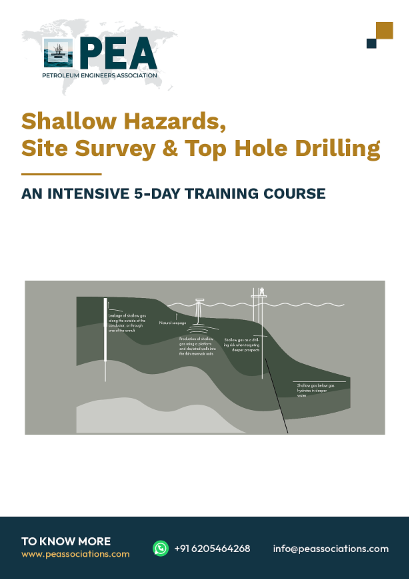
The top hole section is drilled with no casing below the conductor, no blowout preventer in many cases and limited information about what lies ahead. Shallow gas, shallow water flows, boulders, unstable seabed soils and existing infrastructure all sit in this interval, and incidents here escalate quickly because there is little between the formation and the surface.
This course covers the hazards and the practice. It starts with site survey requirements, including shallow seismic, geohazard assessment, seabed imaging and soil data, and how to interpret them for well siting and top hole design. It then covers shallow gas and shallow water flow mechanisms, recognition and response, and seabed and surface conditions affecting foundations and conductor setting. It then covers conductor and surface casing design, driving, jetting and drilling installation methods, riserless drilling and returns to seabed, diverter systems and their operation, cementing practice for shallow strings, and procedures for responding to shallow hazards when they are encountered.
Shallow gas is dangerous because it arrives fast and cannot be contained. In riserless drilling there is no return path to control and no blowout preventer in place; the response is to divert, move off location or keep the hole full and drill ahead with the correct mud weight, depending on the situation. Those responses have to be planned before the section starts.
Site surveys exist to reduce that uncertainty. High resolution seismic identifies shallow gas-bearing sands and faults; seabed imaging identifies boulders, pockmarks, slopes and existing infrastructure; and soil data supports conductor and foundation design. A site survey read properly can move a well location a hundred metres and avoid a serious incident.
Shallow water flows are a different problem, common in deepwater, where overpressured unconsolidated sands flow water and sand behind the casing, washing out the hole, undermining the conductor and compromising the well foundation. Prevention relies on recognising the risk from the survey and designing the top hole, mud weight and cementing accordingly. This course covers both hazards and the operational practice around them.
By the end of this training, participants will be able to:
- Specify site survey requirements for a proposed well location.
- Interpret shallow seismic, seabed imaging and soil data for well siting.
- Identify shallow gas and shallow water flow risk.
- Assess seabed and surface conditions for foundations and conductor setting.
- Design conductor and surface casing for the loads and hazards expected.
- Select conductor installation methods, including driving, jetting and drilling.
- Plan riserless top hole drilling and returns management.
- Specify diverter systems and their operating procedures.
- Design cementing for conductor and surface casing strings.
- Apply response procedures for shallow gas, water flow and other top hole hazards.
The course is instructor-led. Site survey interpretation is taught using real survey data and reports, with participants assessing locations and recommending well positions. Top hole design and operations are covered with procedures and field cases, including shallow gas and shallow water flow incidents. Participants are encouraged to bring their own locations and problems for discussion.
Organisations sending participants to this training will:
- Reduce the risk of shallow gas and shallow water flow incidents.
- Improve well siting decisions using survey data.
- Improve conductor and surface casing design and installation.
- Strengthen top hole procedures and hazard response.
- Protect well foundations and avoid lost locations.
Participants will:
- Be able to specify and interpret a site survey.
- Understand shallow gas and shallow water flow risk and response.
- Be able to design conductor and surface casing strings.
- Understand riserless drilling and diverter operations.
- Be able to plan and supervise top hole sections.
- Drilling and well engineers
- Wellsite supervisors and company representatives
- Geoscientists supporting well siting
- Offshore and deepwater drilling staff
- Marine and survey coordinators
- HSE staff supporting drilling operations
Module 1: Top Hole Hazards
- Why the top hole is high risk
- Shallow gas
- Shallow water flows
- Boulders, faults and unstable soils
- Existing wells and infrastructure
Module 2: Site Survey Requirements
- Survey scope and specification
- High resolution seismic
- Seabed imaging and bathymetry
- Soil boring and geotechnical data
- Survey timing and cost
Module 3: Survey Interpretation
- Identifying shallow gas indicators
- Mapping hazards and clearance distances
- Seabed conditions and slopes
- Well location selection and move decisions
- Reporting and documentation
Module 4: Foundations and Conductor Design
- Conductor loads and functions
- Soil strength and penetration prediction
- Conductor size and wall thickness
- Surface casing design
- Structural considerations for platforms and jackups
Module 5: Conductor Installation
- Driving and hammer selection
- Jetting and drilling in
- Cementing conductors
- Verification of setting and capacity
- Installation problems and their handling
Module 6: Riserless Top Hole Drilling
- Pump and dump operations
- Returns to seabed
- Hole cleaning without returns
- Mud selection for riserless sections
- Environmental considerations
Module 7: Diverter Systems
- Diverter equipment and configuration
- Operating and testing requirements
- Diverter procedures
- Limitations of diverters
- Crew drills and response times
Module 8: Cementing Shallow Strings
- Slurry design for shallow, cold formations
- Displacement and returns monitoring
- Top of cement and remedial options
- Preventing shallow water flow behind casing
Module 9: Hazard Response and Procedures
- Shallow gas response procedures
- Shallow water flow response
- Abandonment and move-off decisions
- Emergency response and crew preparedness
- Incident cases and lessons learned
Upon successful completion of this training course, delegates will be awarded an official Certificate of Completion issued by the Petroleum Engineers Association (PEA), an ISO 9001:2015 certified training organization. The certificate carries 10 Credits and formally records the total learning hours completed.
Each certificate is signed by the Course Facilitator and the CEO of the Petroleum Engineers Association, and serves as verifiable proof of professional training that delegates can present to employers and professional bodies worldwide.
Frequently Asked Questions
All course bookings made through PEA are strictly non-refundable. By registering for a course, you acknowledge and accept that all fees are payable in full and are not subject to refund under any circumstances, including changes in personal or professional commitments or partial attendance.
PEA reserves the right to make reasonable adjustments to course content, trainers, or schedules where necessary, without entitling delegates to a refund. Comprehensive details of each course — including objectives, target audience, and content — are clearly outlined before enrolment, and it is the responsibility of the delegate to ensure the course's suitability prior to booking.
For any inquiries related to cancellations or bookings, please contact our support team, who will be happy to assist you.
