


An Interactive 5-Day Training Course
Multilateral Well Drilling
Drilling Branched Wells
Secure your spot now!
Duration
5 Days
Price
$ 3,500
Starting From
03 May 2027



Multilateral Well Drilling
Have Questions ?
Multilateral Well Drilling - DC-MLW-PEA27
| Code | Date | Time | Duration | Location | Currency | Early Bird Fee Per Person |
|---|---|---|---|---|---|---|
| DC-MLW-PEA27 | 03 - 07 May 2027 | 10 AM CST | 4 Hours / Day |
Online |
USD |
3500 |
Need this for a group? We deliver the same course in-house — face-to-face at your location or online — tailored to your assets and team level. Contact info@peassociations.com
Boost your team's skills and your budget! Enjoy group discounts for collaborative learning. Send an inquiry to info@peassociations.com.
Multilateral Well Drilling
This course covers the drilling and construction of multilateral wells. Participants study multilateral applications and value, TAML junction levels, well architecture and planning, window milling and lateral initiation, junction construction, drilling and completing laterals, re-entry access, integrity requirements, risk and cost assessment.
Description
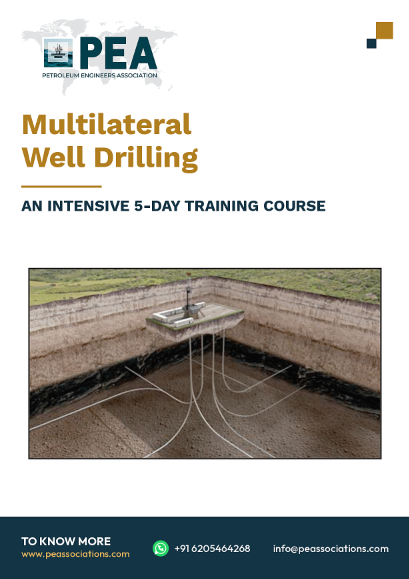
A multilateral well drills two or more branches from a single parent wellbore. It increases reservoir contact per surface slot, reduces well count in offshore developments and can access separate zones or compartments from one well. It also increases complexity, risk and the chance that a branch becomes inaccessible or a junction fails.
This course covers the construction side. It starts with applications, value drivers and when a multilateral is justified against separate wells, then covers the TAML junction classification and what each level provides in mechanical support and hydraulic isolation. It covers architecture and planning, including parent well design to accommodate later laterals, window milling and whipstock systems, lateral initiation and drilling, and junction construction and hardware. The course then covers completing laterals, selective re-entry and access requirements, well integrity considerations for junctions, and the risk, cost and decision analysis behind multilateral projects.
The junction is the whole problem. A branch drilled out of a casing window is straightforward; making that junction mechanically stable, hydraulically isolated if required, and re-enterable years later is what drives cost and complexity. The TAML levels exist to describe exactly how much of that is provided, from an open hole split to a fully cased and pressure-isolated junction.
The parent well has to be designed for it. Casing size, cement quality at the junction depth, window position relative to the trajectory and the hardware that will be run later all have to be planned before the parent well is drilled. Retrofitting a lateral into a well that was not designed for one is possible but usually compromised.
The economic case has to be honest. A multilateral saves a slot, a top hole and sometimes a riser trip, but it adds milling time, junction hardware, higher intervention cost and the risk of losing the whole well if the junction fails. It makes sense where slots are scarce and reservoir contact is valuable, and much less sense where land wells are cheap.
By the end of this training, participants will be able to:
- Identify multilateral applications and the value drivers behind them.
- Compare multilateral options against separate wells on cost and risk.
- Describe TAML junction levels and select an appropriate level.
- Plan parent well design to accommodate laterals.
- Plan window milling and whipstock operations.
- Drill and complete lateral sections.
- Construct junctions and install junction hardware.
- Plan selective re-entry and access to each lateral.
- Address well integrity requirements at junctions.
- Assess multilateral risk, cost and decision criteria.
The course is instructor-led. Junction levels, hardware and construction sequences are covered with drawings, procedures and field records. Participants plan a multilateral well, selecting junction level, sequencing operations and assessing risk and cost against a single-lateral alternative. Field cases include junction failures and lost laterals. Participants are encouraged to bring their own projects for discussion.
Organisations sending participants to this training will:
- Increase reservoir contact per slot in constrained developments.
- Select junction levels appropriate to the reservoir and intervention plan.
- Reduce junction failures and lost lateral access.
- Plan parent wells so that future laterals remain possible.
- Make multilateral decisions on realistic cost and risk comparison.
Participants will:
- Understand multilateral architectures and junction levels.
- Be able to plan a multilateral well and its construction sequence.
- Understand window milling and junction construction operations.
- Understand re-entry and intervention constraints.
- Be able to assess multilateral risk and economics.
- Drilling and well engineers
- Completion engineers
- Reservoir engineers involved in well design
- Field development engineers
- Rig site supervisors on complex wells
- Service company engineers supporting multilateral work
Module 1: Multilateral Applications
- Reasons for multilateral wells
- Reservoir and development drivers
- Slot constrained and offshore applications
- Comparison with separate wells
- When multilaterals are not justified
Module 2: TAML Junction Levels
- Level 1 to Level 6 definitions
- Mechanical support and hydraulic isolation by level
- Selecting a level for the application
- Cost and complexity by level
- Regulatory expectations
Module 3: Architecture and Planning
- Parent well design for future laterals
- Casing size and cement requirements at junctions
- Junction depth and trajectory planning
- Lateral spacing and orientation
- Sequence planning
Module 4: Window Milling and Whipstocks
- Whipstock types and setting
- Anchor and orientation
- Window milling operations and mills
- Confirming window quality
- Problems during milling
Module 5: Drilling the Lateral
- Exiting the window and initiating the lateral
- Directional control from the window
- Hole cleaning and drilling practice in laterals
- Logging and evaluation in laterals
- Returning to the parent bore
Module 6: Junction Construction
- Junction hardware and liner systems
- Cementing at the junction
- Pressure isolation methods
- Level-specific construction sequences
- Verification of the junction
Module 7: Completing Laterals
- Completion options by junction level
- Running completions through junctions
- Zonal isolation between laterals
- Flow control and commingling
- Production monitoring by lateral
Module 8: Access and Re-Entry
- Selective re-entry systems
- Deflectors and orientation
- Intervention access to each lateral
- Tool limitations at junctions
- Planning for future intervention
Module 9: Integrity, Risk and Economics
- Junction integrity over well life
- Failure modes and their consequences
- Loss of lateral access
- Risk assessment for multilateral projects
- Cost comparison and decision criteria
- Lessons learned from field experience
Upon successful completion of this training course, delegates will be awarded an official Certificate of Completion issued by the Petroleum Engineers Association (PEA), an ISO 9001:2015 certified training organization. The certificate carries 10 Credits and formally records the total learning hours completed.
Each certificate is signed by the Course Facilitator and the CEO of the Petroleum Engineers Association, and serves as verifiable proof of professional training that delegates can present to employers and professional bodies worldwide.
Frequently Asked Questions
All course bookings made through PEA are strictly non-refundable. By registering for a course, you acknowledge and accept that all fees are payable in full and are not subject to refund under any circumstances, including changes in personal or professional commitments or partial attendance.
PEA reserves the right to make reasonable adjustments to course content, trainers, or schedules where necessary, without entitling delegates to a refund. Comprehensive details of each course — including objectives, target audience, and content — are clearly outlined before enrolment, and it is the responsibility of the delegate to ensure the course's suitability prior to booking.
For any inquiries related to cancellations or bookings, please contact our support team, who will be happy to assist you.
