

Produce Water First and Gas Second from a Reservoir That Stores Gas by Adsorption
Coalbed Methane Reservoir Engineering
Applied coalbed methane engineering, covering coal as a reservoir, adsorption isotherms and gas storage, dual porosity flow and permeability, dewatering and the negative decline, gas content determination, well completion and stimulation, production forecasting, reserves estimation, water disposal and enhanced recovery by CO2 injection.



Coalbed Methane Reservoir Engineering
Have Questions ?
Coalbed Methane Reservoir Engineering - RE-CBM-PEA27
| Code | Date | Time | Duration | Location | Currency | Early Bird Fee Per Person |
|---|---|---|---|---|---|---|
| RE-CBM-PEA27 | 25 - 29 Oct 2027 | 10 AM CST | 4 Hours Per Day |
Online |
USD |
4000 |
Boost your team's skills and your budget! Enjoy group discounts for collaborative learning. Send an inquiry to info@peassociations.com.
Coalbed Methane Reservoir Engineering
Description
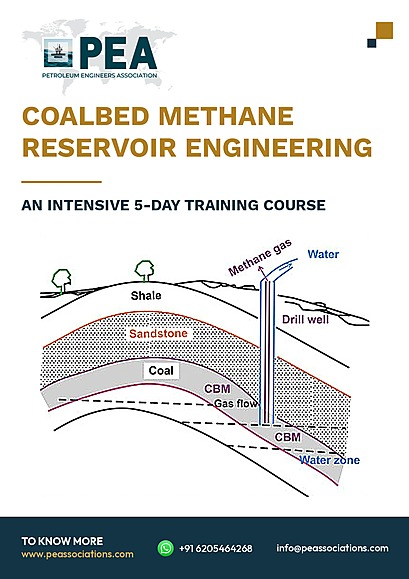
Coalbed methane behaves unlike any conventional reservoir. The gas is not held in pore space as free gas but adsorbed onto the internal surfaces of the coal, and it is released only when pressure falls below the desorption pressure. Pressure is lowered by producing water from the cleat system, which means a CBM well produces water first and gas later, with gas rate rising over months or years before peaking and declining. Everything about development, forecasting, facilities and economics follows from that behaviour.
This training covers it systematically. Coal as a reservoir is developed first, including rank, composition, cleat systems and their geometry. Adsorption is then covered through Langmuir isotherms, their measurement, desorption pressure, gas content determination and the difference between gas content and gas in place. Dual porosity flow through cleats and matrix diffusion follows, together with permeability and its unusual behaviour: stress dependence that reduces permeability with depletion and matrix shrinkage that increases it, with the net effect varying between coals. Dewatering, the negative decline and the characteristic production profile are then developed. Completion, stimulation and horizontal well options follow. Forecasting, reserves, water production and disposal, and enhanced recovery by CO2 or nitrogen injection close the training.
The production profile is the defining feature and the source of most commercial disappointment. A CBM well produces water at high rate and little or no gas initially, and gas rate builds as reservoir pressure falls below desorption pressure across an expanding region. Peak gas rate may occur one to three years after first production. This means early production data does not indicate ultimate performance, wells that look poor may improve, and the capital is spent long before the revenue arrives. Development economics are correspondingly sensitive to the length of the dewatering period.
Permeability behaves in two opposing ways as the reservoir depletes. Rising effective stress compresses the cleats and reduces permeability, as in any reservoir. But desorption removes gas from the coal matrix, which causes the matrix to shrink, which widens the cleats and increases permeability. Which effect dominates varies between coals and changes through depletion, and the net permeability trajectory strongly influences long term well performance. Coals in which shrinkage dominates can show permeability increasing several fold over field life.
Gas content measurement is the foundation of resource estimation and carries substantial uncertainty. Desorption canister testing measures lost gas during core recovery, desorbed gas over a period of days or weeks and residual gas after crushing, and the lost gas estimate in particular is an extrapolation. Isotherm measurement gives the storage capacity at a given pressure, which may exceed the actual gas content if the coal is undersaturated, and undersaturation means production begins only after pressure has been reduced substantially with no gas at all.
Finally, water is the operational and economic problem. CBM produces large water volumes, often of poor quality, and disposal cost is a major operating expense. Water production must fall for gas production to rise, and fields where water rates remain high have both a cost problem and a reservoir problem. Water sourcing, treatment, disposal permitting and cost frequently determine whether a CBM development proceeds.
By the end of this training, participants will be able to:
- Characterise coal as a reservoir including rank, composition, cleat systems and their properties
- Interpret adsorption isotherms and determine desorption pressure and storage capacity
- Determine gas content from desorption testing and assess its uncertainty
- Identify undersaturation and assess its consequences for development
- Analyse dual porosity flow including cleat flow and matrix diffusion
- Evaluate permeability behaviour including stress dependence and matrix shrinkage effects
- Predict the dewatering period and the characteristic gas production profile
- Design completions and stimulation appropriate to coal seams
- Forecast CBM well and field production and estimate reserves
- Assess water production, disposal requirements and their economic effect
- Evaluate enhanced coalbed methane recovery by CO2 or nitrogen injection
The training develops coal reservoir behaviour and then applies it through calculation and data interpretation. Participants interpret isotherms, calculate gas in place, assess saturation state, analyse production histories through dewatering and gas build-up, and forecast well performance. Permeability trajectory calculations demonstrate the competing stress and shrinkage effects. CBM field developments are examined for their production performance, water handling experience and economic outcome, including projects that failed on dewatering duration or water disposal cost.
Organisations sending participants to this training will:
- Evaluate CBM opportunities with correct understanding of the production profile
- Improve resource and reserves estimation through proper gas content and saturation assessment
- Plan water handling and disposal realistically before development commitment
- Improve well spacing and development design for dewatering efficiency
- Avoid development decisions based on early production data that misrepresents ultimate performance
- Assess enhanced CBM and CO2 storage opportunities in coal
Participants will:
- Understand why coal reservoirs behave as they do
- Interpret isotherms and gas content data correctly
- Forecast CBM production through dewatering and gas build-up
- Assess water handling requirements and their economic weight
- Estimate CBM reserves with appropriate evidence
- Build a specialist capability applicable to CBM and to CO2 storage in coal
- Reservoir engineers working coalbed methane assets
- Production engineers managing CBM wells and dewatering
- Development engineers evaluating CBM opportunities
- Reserves and evaluation engineers assessing coal resources
- Geoscientists working on coal characterisation
- Facilities and water management engineers on CBM projects
- Technical staff evaluating CBM and enhanced CBM projects
Module 1 - Coal as a Reservoir
- Coal formation, rank and its progression
- Coal composition: macerals, ash, moisture, volatile matter
- Gas generation in coal: biogenic and thermogenic
- Cleat systems: face cleat, butt cleat, spacing and aperture
- Matrix and cleat dual porosity structure
- Coal seam geometry, continuity and thickness
- Structural setting and its effect on permeability
- Comparison with conventional and other unconventional reservoirs
- Coring, sampling and handling of coal
- Screening a coal for CBM potential
Module 2 - Gas Storage and Adsorption
- Adsorption as the dominant storage mechanism
- Langmuir isotherm and its parameters
- Isotherm measurement and sample requirements
- Effect of coal rank, ash, moisture and temperature on isotherms
- Desorption pressure and its determination
- Free gas in cleats and its small contribution
- Gas content definition and measurement
- Desorption canister testing: lost, desorbed and residual gas
- Lost gas estimation methods and their uncertainty
- Saturated and undersaturated coals
- Consequences of undersaturation for development
- Gas in place calculation for coal seams
Module 3 - Flow and Permeability
- Dual porosity flow: cleat flow and matrix diffusion
- Darcy flow in the cleat system
- Diffusion in the matrix and sorption time
- Diffusion coefficient determination
- Relative permeability in the cleat system
- Absolute permeability measurement and its difficulty
- Permeability from well testing in coal
- Stress-dependent permeability and cleat compression
- Matrix shrinkage on desorption and permeability increase
- Net permeability trajectory through depletion
- Permeability anisotropy along and across cleats
- Effect of permeability on development viability
Module 4 - Production Behaviour and Dewatering
- The characteristic CBM production profile
- Dewatering phase and its duration
- Negative decline and gas rate build-up
- Peak gas rate timing and its determinants
- Pressure drawdown propagation and desorption region growth
- Water production behaviour and decline
- Effect of well spacing on dewatering efficiency
- Interference between wells as a positive effect
- Effect of aquifer connection on dewatering
- Recognising a well that will not dewater
- Early production data and its limited predictive value
Module 5 - Well Design, Completion and Stimulation
- Vertical, deviated and horizontal well options
- Multi-seam completion strategies
- Openhole cavity completions
- Cased and perforated completions
- Hydraulic fracturing in coal and its particular behaviour
- Fracture geometry in coal and cleat interaction
- Fluid and proppant selection for coal
- Coal fines production and its management
- Underreamed and cavitated completions
- Horizontal and multilateral wells in coal
- Artificial lift selection for high water rate low gas rate wells
- Well spacing and pattern design
Module 6 - Well Testing and Reservoir Characterisation
- Well testing objectives in coal
- Injection falloff testing and its application
- Slug and drill stem testing in coal
- Interpreting tests in dual porosity systems
- Permeability and skin determination
- Reservoir pressure determination
- Pilot programme design for CBM appraisal
- Production pilot duration requirements
- Integrating test, isotherm and gas content data
- Characterisation programme for a CBM prospect
Module 7 - Forecasting, Simulation and Reserves
- Material balance for coal seam reservoirs
- Accounting for desorption in material balance
- Analytical forecasting methods for CBM
- Decline analysis after peak gas rate
- CBM simulation: dual porosity, desorption, shrinkage representation
- History matching CBM production
- Forecast sensitivity to permeability trajectory and saturation state
- Recovery factor expectations in CBM
- Reserves classification for coalbed methane
- Evidence requirements and the difficulty of early booking
- Common causes of CBM forecast error
Module 8 - Water, Facilities and Economics
- Produced water volumes and their profile
- Water quality and its variability
- Disposal options: reinjection, surface discharge, evaporation, treatment
- Disposal permitting and regulatory constraints
- Water treatment technology and cost
- Gathering, compression and dehydration for low pressure gas
- Compression requirement and staging
- Gas quality and carbon dioxide content
- Development cost structure and well cost
- Economic sensitivity to dewatering duration and water disposal cost
- Economic limit and abandonment
- CBM project outcomes and their determinants
Module 9 - Enhanced Coalbed Methane and CO2 Storage
- Enhanced recovery concept in coal
- Carbon dioxide injection and preferential adsorption
- Nitrogen injection and partial pressure reduction
- Flue gas injection
- CO2 to methane exchange ratio
- Coal swelling on CO2 adsorption and permeability loss
- Injectivity problems in enhanced CBM
- Field pilots and their results
- CO2 storage capacity in coal seams
- Regulatory and monitoring requirements for CO2 storage in coal
- Economic evaluation of enhanced CBM with storage value
Upon successful completion of this training course, delegates will be awarded an official Certificate of Completion issued by the Petroleum Engineers Association (PEA), an ISO 9001:2015 certified training organization. The certificate carries 10 Credits and formally records the total learning hours completed.
Each certificate is signed by the Course Facilitator and the CEO of the Petroleum Engineers Association, and serves as verifiable proof of professional training that delegates can present to employers and professional bodies worldwide.
Frequently Asked Questions
All course bookings made through PEA are strictly non-refundable. By registering for a course, you acknowledge and accept that all fees are payable in full and are not subject to refund under any circumstances, including changes in personal or professional commitments or partial attendance.
PEA reserves the right to make reasonable adjustments to course content, trainers, or schedules where necessary, without entitling delegates to a refund. Comprehensive details of each course — including objectives, target audience, and content — are clearly outlined before enrolment, and it is the responsibility of the delegate to ensure the course's suitability prior to booking.
For any inquiries related to cancellations or bookings, please contact our support team, who will be happy to assist you.
