


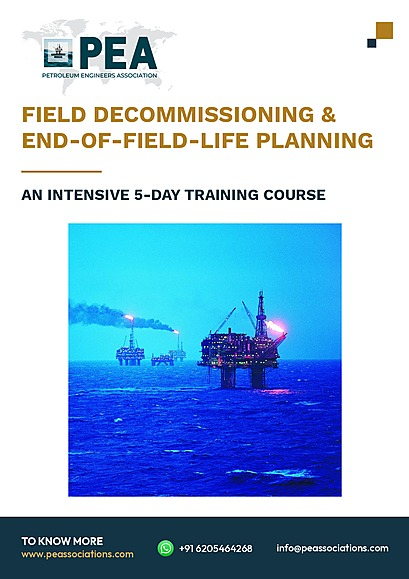
An Interactive 5-Day Training Course
Field Decommissioning & End-of-Field-Life Planning
Planning field decommissioning and end-of-life operations
Secure your spot now!
Duration
5 Days
Price
$ 4,000
Starting From
18 Oct 2027



Field Decommissioning & End-of-Field-Life Planning
Have Questions ?
Field Decommissioning & End-of-Field-Life Planning - RE-FDEC-PEA27
| Code | Date | Time | Duration | Location | Currency | Early Bird Fee Per Person |
|---|---|---|---|---|---|---|
| RE-FDEC-PEA27 | 18 - 22 Oct 2027 | 10 AM CST | 4 Hours Per Day |
Online |
USD |
4000 |
Need this for a group? We deliver the same course in-house — face-to-face at your location or online — tailored to your assets and team level. Contact info@peassociations.com.
Boost your team's skills and your budget! Enjoy group discounts for collaborative learning. Send an inquiry to info@peassociations.com.
Field Decommissioning & End-of-Field-Life Planning
This training covers end of field life planning and decommissioning. It works through economic limit determination and options for extending it, the cessation of production decision, well abandonment engineering and barrier requirements, facility and pipeline decommissioning options, cost estimation and provisioning, regulatory and liability frameworks, reuse and repurposing for storage or other service, and the planning and execution of a decommissioning programme.
Description
Decommissioning is a large, certain and late cost that is easy to defer thinking about and expensive to handle badly. It is also increasingly a live commercial issue: liability provisions affect balance sheets, security requirements tie up capital, transactions turn on who carries the obligation, and regulators are tightening both the standards and the timing. Planning for it from a position of understanding, rather than reacting to it when production ceases, materially changes both the cost and the options available.
This training covers the subject end to end. Economic limit determination is developed first, since when a field ceases to produce is a decision rather than an event, and options to extend it, cost reduction, water shut-off, infill, third party processing, ownership change, all defer the liability and add value. The cessation of production decision and its governance follow. Well abandonment engineering is then covered in detail: barrier requirements and their basis, permanent plugging design, cement placement and verification, sustained casing pressure, subsea and platform well differences and the cost drivers. Facility and pipeline decommissioning options, comparative assessment and their regulatory basis follow. Cost estimation, provisioning and security arrangements are then addressed, along with the regulatory and liability frameworks. Reuse and repurposing, execution planning, contracting and waste management close the training.
The largest lever on decommissioning cost is timing rather than method. Every year of continued production defers the liability, and deferral has present value that is often substantial relative to the cost of the measures required to achieve it. This inverts the usual view of late life investment: spending money to extend a marginal field's life is not only about the incremental production, it is about deferring a large certain cost. Evaluating late life opportunities without including this effect systematically undervalues them.
Wells dominate the cost in most decommissioning programmes. Permanent abandonment requires barriers that isolate every permeable zone from surface and from each other, verified to standards that have tightened over time, and achieving that in old wells with degraded cement, casing damage, sustained annulus pressure or incomplete records is where cost escalates. Wells that were plugged decades ago to earlier standards may require re-entry. Assessing the well stock early, well before cessation, is what allows the programme to be planned rather than discovered.
Facility removal options are subject to comparative assessment rather than to a single prescribed answer in most jurisdictions. Complete removal, partial removal, leaving in place, and toppling are evaluated against technical feasibility, safety, environmental impact, cost and other users of the sea or land, and the outcome varies by structure and by jurisdiction. Building the case for a derogation from full removal requires evidence assembled to a defined standard, and starting that work late constrains the options.
Finally, repurposing is now a genuine alternative for some infrastructure. Depleted fields and their wells and platforms are being assessed for CO2 storage, gas storage and hydrogen service, and pipelines for CO2 and hydrogen transport. This changes the decommissioning decision from a question of how to remove to a question of whether to remove, and it requires the assessment to happen before wells are plugged and structures removed, since those actions are irreversible
By the end of this training, participants will be able to:
- Determine economic limit and identify options to extend field life
- Quantify the value of deferring decommissioning liability
- Structure and support a cessation of production decision
- Specify well abandonment barrier requirements and permanent plugging design
- Assess well stock condition and identify wells that will drive abandonment cost
- Evaluate facility and pipeline decommissioning options through comparative assessment
- Estimate decommissioning cost and assess provision adequacy
- Apply regulatory and liability frameworks including security arrangements
- Assess reuse and repurposing options for wells, facilities and pipelines
- Plan and contract a decommissioning programme including waste and environmental management
Organisations sending participants to this training will:
- Extend field life where doing so creates value including liability deferral
- Improve decommissioning cost estimates and provision adequacy
- Reduce decommissioning execution cost through earlier planning
- Improve regulatory engagement and approval outcomes
- Identify repurposing opportunities before irreversible actions foreclose them
- Handle decommissioning liability correctly in transactions and financial reporting
Participants will:
- Determine when a field should cease production and why
- Value life extension correctly including deferral benefit
- Specify well abandonment requirements and estimate their cost
- Conduct comparative assessment for facility decommissioning
- Understand the regulatory and liability framework they operate within
- Build a capability in an area of substantial and growing industry activity
- Reservoir and production engineers on late life assets
- Well engineers responsible for abandonment planning and execution
- Facilities and project engineers on decommissioning projects
- Asset managers accountable for late life fields
- Commercial and finance staff handling decommissioning liability
- Regulatory, environmental and compliance personnel
- Technical staff evaluating late life asset transactions
Module 1 - Late Life and Economic Limit
- Characteristics of a late life field
- Economic limit definition and calculation
- Cost structure in late life and its behaviour
- Fixed cost dominance at low production rates
- Effect of price on economic limit
- Abandonment cost and its exclusion from or inclusion in the limit calculation
- Field level and well level economic limits
- Shutting in wells against ceasing production
- Recognising when a field is approaching cessation
- Planning horizon for end of life work
Module 2 - Life Extension Options
- Operating cost reduction and its effect on economic limit
- Manning, logistics and maintenance strategy in late life
- Facility rationalisation and equipment decommissioning during production
- Water shut-off and water handling cost reduction
- Well intervention and low cost production restoration
- Infill drilling and recompletion in late life
- Third party tie-backs and processing revenue
- Infrastructure sharing and hub arrangements
- Ownership transfer to late life specialists
- Value of deferring decommissioning liability
- Evaluating life extension including deferral benefit
- When extension is not economic
Module 3 - Cessation of Production Decision
- Cessation of production definition and its consequences
- Regulatory notification and approval requirements
- Partner agreement and its mechanics
- Point of no return and its identification
- Irreversibility of cessation decisions
- Governance and approval for cessation
- Timing of cessation relative to decommissioning readiness
- Interim period between cessation and decommissioning
- Preservation and maintenance during the interim period
- Documentation of the cessation case
Module 4 - Well Abandonment Engineering
- Abandonment objectives and the permanent barrier principle
- Barrier requirements: number, position, extent, verification
- Regulatory and industry standards for abandonment
- Permeable zone isolation requirements
- Cement plug design, placement and verification
- Alternative barrier materials and their qualification
- Casing cutting, retrieval and its cost
- Annulus cement quality and its assessment
- Sustained casing pressure and its remediation
- Wellhead and conductor removal
- Subsea well abandonment and its additional requirements
- Platform, land and subsea well cost differences
- Rig, rigless and light well intervention abandonment methods
- Well stock assessment and cost estimation
Module 5 - Facility Decommissioning
- Decommissioning options: full removal, partial removal, leave in place, toppling
- Comparative assessment methodology
- Assessment criteria: safety, environment, technical feasibility, cost, other users
- Regulatory frameworks and derogation processes
- Topsides preparation, cleaning and making safe
- Hydrocarbon removal and inventory management
- Topsides removal methods and heavy lift
- Substructure and jacket removal
- Floating facility disconnection and disposal
- Onshore facility demolition and site restoration
- Subsea infrastructure removal
- Drill cuttings piles and their management
- Onshore disposal, recycling and waste routing
Module 6 - Pipeline and Subsea Decommissioning
- Pipeline decommissioning options and their assessment
- Cleaning, flushing and making safe
- Leave in place with remediation against removal
- Trenching, burial and rock dumping
- Riser and spool removal
- Umbilical and cable decommissioning
- Subsea structure and manifold removal
- Debris clearance and seabed survey
- Fishing gear interaction and its assessment
- Post-decommissioning monitoring requirements
- Residual liability for material left in place
Module 7 - Cost Estimation and Provisioning
- Decommissioning cost breakdown by element
- Well abandonment cost drivers and estimation
- Facility removal cost estimation
- Estimating methods and their accuracy at different stages
- Benchmarking against completed programmes
- Cost escalation and market rate exposure
- Contingency and risk allowance
- Provision accounting and its basis
- Discounting and its treatment in provisions
- Decommissioning security: forms, amounts and triggers
- Effect of provisions and security on balance sheet and financing
- Updating estimates and provisions over time
Module 8 - Regulatory, Liability and Commercial
- Regulatory frameworks by jurisdiction and their requirements
- Approval process and required documentation
- Consultation and stakeholder engagement requirements
- Liability allocation between owners past and present
- Joint and several liability and its consequences
- Decommissioning liability in transactions
- Tax treatment of decommissioning expenditure
- Insurance and financial assurance
- Late life ownership transfer and its liability implications
- Government and industry cost reduction initiatives
- Dispute areas and their management
Module 9 - Reuse, Repurposing and Execution
- Repurposing options: CO2 storage, gas storage, hydrogen, geothermal, offshore wind
- Assessing wells and facilities for reuse
- Timing: assessing reuse before irreversible actions
- Technical requirements for conversion
- Regulatory pathways for repurposing
- Commercial models for repurposed infrastructure
- Decommissioning programme planning and sequencing
- Campaign approaches and their cost benefit
- Contracting strategy for decommissioning work
- Vessel, rig and yard availability and its scheduling effect
- Waste management, recycling and disposal routes
- HSE management during decommissioning execution
- Close-out, documentation and residual monitoring obligations
Upon successful completion of this training course, delegates will be awarded an official Certificate of Completion issued by the Petroleum Engineers Association (PEA), an ISO 9001:2015 certified training organization. The certificate carries 10 Credits and formally records the total learning hours completed.
Each certificate is signed by the Course Facilitator and the CEO of the Petroleum Engineers Association, and serves as verifiable proof of professional training that delegates can present to employers and professional bodies worldwide.
Your expert course leader is a senior petroleum engineering consultant, certified trainer and university lecturer with more than 25 years of experience, specialising in field decommissioning and end-of-field-life planning.
His technical expertise covers economic limit determination and life extension, cessation of production decisions, well abandonment engineering, facility and pipeline decommissioning, cost estimation and provisioning, regulatory and liability frameworks, reuse and repurposing options and execution planning.
Over the course of his career, he has provided consulting and project support to international operators and national oil companies across the Middle East, North Africa, Asia Pacific and the Americas, working on decommissioning planning studies, well abandonment programmes and end-of-field-life cost and liability assessments.
He has designed and delivered technical training programmes on field decommissioning and end-of-field-life planning for engineers and technical teams, conducting these sessions both onsite and online across the Middle East, Asia Pacific, Africa and Europe.
Frequently Asked Questions
All course bookings made through PEA are strictly non-refundable. By registering for a course, you acknowledge and accept that all fees are payable in full and are not subject to refund under any circumstances, including changes in personal or professional commitments or partial attendance.
PEA reserves the right to make reasonable adjustments to course content, trainers, or schedules where necessary, without entitling delegates to a refund. Comprehensive details of each course — including objectives, target audience, and content — are clearly outlined before enrolment, and it is the responsibility of the delegate to ensure the course's suitability prior to booking.
For any inquiries related to cancellations or bookings, please contact our support team, who will be happy to assist you.
