


An Interactive 5-Day Training Course
Fundamentals of Enhanced Oil Recovery (EOR)
Introduction to thermal, chemical and gas EOR methods
Secure your spot now!
Duration
5 Days
Price
$ 3,000
Starting From
15 Feb 2027



Fundamentals of Enhanced Oil Recovery (EOR)
Have Questions ?
Fundamentals of Enhanced Oil Recovery (EOR) - RE-EOR01-PEA27
| Code | Date | Time | Duration | Location | Currency | Early Bird Fee Per Person |
|---|---|---|---|---|---|---|
| RE-EOR01-PEA27 | 15 - 19 Feb 2027 | 10 AM CST | 4 Hours Per Day |
Online |
USD |
3000 |
Need this for a group? We deliver the same course in-house — face-to-face at your location or online — tailored to your assets and team level. Contact info@peassociations.com.
Boost your team's skills and your budget! Enjoy group discounts for collaborative learning. Send an inquiry to info@peassociations.com.
Fundamentals of Enhanced Oil Recovery (EOR)
This course provides a complete technical foundation in Enhanced Oil Recovery. Participants learn how each major EOR process works at the pore and reservoir scale, how to screen candidate reservoirs, and how to evaluate incremental recovery, injectivity, and project economics before committing to a pilot or full-field application.
Description
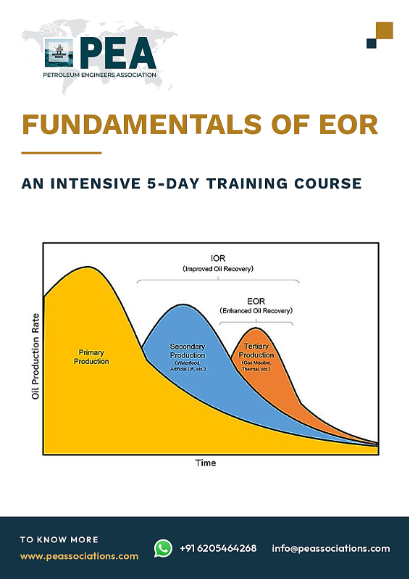
Primary and secondary recovery typically leave 50 to 70 percent of the original oil in place unrecovered. Enhanced Oil Recovery methods target this remaining oil by changing the physics of displacement — reducing interfacial tension, lowering oil viscosity, improving mobility ratio, or altering wettability. Selecting the right process for a given reservoir requires a clear understanding of displacement mechanisms, rock and fluid interactions, and the screening criteria that separate viable candidates from poor ones.
This course covers the full range of established EOR processes: thermal methods (steam flooding, cyclic steam stimulation, SAGD, in-situ combustion), gas injection methods (miscible and immiscible CO2, hydrocarbon gas, nitrogen, WAG), and chemical methods (polymer, surfactant, alkaline, and combined ASP flooding). Participants work through the governing mechanisms of each process, the laboratory and reservoir data needed to evaluate it, screening and ranking of candidate reservoirs, pilot design considerations, and performance monitoring of ongoing EOR projects. Field case histories are used throughout to connect theory to actual project outcomes.
Most producing reservoirs worldwide are mature, and the rate of new discoveries has not kept pace with depletion. The largest remaining resource in many operating companies is not undiscovered oil — it is the oil left behind in fields already on production. Residual oil trapped by capillary forces after waterflooding, and bypassed oil left in poorly swept zones, together represent the primary target of Enhanced Oil Recovery.
EOR processes recover this oil by modifying the fluid-fluid and rock-fluid properties that control displacement efficiency. Miscible gas injection eliminates interfacial tension between the injected fluid and the oil. Thermal methods reduce oil viscosity by orders of magnitude. Chemical floods lower interfacial tension, improve mobility control, or alter wettability. Each mechanism addresses a specific cause of poor recovery, which is why process selection must start from a diagnosis of why oil is being left behind in a particular reservoir. Applying the wrong process to the wrong reservoir is the most common cause of failed EOR projects, and disciplined screening is the first defence against it. This course builds that discipline, giving engineers the technical basis to evaluate, select, and plan EOR applications with confidence.
By the end of this training, participants will be able to:
- Explain the difference between primary, secondary, and tertiary recovery, and quantify the target oil for EOR in a given reservoir
- Describe the microscopic and macroscopic displacement mechanisms that control recovery efficiency, including capillary number, mobility ratio, and sweep efficiency
- Analyse the governing mechanisms of thermal recovery processes including steam flooding, cyclic steam stimulation, SAGD, and in-situ combustion
- Evaluate miscible and immiscible gas injection processes, including CO2 flooding, hydrocarbon gas injection, nitrogen injection, and WAG schemes
- Assess chemical EOR methods — polymer, surfactant, alkaline, and ASP flooding — and the laboratory data required to design them
- Apply industry-standard screening criteria to rank candidate reservoirs for each EOR process
- Estimate incremental recovery, injection requirements, and key uncertainties for a proposed EOR application
- Identify the data acquisition, pilot design, and surveillance requirements of an EOR project
- Interpret performance data from ongoing EOR projects and diagnose common operational problems
The course is delivered through structured technical lectures supported by worked examples, screening exercises, and field case histories drawn from thermal, gas, and chemical EOR projects worldwide. Each process is developed from its governing mechanism through to field application, so participants see the connection between reservoir physics, laboratory measurements, and project performance. Class discussion is encouraged throughout, and participants are welcome to bring questions from their own fields for discussion.
Organisations sending participants to this training will:
- Build in-house capability to screen and rank their reservoir portfolio for EOR potential
- Reduce the risk of committing capital to poorly matched EOR processes
- Improve the quality of EOR feasibility studies, pilot proposals, and development plans
- Strengthen technical dialogue between reservoir, production, and facilities teams on EOR projects
- Make better-informed decisions on laboratory programs and data acquisition for EOR evaluation
- Extend the economic life and ultimate recovery of mature producing assets
Participants will:
- Gain a solid working knowledge of all major EOR processes and their governing mechanisms
- Be able to screen a reservoir against established EOR criteria and defend the result
- Understand the laboratory and field data needed to evaluate and design an EOR application
- Read and critically assess EOR feasibility studies and vendor proposals
- Reservoir engineers involved in field development planning or mature field management
- Production engineers working on waterflood or EOR assets
- Petroleum engineers evaluating incremental recovery opportunities
- Geologists and petrophysicists supporting EOR screening and characterisation studies
- Asset managers and team leaders responsible for mature field performance
- Facilities and process engineers supporting injection projects
- Government and regulatory professionals reviewing EOR development plans
Module 1: Recovery Fundamentals and the EOR Target
- Primary, secondary, and tertiary recovery — definitions and recovery factors
- Residual oil and bypassed oil — where the remaining oil sits and why
- Microscopic displacement efficiency and capillary number
- Macroscopic (volumetric) sweep efficiency and mobility ratio
- Classification of EOR processes and worldwide application statistics
Module 2: Rock and Fluid Fundamentals for EOR
- Wettability, interfacial tension, and capillary pressure
- Relative permeability and residual saturations
- Oil properties relevant to EOR: viscosity, composition, PVT behaviour
- Reservoir heterogeneity and its impact on sweep
Module 3: Thermal EOR Processes
- Heavy oil and bitumen resources — the thermal target
- Cyclic steam stimulation (CSS)
- Steam flooding: mechanisms, steam-oil ratio, heat management
- Steam-assisted gravity drainage (SAGD)
- In-situ combustion: dry and wet combustion, air injection
- Screening criteria and field case histories
Module 4: Gas Injection EOR
- Miscibility concepts: first-contact and multiple-contact miscibility, MMP
- CO2 flooding: mechanisms, design, and performance
- Hydrocarbon gas and nitrogen injection
- Immiscible gas injection applications
- Water-alternating-gas (WAG) and mobility control in gas floods
- CO2 sourcing, and the link between CO2 EOR and CCUS
- Screening criteria and field case histories
Module 5: Chemical EOR
- Polymer flooding: mobility control, polymer types, degradation, injectivity
- Surfactant flooding: interfacial tension reduction, phase behaviour, adsorption
- Alkaline flooding and alkaline-surfactant-polymer (ASP) processes
- Laboratory design: core floods, phase behaviour screening, compatibility testing
- Screening criteria and field case histories
Module 6: Screening, Ranking, and Project Evaluation
- Industry-standard technical screening criteria by process
- Ranking candidate reservoirs across a portfolio
- Estimating incremental recovery and injection requirements
- Economic evaluation basics: incremental cost, utility factors, key uncertainties
Module 7: Pilot Design, Surveillance, and Field Implementation
- Purpose and design of EOR pilots
- Data acquisition and baseline surveillance requirements
- Monitoring EOR performance: injection conformance, breakthrough, tracer surveys
- Common operational problems and mitigation
- Scale-up from pilot to full-field development
Upon successful completion of this training course, delegates will be awarded an official Certificate of Completion issued by the Petroleum Engineers Association (PEA), an ISO 9001:2015 certified training organization. The certificate carries 10 Credits and formally records the total learning hours completed.
Each certificate is signed by the Course Facilitator and the CEO of the Petroleum Engineers Association, and serves as verifiable proof of professional training that delegates can present to employers and professional bodies worldwide.
Your expert course leader is a senior petroleum engineering consultant, certified trainer and university lecturer with more than 25 years of experience, specialising in enhanced oil recovery methods and screening.
His technical expertise covers thermal, chemical and gas injection recovery methods, displacement fundamentals, EOR screening criteria, pilot design and field performance evaluation across a range of enhanced recovery processes.
He has provided consulting and technical support to international operators and national oil companies across the Middle East, North Africa, Asia Pacific and the Americas, working on EOR screening studies, pilot design and performance evaluation, and field development planning projects across mature and brownfield assets.
He has designed and delivered technical training programmes on enhanced oil recovery fundamentals for operating companies and service providers, conducting both classroom and online sessions for engineers and technical staff across the Middle East, Asia Pacific, Africa and Europe.
Frequently Asked Questions
All course bookings made through PEA are strictly non-refundable. By registering for a course, you acknowledge and accept that all fees are payable in full and are not subject to refund under any circumstances, including changes in personal or professional commitments or partial attendance.
PEA reserves the right to make reasonable adjustments to course content, trainers, or schedules where necessary, without entitling delegates to a refund. Comprehensive details of each course — including objectives, target audience, and content — are clearly outlined before enrolment, and it is the responsibility of the delegate to ensure the course's suitability prior to booking.
For any inquiries related to cancellations or bookings, please contact our support team, who will be happy to assist you.
