


An Interactive 5-Day Training Course
Underground Gas Storage (UGS)
Engineering design and operation of underground gas storage
Secure your spot now!
Duration
5 Days
Price
$ 4,000
Starting From
19 Jul 2027



Underground Gas Storage (UGS)
Have Questions ?
Underground Gas Storage (UGS) - RE-UGS-PEA27
| Code | Date | Time | Duration | Location | Currency | Early Bird Fee Per Person |
|---|---|---|---|---|---|---|
| RE-UGS-PEA27 | 19 - 23 Jul 2027 | 10 AM CST | 4 Hours Per Day |
Online |
USD |
4000 |
Need this for a group? We deliver the same course in-house — face-to-face at your location or online — tailored to your assets and team level. Contact info@peassociations.com.
Boost your team's skills and your budget! Enjoy group discounts for collaborative learning. Send an inquiry to info@peassociations.com.
Underground Gas Storage (UGS)
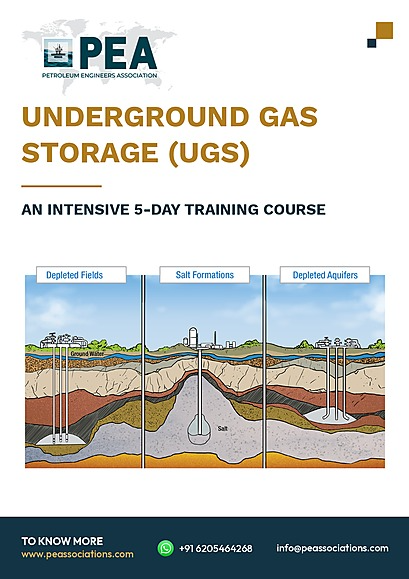
This training covers underground gas storage in depleted fields, aquifers and salt caverns. It works through storage type selection, cushion and working gas determination, deliverability and its dependence on inventory, injection and withdrawal cycling, inventory verification and gas migration, well design for high rate cyclic service, salt cavern development and behaviour, integrity and containment monitoring, surface facilities and the commercial performance measures that govern storage operations.
Description
A gas storage facility is judged on two things: how much working gas it holds and how fast it can deliver it on a cold day. Neither is a fixed property. Deliverability falls as inventory is withdrawn because reservoir pressure falls with it, so the ability to meet a peak demand at the end of a long withdrawal season is what actually matters commercially. Everything in storage engineering, cushion gas volume, well count and design, compression, facility capacity, follows from that requirement.
This training covers the three principal storage types and their engineering. Depleted field storage is developed first, covering conversion from production, cushion and working gas determination, deliverability characterisation and the cycling behaviour that distinguishes storage from production operation. Aquifer storage follows with its additional requirements: bubble development, water displacement, containment demonstration and the substantially larger cushion gas requirement. Salt cavern storage is then covered, including solution mining, cavern geometry, creep closure, cycling capability and its high deliverability characteristics. Well design for high rate cyclic service, tubular and completion selection, and integrity monitoring follow. Inventory verification, gas migration and loss accounting are addressed, then surface facilities, compression, dehydration and operations. Commercial performance measures close the training.
Cushion gas is the capital that never comes back. A portion of the gas injected into a storage reservoir must remain permanently to maintain the pressure required for deliverability, and in depleted field storage it commonly represents half or more of total inventory. That gas is purchased at the start of the project and recovered, if at all, only at the end of the facility's life. Determining the minimum cushion consistent with the required deliverability is one of the more valuable calculations in storage development, and using inert gas as partial cushion is one of the few ways to reduce it.
Deliverability is a curve, not a number. At full inventory a storage field can deliver at high rate; as gas is withdrawn, pressure falls and deliverability with it. Storage contracts specify rates that must be met at defined inventory levels, and meeting them at low inventory is the binding design case. Characterising the deliverability curve, verifying it in operation, and maintaining it as wells degrade is the central operational discipline.
Cyclic service is harder on wells than production service. A storage well is injected into and produced from at high rate every year, reversing flow direction and cycling pressure and temperature. Tubulars, completions, packers, cement and casing all experience fatigue that a production well does not, and integrity failures in storage wells have caused major incidents with substantial consequence. Well integrity management is a more prominent discipline in storage than in production operations.
Finally, inventory verification is genuinely difficult and commercially important. The gas in the reservoir cannot be measured directly; it is inferred from injected and withdrawn volumes, from pressure behaviour and from material balance, and the three do not always agree. Discrepancies may indicate measurement error, gas migration out of the storage volume, or an incorrect understanding of the storage geometry, and distinguishing between them matters for both operations and commercial accounting.
By the end of this training, participants will be able to:
- Compare storage types and select the appropriate option against deliverability, capacity and cycling requirements
- Determine cushion and working gas volumes and evaluate options for reducing cushion requirement
- Characterise deliverability as a function of inventory and verify it against operating data
- Analyse injection and withdrawal cycling behaviour and its effect on reservoir performance
- Verify inventory using material balance, pressure behaviour and volumetric methods
- Diagnose gas migration and loss and distinguish it from measurement error
- Design wells and completions for high rate cyclic storage service
- Assess well and caprock integrity requirements and design monitoring programmes
- Describe salt cavern development, behaviour and operation
- Specify surface facilities and evaluate storage commercial performance
The training works through storage engineering using operating data from storage facilities. Participants determine cushion and working gas, construct and verify deliverability curves, perform inventory verification by multiple methods and diagnose discrepancies. Well design for cyclic service is developed against the loads involved. Storage incidents including well integrity failures and gas migration events are examined for their cause and their consequences. Commercial performance measures are calculated for a storage operation across a withdrawal season.
Organisations sending participants to this training will:
- Improve deliverability performance and contract compliance
- Reduce cushion gas investment through better technical determination
- Improve inventory accounting accuracy and reduce unexplained discrepancies
- Reduce well integrity failures in cyclic service
- Improve storage facility design and conversion project outcomes
- Strengthen the technical basis of storage commercial commitments
Participants will:
- Determine cushion, working gas and deliverability for a storage facility
- Verify inventory and diagnose discrepancies
- Design wells for cyclic storage service
- Assess integrity risk and specify monitoring
- Understand storage commercial drivers and their technical basis
- Build a specialist capability in a growing sector as gas systems balance renewables
- Reservoir engineers working on gas storage facilities
- Production and operations engineers running storage operations
- Well and completion engineers designing storage wells
- Integrity engineers responsible for storage well and caprock integrity
- Facilities engineers supporting storage surface plant
- Project engineers developing or converting storage facilities
- Commercial staff requiring technical understanding of storage performance
Module 1 - Gas Storage Purpose and Types
- Why gas is stored: seasonal balancing, peaking, security, trading
- Storage service types: seasonal, peaking, balancing, strategic
- Depleted field storage and its characteristics
- Aquifer storage and its requirements
- Salt cavern storage and its characteristics
- Lined rock cavern and other options
- Comparison on capacity, deliverability, cycling and cost
- Storage type selection against service requirement
- Storage within the gas system and its role
- Storage economics and revenue models
Module 2 - Depleted Field Storage
- Site selection criteria for depleted field conversion
- Reservoir quality, seal and containment requirements
- Legacy well inventory and its assessment
- Conversion from production to storage operation
- Cushion and working gas definitions
- Cushion gas determination from deliverability requirements
- Inert gas cushion and its use
- Initial fill and pressure build-up
- Maximum operating pressure determination
- Reservoir behaviour under cycling
- Water encroachment and its management
- Conversion project cost and sequence
Module 3 - Aquifer Storage
- Aquifer storage principle and gas bubble formation
- Site selection and structural requirements
- Caprock demonstration in the absence of proven hydrocarbon containment
- Bubble development and its duration
- Water displacement and its energy requirement
- Cushion gas requirement and its magnitude
- Deliverability development over successive cycles
- Water production during withdrawal
- Containment monitoring and bubble extent verification
- Development risk and cost relative to depleted fields
- Operating experience with aquifer storage
Module 4 - Salt Cavern Storage
- Salt geology: domes, bedded salt and their suitability
- Solution mining and cavern development
- Cavern geometry, sonar surveying and volume determination
- Cavern spacing and pillar requirements
- Salt creep and cavern closure over time
- Minimum and maximum operating pressure determination
- Cushion gas requirement in caverns
- High deliverability and rapid cycling capability
- Cavern integrity testing and mechanical integrity demonstration
- Brine handling and disposal during development
- Cavern abandonment and closure
- Hydrogen and other gas storage in caverns
Module 5 - Deliverability and Inventory Behaviour
- Deliverability definition and its measurement
- Deliverability as a function of inventory and pressure
- Well deliverability and its aggregation to facility level
- Backpressure equation applied to storage wells
- Non-Darcy flow at high storage withdrawal rates
- Deliverability curve construction and verification
- Peak day and design case determination
- Deliverability decline over facility life and its causes
- Deliverability enhancement: new wells, stimulation, compression
- Injection capability and its constraints
- Turn cycle and its operational significance
Module 6 - Inventory Verification and Gas Migration
- Inventory accounting: injected, withdrawn, in place
- Material balance verification of inventory
- Pressure inventory relationship and its use
- Volumetric verification methods
- Reconciling metered volumes with reservoir behaviour
- Measurement uncertainty and its contribution to discrepancy
- Gas migration out of the storage volume
- Migration pathways: caprock, faults, wells, spill point
- Detecting migration from pressure and observation well data
- Native gas and its accounting
- Commercial consequences of unexplained inventory discrepancy
- Investigating and resolving inventory discrepancies
Module 7 - Well Design and Integrity
- Loads on a storage well: cyclic pressure, temperature, flow reversal
- Casing and tubing design for cyclic service
- Connection selection and fatigue considerations
- Cement design and long term integrity
- Completion design for high rate bidirectional flow
- Subsurface safety valve requirements
- Annulus monitoring and pressure management
- Corrosion and erosion in storage wells
- Well integrity monitoring and testing programmes
- Legacy well assessment and remediation in converted fields
- Storage well incidents and their lessons
- Regulatory integrity requirements for storage wells
Module 8 - Surface Facilities and Operations
- Facility configuration for injection and withdrawal
- Compression: injection compression and withdrawal boosting
- Compressor selection for bidirectional cyclic service
- Dehydration during withdrawal
- Separation, liquid handling and produced water
- Metering and custody transfer at the facility boundary
- Gas quality management and specification
- Facility capacity matching to reservoir deliverability
- Seasonal operating cycle and its planning
- Nomination, scheduling and operational response
- Maintenance planning around the storage cycle
- Emergency response and system security obligations
Module 9 - Commercial Performance and Development
- Storage products: firm, interruptible, park and loan
- Capacity, deliverability and injection rate as contracted services
- Revenue models: capacity fees, spreads, ancillary services
- Performance obligations and penalties
- Utilisation and cycling rate as performance measures
- Operating cost structure for a storage facility
- Cushion gas as a capital item and its treatment
- Storage valuation and spread economics
- Expansion and deliverability enhancement projects
- Regulatory framework and third party access
- Role of storage in systems with high renewable generation
- Conversion of storage facilities to hydrogen or CO2 service
Upon successful completion of this training course, delegates will be awarded an official Certificate of Completion issued by the Petroleum Engineers Association (PEA), an ISO 9001:2015 certified training organization. The certificate carries 10 Credits and formally records the total learning hours completed.
Each certificate is signed by the Course Facilitator and the CEO of the Petroleum Engineers Association, and serves as verifiable proof of professional training that delegates can present to employers and professional bodies worldwide.
Your expert course leader is a senior petroleum engineering consultant, certified trainer and university lecturer with more than 25 years of experience, specialising in underground gas storage.
His technical expertise covers storage types and their selection, cushion and working gas, deliverability and its determination, cycling behaviour and inventory verification, well design for high rate cyclic service, salt cavern storage, integrity and containment, surface facilities and storage operations and commercial performance.
Over the course of his career, he has provided consulting and project support to international operators and national oil companies across the Middle East, North Africa, Asia Pacific and the Americas, working on gas storage facility design studies, deliverability and inventory reviews and integrity assessment projects across depleted reservoir, aquifer and salt cavern storage sites.
He has designed and delivered technical training programmes on underground gas storage for engineers and technical teams, conducting these sessions both onsite and online across the Middle East, Asia Pacific, Africa and Europe.
Frequently Asked Questions
All course bookings made through PEA are strictly non-refundable. By registering for a course, you acknowledge and accept that all fees are payable in full and are not subject to refund under any circumstances, including changes in personal or professional commitments or partial attendance.
PEA reserves the right to make reasonable adjustments to course content, trainers, or schedules where necessary, without entitling delegates to a refund. Comprehensive details of each course — including objectives, target audience, and content — are clearly outlined before enrolment, and it is the responsibility of the delegate to ensure the course's suitability prior to booking.
For any inquiries related to cancellations or bookings, please contact our support team, who will be happy to assist you.
