


An Interactive 5-Day Training Course
PVT Properties of Reservoir Fluids
Understanding and applying PVT properties of reservoir fluids
Secure your spot now!
Duration
5 Days
Price
$ 4,000
Starting From
02 Aug 2027



PVT Properties of Reservoir Fluids
Have Questions ?
PVT Properties of Reservoir Fluids - PEA-PVTRF-PEA27
| Code | Date | Time | Duration | Location | Currency | Early Bird Fee Per Person |
|---|---|---|---|---|---|---|
| PEA-PVTRF-PEA27 | 02 - 06 Aug 2027 | 10 AM CST | 4 Hours Per Day |
Online |
USD |
4000 |
Need this for a group? We deliver the same course in-house — face-to-face at your location or online — tailored to your assets and team level. Contact info@peassociations.com.
Boost your team's skills and your budget! Enjoy group discounts for collaborative learning. Send an inquiry to info@peassociations.com.
PVT Properties of Reservoir Fluids
A complete course on reservoir fluid properties. It covers phase behaviour and fluid classification, sampling and sample validation, the standard laboratory studies and how to read their reports, empirical correlations and their limits, equation of state modelling and tuning, black oil and compositional fluid descriptions, and the application of PVT data throughout reservoir, production and facilities engineering.
Description
Reservoir fluid properties enter every calculation in petroleum engineering. Volumetrics need formation volume factor. Material balance needs formation volume factor, solution gas-oil ratio and compressibility, and is highly sensitive to all three. Inflow performance needs viscosity and density. Facility design needs the composition and the amount of gas that will evolve at each separator stage. Reserves depend on the surface volumes a reservoir barrel yields. An error in the fluid description propagates through all of it, and unlike most reservoir uncertainties it is entirely avoidable: fluid properties can be measured directly, and a good sample can be obtained from most wells if the sampling is planned before the well is put on production.
This course covers the subject from sampling through to application. It addresses phase behaviour and the classification of reservoir fluids, the design and execution of sampling programmes and the validation of samples for representativeness, the standard laboratory studies including constant composition expansion, differential liberation, constant volume depletion, separator tests, viscosity and swelling tests, reading and quality checking a laboratory report, empirical correlations and the data ranges over which they are valid, equation of state fundamentals, characterisation of the heavy fraction, tuning to laboratory data and the risks of over-tuning, black oil table generation and its limits, compositional and modified black oil descriptions, compositional gradients with depth, and the application of PVT data in reservoir engineering, production engineering, facility design and allocation.
A reservoir fluid is a mixture of hundreds of components existing at conditions where its phase behaviour is highly sensitive to pressure and temperature. As it is produced, that mixture moves from reservoir conditions to separator conditions and finally to stock tank conditions, splitting into gas and liquid phases whose compositions change at every stage. The engineering description of this process is what PVT analysis provides.
The measurement chain begins with a sample, and this is where most PVT problems originate. A subsurface sample taken from a well flowing below its bubble point is not representative because the gas and liquid entering the sampler are not in the proportions present in the reservoir. Surface samples recombined at an incorrect gas-oil ratio give a fluid with the wrong bubble point. Contamination with oil-based mud alters the composition and the measured properties. A laboratory can only report the properties of the sample it received, and a great deal of PVT data in use throughout the industry was measured on samples that were not representative of the reservoir fluid.
From a validated sample the laboratory produces a set of studies that describe the fluid under the depletion and separation processes it will experience. Converting those measurements into the form engineering calculations require involves further choices: which correlation to use when laboratory data is absent, whether a black oil description is adequate or a compositional model is required, how to characterise the plus fraction, and how far an equation of state may be tuned before it stops representing physics and starts fitting numbers. Each of these choices has consequences that show up much later, usually in a material balance that will not close or a facility that produces the wrong split. This course covers the chain end to end.
By the end of this training, participants will be able to:
- Classify reservoir fluids from composition, production data and phase behaviour
- Design fluid sampling programmes and select between subsurface and surface sampling methods
- Assess sample validity, representativeness and contamination
- Interpret the standard laboratory PVT studies and quality check a laboratory report
- Apply empirical correlations for oil, gas and water properties within their valid ranges
- Calculate gas properties including pseudo-critical parameters, compressibility factor and viscosity
- Build and tune an equation of state model to laboratory measurements
- Characterise the heavy fraction and apply component lumping appropriately
- Generate black oil tables and determine when a compositional description is required
- Apply PVT data correctly in reservoir, production, facility and allocation calculations
Organisations sending participants to this training will:
- Improve the quality of fluid data underpinning reserves, forecasts and facility design
- Design sampling programmes that produce representative samples the first time
- Detect unrepresentative samples and inconsistent laboratory reports before they enter calculations
- Reduce errors in material balance, volumetrics and allocation traceable to fluid properties
- Specify laboratory programmes that deliver what the engineering actually requires
- Improve facility and separator design through better prediction of surface yields
Participants will:
- Read and quality check a PVT laboratory report with confidence
- Design and supervise a fluid sampling programme
- Select and apply correlations appropriately and know when they should not be used
- Build and tune equation of state models
- Recognise when a black oil description is inadequate
- Apply fluid properties correctly across reservoir and production engineering
- Reservoir engineers and petroleum engineers at all levels
- Production engineers dealing with well performance and separation
- Process and facilities engineers designing separation and processing systems
- Petrophysicists and geoscientists working with fluid data
- Laboratory and fluid specialists working with operating companies
- Reserves and evaluation staff relying on fluid property data
- Graduate engineers building a fluid properties foundation
Module 1 — Phase Behaviour and Fluid Classification
- Pure component and multicomponent phase behaviour
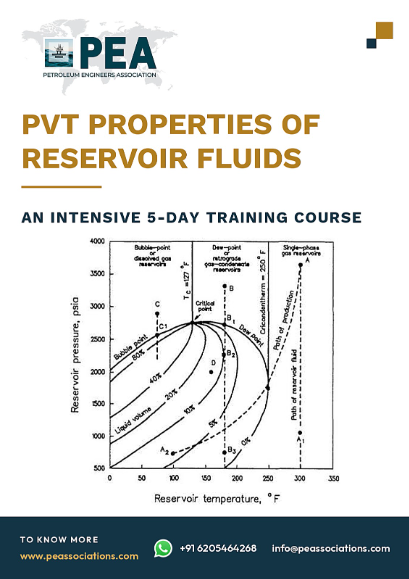
- Pressure-temperature diagrams, critical point and cricondentherm
- Reservoir fluid classes: dry gas, wet gas, condensate, volatile oil and black oil
- Retrograde condensation and its practical significance
- Field indicators of fluid type from gas-oil ratio, gravity and colour
- Near-critical fluids and classification difficulty
- Effect of fluid type on development and facility decisions
Module 2 — Fluid Sampling
- Sampling objectives and timing in the well life cycle
- Well conditioning before sampling
- Subsurface sampling: tools, depth selection and procedure
- Surface separator sampling and recombination
- Gas-oil ratio measurement and its effect on recombination
- Sampling saturated and undersaturated reservoirs
- Oil-based mud contamination, detection and correction
- Sample handling, transfer, storage and chain of custody
- Sample validation criteria and rejection
Module 3 — Laboratory PVT Studies
- Compositional analysis and the plus fraction
- Constant composition expansion and its outputs
- Differential liberation and its role for oil systems
- Constant volume depletion for condensate and volatile oil
- Separator tests and multi-stage separation optimisation
- Viscosity measurement across the pressure range
- Swelling and multiple contact tests for injection studies
- Reading a laboratory report section by section
- Quality control checks on laboratory data and consistency tests
Module 4 — Oil Property Correlations
- Bubble point pressure correlations and their data basis
- Solution gas-oil ratio correlations
- Oil formation volume factor above and below bubble point
- Oil density and specific gravity calculation
- Dead, saturated and undersaturated oil viscosity
- Isothermal oil compressibility
- Correlation selection by geographic and property range
- Tuning correlations to available laboratory points
- Error propagation from correlation choice into engineering results
Module 5 — Gas and Water Properties
- Gas composition, apparent molecular weight and gravity
- Pseudo-critical properties and mixing rules
- Non-hydrocarbon corrections for nitrogen, carbon dioxide and hydrogen sulphide
- Compressibility factor determination and iterative solution
- Gas formation volume factor and expansion factor
- Gas viscosity and gas compressibility
- Gas condensate two-phase behaviour and yield calculation
- Formation water properties, salinity and gas solubility
- Water formation volume factor, compressibility and viscosity
Module 6 — Equation of State Modelling
- Cubic equations of state and their formulation
- Binary interaction parameters and mixing rules
- Vapour-liquid equilibrium and flash calculation
- Plus fraction characterisation and splitting methods
- Component lumping and pseudo-component selection
- Tuning strategy: which parameters and in what order
- Matching saturation pressure, liberation and separator data
- Over-tuning and loss of predictive capability
- Validating a tuned model against data not used in tuning
Module 7 — Fluid Descriptions for Engineering Use
- Black oil table generation from laboratory or equation of state data
- Consistency requirements in black oil tables
- Limits of the black oil assumption
- Modified black oil and volatilised oil-gas ratio
- Fully compositional descriptions and when they are required
- Fluid description selection by process and study objective
- Compositional gradients with depth and their causes
- Multiple fluid regions and compartment-specific descriptions
- Handling injection gas and changing composition
Module 8 — Application Across Petroleum Engineering
- PVT inputs to volumetric and reserves calculation
- Material balance sensitivity to fluid property error
- Fluid properties in inflow performance and well modelling
- Multiphase flow and lift calculations
- Separator design, staging and surface yield optimisation
- Facility sizing and gas handling requirements
- Allocation, shrinkage factors and production accounting
- Injection and enhanced recovery studies requiring fluid data
- Flow assurance links: hydrates, wax and asphaltene stability
- Building a fluid data management practice for an asset
Upon successful completion of this training course, delegates will be awarded an official Certificate of Completion issued by the Petroleum Engineers Association (PEA), an ISO 9001:2015 certified training organization. The certificate carries 10 Credits and formally records the total learning hours completed.
Each certificate is signed by the Course Facilitator and the CEO of the Petroleum Engineers Association, and serves as verifiable proof of professional training that delegates can present to employers and professional bodies worldwide.
Your expert course leader is a senior petroleum engineering consultant, certified trainer and university lecturer with more than 25 years of experience, specialising in PVT properties of reservoir fluids.
His technical expertise covers phase behaviour, fluid sampling procedures, laboratory PVT studies, correlations, equation of state modelling, black oil and compositional fluid descriptions and the application of PVT data across reservoir and production engineering.
Over the course of his career, he has provided consulting and project support to international operators and national oil companies across the Middle East, North Africa, Asia Pacific and the Americas, working on fluid characterisation studies, PVT data quality reviews and reservoir fluid modelling projects across oil, gas and gas condensate fields.
He has designed and delivered technical training programmes on PVT properties of reservoir fluids for engineers and technical teams, conducting these sessions both onsite and online across the Middle East, Asia Pacific, Africa and Europe.
Frequently Asked Questions
All course bookings made through PEA are strictly non-refundable. By registering for a course, you acknowledge and accept that all fees are payable in full and are not subject to refund under any circumstances, including changes in personal or professional commitments or partial attendance.
PEA reserves the right to make reasonable adjustments to course content, trainers, or schedules where necessary, without entitling delegates to a refund. Comprehensive details of each course — including objectives, target audience, and content — are clearly outlined before enrolment, and it is the responsibility of the delegate to ensure the course's suitability prior to booking.
For any inquiries related to cancellations or bookings, please contact our support team, who will be happy to assist you.
