


An Interactive 5-Day Training Course
Naturally Fractured Reservoirs
Characterisation and management of naturally fractured reservoir systems
Secure your spot now!
Duration
5 Days
Price
$ 4,000
Starting From
14 Jun 2027



Naturally Fractured Reservoirs
Have Questions ?
Naturally Fractured Reservoirs - RE-NFR-PEA27
| Code | Date | Time | Duration | Location | Currency | Early Bird Fee Per Person |
|---|---|---|---|---|---|---|
| RE-NFR-PEA27 | 14 - 18 Jun 2027 | 10 AM CST | 4 Hours Per Day |
Online |
USD |
4000 |
Need this for a group? We deliver the same course in-house — face-to-face at your location or online — tailored to your assets and team level. Contact info@peassociations.com.
Boost your team's skills and your budget! Enjoy group discounts for collaborative learning. Send an inquiry to info@peassociations.com.
Naturally Fractured Reservoirs
Description
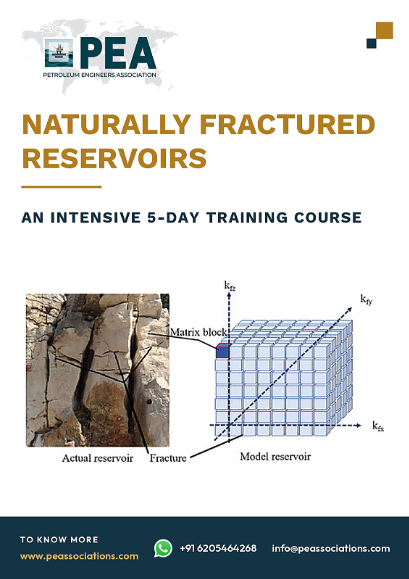
A naturally fractured reservoir contains two connected flow systems with radically different properties. The fracture network holds very little fluid but conducts it quickly. The matrix holds almost all the hydrocarbon but releases it slowly. Production behaviour is governed by the exchange between them, and that exchange is controlled by capillary pressure, gravity, wettability, block size and the pressure difference across the interface. Treat such a reservoir as a single porous medium and every important conclusion will be wrong: the productivity will be underestimated, the recovery factor will be overestimated, water breakthrough will arrive far earlier than predicted, and the material balance will return a pore volume that makes no geological sense.
This course covers fractured reservoirs as a distinct engineering problem. It works through fracture genesis, geometry and the characterisation of a fracture network from core, image logs, well tests, production data, seismic attributes and outcrop analogues; the dual porosity and dual permeability formulations and the parameters that define them; matrix-fracture transfer including capillary imbibition, gravity drainage, diffusion and block-to-block reinfiltration; well test signatures and their interpretation; production behaviour, decline characteristics and rapid water and gas breakthrough; modelling approaches from dual porosity simulation to discrete fracture networks; recovery mechanisms including depletion, waterflooding, gas injection and enhanced recovery in fractured systems; and the surveillance and management practices that fractured fields require.
Fractured reservoirs hold a substantial share of world reserves, concentrated in carbonate provinces but present in every rock type. They are recognised by their behaviour before they are recognised by their description: wells that produce at rates far above what matrix permeability could support, pressure that equalises across large distances almost instantly, water that arrives at a producer within weeks of injection starting, and recovery factors that stall at values the matrix properties do not explain.
The engineering difficulty is that the fracture network cannot be characterised directly at reservoir scale. Core shows fractures at centimetre scale in a sample that may or may not be representative and that was almost certainly damaged during recovery. Image logs show fracture intersections with the borehole, which is a one dimensional sample of a three dimensional network. Well tests give an effective permeability that is dominated by fractures but says nothing about their geometry. Production data reveals connectivity after the fact. Every characterisation is therefore inferential, built by combining evidence from different scales, and the resulting description must be tested against dynamic behaviour rather than assumed correct.
Recovery is where the consequences become expensive. In a water-wet fractured reservoir, water entering the fracture system imbibes into the matrix and displaces oil, and recovery can be good. In a mixed or oil-wet system, imbibition is weak or absent, water bypasses the matrix through the fracture network, and the field produces water while the matrix remains full of oil. Gravity drainage can be highly effective given sufficient block height and vertical continuity, and negligible where blocks are small. The difference between these outcomes is enormous, it is set by rock and fluid properties rather than by operational choice, and establishing which one applies is among the most valuable analyses that can be performed on a fractured field.
By the end of this training, participants will be able to:
- Describe fracture origin, geometry and the parameters used to characterise a fracture network
- Integrate core, image log, well test, production, seismic and analogue data into a fracture description
- Distinguish dual porosity, dual permeability and single medium behaviour from dynamic evidence
- Determine storativity ratio and interporosity flow coefficient from well test analysis
- Quantify matrix-fracture transfer including capillary imbibition, gravity drainage and diffusion
- Assess the effect of wettability and block size on recovery from the matrix
- Interpret production behaviour, decline characteristics and early water and gas breakthrough
- Select modelling approaches appropriate to the fracture system and the study objective
- Evaluate recovery mechanisms including depletion, waterflooding and gas injection in fractured systems
- Design surveillance and management practices suited to fractured field production
The course is delivered as a technical programme that moves from fracture characterisation to production management, treating the fractured system as a two-medium problem throughout. Each concept is developed through its physical mechanism and then applied to field data from fractured carbonate and clastic reservoirs. Case material includes fields where fracture behaviour was recognised late and the development suffered, and fields where matrix contribution was correctly assessed and recovery matched expectation. The limits of characterisation are addressed directly, since fracture descriptions are always partly inferred.
Organisations sending participants to this training will:
- Avoid development decisions based on reservoir descriptions that ignore fracture behaviour
- Improve recovery forecasts and reserves estimates for fractured assets
- Anticipate and manage rapid water and gas breakthrough rather than reacting to it
- Select recovery methods suited to the matrix-fracture system rather than to a conventional analogue
- Design fracture characterisation and surveillance programmes that deliver usable information
- Reduce the risk of injecting into a fracture network that bypasses the oil
Participants will:
- Recognise fractured reservoir behaviour from dynamic evidence
- Build a fracture description from the data actually available
- Quantify matrix contribution and its dependence on wettability and block size
- Interpret well tests and production data from fractured systems correctly
- Select and justify modelling and recovery approaches for fractured fields
- Take technical responsibility for a fractured asset
- Reservoir engineers working on fractured or suspected fractured fields
- Development and production geologists in carbonate and fractured provinces
- Petrophysicists interpreting fractures from image and conventional logs
- Simulation engineers modelling dual porosity systems
- Production engineers dealing with early breakthrough and conformance in fractured fields
- Well test analysts interpreting fractured reservoir responses
- Subsurface team leads and technical managers responsible for fractured assets
Module 1 — Fracture Origin, Geometry and Classification
- Mechanical origin of natural fractures and stress control
- Tectonic, regional, contractional and diagenetic fracture sets
- Fracture geometry: orientation, spacing, aperture, length and connectivity
- Fracture porosity, permeability and their orders of magnitude
- Fracture reservoir classification by matrix and fracture contribution
- Effect of lithology, bed thickness and mechanical stratigraphy
- Fault damage zones and their relationship to fracture density
- Fracture corridors, swarms and karst-associated systems
Module 2 — Fracture Characterisation From Data
- Core observation, fracture logging and induced fracture recognition
- Borehole image log interpretation and fracture picking
- Distinguishing open, mineralised and drilling induced fractures
- Conventional log responses to fracturing
- Mud loss, drilling and completion evidence
- Well test derived fracture permeability and connectivity
- Production and interference evidence of fracture connectivity
- Seismic attributes, curvature and fracture prediction
- Outcrop analogues and their appropriate use
- Building an integrated fracture description across scales
Module 3 — Dual Porosity Theory and Parameters
- Warren and Root idealisation and its assumptions
- Storativity ratio and its physical meaning
- Interporosity flow coefficient and shape factor
- Dual porosity versus dual permeability behaviour
- Effective properties of the combined system
- Pseudo-steady-state and transient matrix flow models
- Limitations of the idealised sugar cube representation
- Representative block size determination
Module 4 — Matrix-Fracture Transfer Mechanisms
- Capillary imbibition and its rate dependence
- Wettability control on imbibition and its measurement
- Gravity drainage and block height requirements
- Capillary continuity and block-to-block reinfiltration
- Molecular diffusion in gas injection processes
- Thermal transfer in fractured thermal recovery
- Fluid expansion contribution from the matrix
- Transfer function formulation and shape factor derivation
Module 5 — Well Testing in Fractured Reservoirs
- Characteristic dual porosity pressure derivative response
- Extracting storativity ratio and interporosity coefficient
- Dual permeability and crossflow signatures
- Effect of wellbore storage on early time fracture response
- Fracture corridor and high conductivity feature responses
- Boundary and composite behaviour in fractured systems
- Interference and pulse testing for fracture connectivity
- Non-uniqueness in fractured reservoir test interpretation
Module 6 — Production Behaviour and Material Balance
- Characteristic production and pressure behaviour of fractured fields
- Rapid pressure equalisation and its diagnostic value
- Early water and gas breakthrough mechanisms
- Decline behaviour in fracture-dominated production
- Material balance formulation for two-medium systems
- Apparent pore volume inconsistencies and their explanation
- Estimating fracture and matrix contribution from field history
- Surveillance data required for fractured field diagnosis
Module 7 — Modelling Approaches
- Single medium representation and when it is defensible
- Dual porosity and dual permeability simulation formulations
- Shape factor selection and sensitivity
- Discrete fracture network construction and conditioning
- Upscaling a discrete network to flow simulation properties
- Hybrid and multiple interacting continua approaches
- Model selection by objective, data availability and fracture system
- History matching fractured reservoirs and parameter non-uniqueness
Module 8 — Recovery Mechanisms and Field Development
- Primary depletion behaviour and expansion drive in fractured systems
- Waterflooding fractured reservoirs and the imbibition requirement
- Water injection in oil-wet and mixed-wet fractured systems
- Gas injection, gravity drainage and gas-oil gravity drainage projects
- Gas cap expansion and gravity stable displacement
- Enhanced recovery options: surfactants, wettability alteration and thermal
- Well placement, horizontal wells and fracture intersection strategy
- Completion strategy and zonal isolation in fractured wells
- Recovery factor expectation by system type
Module 9 — Production Management and Surveillance
- Rate management and critical rate for coning in fractured systems
- Water and gas shutoff options and their limited effectiveness
- Conformance control in fracture-dominated flow
- Injection allocation and pattern management in fractured fields
- Surveillance programme design for fractured assets
- Tracer testing and connectivity monitoring
- Diagnosing whether the matrix is contributing
- Updating the fracture description as production evidence accumulates
- Managing expectations on recovery factor and field life
Upon successful completion of this training course, delegates will be awarded an official Certificate of Completion issued by the Petroleum Engineers Association (PEA), an ISO 9001:2015 certified training organization. The certificate carries 10 Credits and formally records the total learning hours completed.
Each certificate is signed by the Course Facilitator and the CEO of the Petroleum Engineers Association, and serves as verifiable proof of professional training that delegates can present to employers and professional bodies worldwide.
Your expert course leader is a senior petroleum engineering consultant, certified trainer and university lecturer with more than 25 years of experience, specialising in naturally fractured reservoirs.
His technical expertise covers fracture characterisation, dual porosity behaviour, matrix-fracture fluid transfer, well testing signatures in fractured systems, modelling approaches for fractured reservoirs and the recovery mechanisms and production management practices specific to fractured fields.
Over the course of his career, he has provided consulting and project support to international operators and national oil companies across the Middle East, North Africa, Asia Pacific and the Americas, working on fractured carbonate field studies, reservoir characterisation projects and production optimisation in naturally fractured assets.
He has designed and delivered technical training programmes on naturally fractured reservoirs for engineers and technical teams, conducting these sessions both onsite and online across the Middle East, Asia Pacific, Africa and Europe.
Frequently Asked Questions
All course bookings made through PEA are strictly non-refundable. By registering for a course, you acknowledge and accept that all fees are payable in full and are not subject to refund under any circumstances, including changes in personal or professional commitments or partial attendance.
PEA reserves the right to make reasonable adjustments to course content, trainers, or schedules where necessary, without entitling delegates to a refund. Comprehensive details of each course — including objectives, target audience, and content — are clearly outlined before enrolment, and it is the responsibility of the delegate to ensure the course's suitability prior to booking.
For any inquiries related to cancellations or bookings, please contact our support team, who will be happy to assist you.
