


An Interactive 5-Day Training Course
Gas Well Deliverability & Back-Pressure Testing
Testing and forecasting gas well deliverability performance
Secure your spot now!
Duration
5 Days
Price
$ 4,000
Starting From
02 Aug 2027



Gas Well Deliverability & Back-Pressure Testing
Have Questions ?
Gas Well Deliverability & Back-Pressure Testing - RE-GWD-PEA27
| Code | Date | Time | Duration | Location | Currency | Early Bird Fee Per Person |
|---|---|---|---|---|---|---|
| RE-GWD-PEA27 | 02 - 06 Aug 2027 | 10 AM CST | 4 Hours Per Day |
Online |
USD |
4000 |
Need this for a group? We deliver the same course in-house — face-to-face at your location or online — tailored to your assets and team level. Contact info@peassociations.com.
Boost your team's skills and your budget! Enjoy group discounts for collaborative learning. Send an inquiry to info@peassociations.com.
Gas Well Deliverability & Back-Pressure Testing
Description
Gas well deliverability determines what a field can contract to supply. Gas sales agreements commit to daily quantities that the wells must be able to deliver against a defined pipeline pressure, and the ability to meet that commitment through field life depends on well deliverability declining predictably as reservoir pressure falls. Establishing deliverability requires testing, and interpreting those tests requires understanding why gas flow behaves differently from liquid flow.
This training develops that understanding. Gas flow theory is covered with the real gas pseudo-pressure formulation that handles the pressure dependence of gas properties, together with the conditions under which pressure and pressure squared approximations are acceptable. The empirical backpressure equation and the theoretical laminar-inertial-turbulent equation are then developed, with their coefficients and their physical meaning. Test types are covered in detail: flow after flow testing and its stabilisation requirement, isochronal testing for low permeability wells, and modified isochronal testing where even isochronal stabilisation is impractical. Analysis procedures for each are worked through, including the determination of the stabilised deliverability curve from transient data. Non-Darcy flow, condensate banking, water production, deliverability decline and forecasting complete the training.
Gas properties change with pressure, and that is why gas well analysis differs from oil well analysis. Viscosity and compressibility factor both vary substantially across the pressure range between the reservoir and the wellbore, which means the flow equation cannot be integrated with constant properties. Pseudo-pressure handles this by absorbing the property variation into a transformed variable, and using it correctly is what makes gas well analysis quantitative. Pressure squared approximations work at low pressure and pressure approximations work at high pressure, but neither works across a wide range.
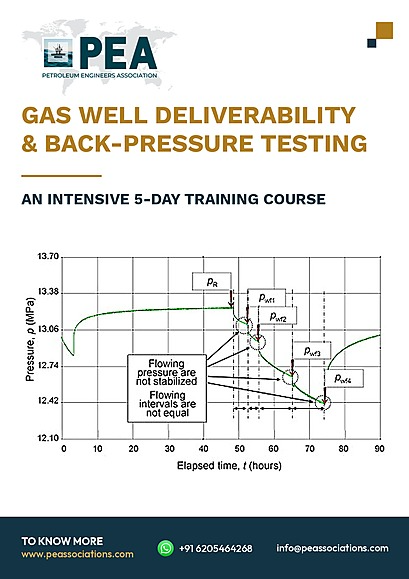
Stabilisation is the practical difficulty in deliverability testing. The backpressure equation describes stabilised flow, which requires the transient to have reached the drainage boundary. In a high permeability well this takes hours. In a tight gas well it can take months, which makes a conventional flow after flow test impossible. Isochronal testing solves this by using equal duration flow periods that need not be stabilised, combined with one extended flow to establish the stabilised curve position. Understanding why the method works is necessary to apply it correctly.
Non-Darcy flow is a gas well phenomenon with real consequences. At the high velocities near a gas wellbore, the relationship between pressure drop and rate becomes non-linear, producing an apparent skin that increases with rate. A single-rate test cannot distinguish this rate dependent skin from mechanical damage, which is why multi-rate testing is required to separate them. Treating a turbulence-dominated well for damage produces no benefit.
Finally, deliverability declines through field life as reservoir pressure falls, and the shape of that decline determines when compression must be installed and when the contracted rate can no longer be met. Forecasting deliverability rather than only production is what allows compression timing, well count and contract commitments to be planned rather than discovered.
By the end of this training, participants will be able to:
- Apply real gas pseudo-pressure formulation and select appropriate approximations for the pressure range
- Derive and apply the empirical backpressure deliverability equation and determine its coefficients
- Apply the laminar-inertial-turbulent deliverability equation and interpret its coefficients physically
- Design flow after flow, isochronal and modified isochronal tests appropriate to reservoir permeability
- Analyse deliverability test data and construct stabilised deliverability curves
- Determine absolute open flow potential and interpret it correctly
- Separate mechanical skin from rate dependent non-Darcy skin using multi-rate data
- Assess the effect of condensate banking and water production on gas well deliverability
- Forecast deliverability decline through field life and determine compression timing
- Use deliverability results in well count, contract commitment and development planning
Organisations sending participants to this training will:
- Establish gas well deliverability reliably for contract commitment and field planning
- Design deliverability tests that produce interpretable results in low permeability reservoirs
- Avoid stimulation spend on wells whose skin is turbulence rather than damage
- Improve compression timing decisions and their capital planning
- Improve well count determination for gas developments
- Strengthen the technical basis of gas supply commitments
Participants will:
- Analyse gas deliverability tests independently and correctly
- Design tests appropriate to reservoir permeability and operational constraint
- Distinguish damage from turbulence in gas well performance
- Forecast deliverability decline and its consequences
- Apply pseudo-pressure correctly rather than defaulting to approximations
- Build a specialist skill applied across every gas producing asset
- Reservoir engineers working gas and gas condensate assets
- Production engineers responsible for gas well performance
- Well test engineers and analysts
- Development engineers planning gas field well counts and compression
- Reserves and evaluation engineers assessing gas properties
- Operations engineers managing gas delivery against contract
- Commercial staff requiring technical understanding of deliverability commitments
Module 1 - Gas Flow Fundamentals
- Gas properties: compressibility factor, viscosity, formation volume factor, compressibility
- Pressure dependence of gas properties and its consequence for flow equations
- Real gas pseudo-pressure definition and calculation
- Pressure and pressure squared approximations and their valid ranges
- Pseudo-time and its application
- Radial flow of gas and the deliverability equation
- Transient, stabilised and pseudo-steady state gas flow
- Time to stabilisation and its dependence on permeability
- Total compressibility for gas systems
Module 2 - Deliverability Equations
- Empirical backpressure equation and its historical basis
- Deliverability coefficient C and exponent n and their meaning
- Physical bounds on the exponent n
- Laminar-inertial-turbulent equation derivation
- Coefficients a and b and their physical interpretation
- Relationship between the two formulations
- Absolute open flow potential definition and its uses and misuses
- Deliverability against a specified wellhead or pipeline pressure
- Converting between bottomhole and wellhead deliverability
- Selecting the equation form for a given application
Module 3 - Flow After Flow Testing
- Flow after flow test procedure and sequence
- Stabilisation requirement and its verification
- Rate selection and sequencing
- Data acquisition requirements and gauge placement
- Constructing the deliverability plot
- Determining C and n from the plot
- Determining a and b from the LIT plot
- Applicability limits: permeability, drainage area, test duration
- Common errors: unstabilised data treated as stabilised
- Worked flow after flow analyses
Module 4 - Isochronal Testing
- Rationale for isochronal testing in low permeability wells
- Isochronal test procedure and shut-in requirements
- Equal duration flow periods and their basis
- Extended flow period and its purpose
- Constructing transient and stabilised deliverability curves
- Determining the stabilised curve from the extended flow point
- Analysis using both empirical and LIT formulations
- Test duration selection and operational practicality
- Verifying that shut-in periods are adequate
- Worked isochronal test analyses
Module 5 - Modified Isochronal Testing
- Rationale where full pressure recovery is impractical
- Modified isochronal procedure and its assumptions
- Use of unstabilised shut-in pressures
- Analysis procedure and its differences from isochronal analysis
- Accuracy and limitations of the modified method
- Selecting between flow after flow, isochronal and modified isochronal
- Test design decision framework
- Worked modified isochronal analyses
Module 6 - Non-Darcy Flow and Skin
- Non-Darcy flow mechanism and the Forchheimer equation
- Turbulence coefficient and its determination
- Rate dependent skin and its magnitude
- Separating mechanical skin from turbulence skin using multi-rate data
- Effect of completion geometry on turbulence
- Perforation density, phasing and their effect on non-Darcy skin
- Gravel pack and sand control turbulence effects
- Hydraulic fracturing and turbulence in the fracture
- Deciding whether stimulation will improve deliverability
- Completion design to reduce turbulence
Module 7 - Multiphase and Fluid Effects
- Condensate banking and its effect on gas deliverability
- Two-phase pseudo-pressure for condensate systems
- Deliverability testing in gas condensate wells
- Water production and its effect on gas deliverability
- Liquid loading and its onset
- Critical unloading velocity and deliverability implications
- Relative permeability effects on gas flow
- High water saturation and reduced gas mobility
- Distinguishing fluid effects from reservoir and completion effects
Module 8 - Deliverability Forecasting and Application
- Deliverability decline with reservoir pressure depletion
- Updating deliverability curves as pressure falls
- Forecasting well deliverability through field life
- Effect of wellhead and pipeline pressure on achievable rate
- Compression requirement determination and timing
- Tubing size and its effect on deliverability
- Well count determination from deliverability and contract requirement
- Deliverability against contract quantity and firm commitment
- Field deliverability aggregation and its constraints
- Deliverability surveillance and periodic retesting
- Integrating deliverability into development and reserves work
Upon successful completion of this training course, delegates will be awarded an official Certificate of Completion issued by the Petroleum Engineers Association (PEA), an ISO 9001:2015 certified training organization. The certificate carries 10 Credits and formally records the total learning hours completed.
Each certificate is signed by the Course Facilitator and the CEO of the Petroleum Engineers Association, and serves as verifiable proof of professional training that delegates can present to employers and professional bodies worldwide.
Your expert course leader is a senior petroleum engineering consultant, certified trainer and university lecturer with more than 25 years of experience, specialising in gas well deliverability and back-pressure testing.
His technical expertise covers gas flow theory and pseudo-pressure, the backpressure and LIT deliverability equations, flow after flow, isochronal and modified isochronal test design and analysis, non-Darcy flow, condensate and water effects, absolute open flow potential and deliverability forecasting.
Over the course of his career, he has provided consulting and project support to international operators and national oil companies across the Middle East, North Africa, Asia Pacific and the Americas, working on gas well test design and interpretation studies, deliverability forecasting and gas field development planning projects.
He has designed and delivered technical training programmes on gas well deliverability and back-pressure testing for engineers and technical teams, conducting these sessions both onsite and online across the Middle East, Asia Pacific, Africa and Europe.
Frequently Asked Questions
All course bookings made through PEA are strictly non-refundable. By registering for a course, you acknowledge and accept that all fees are payable in full and are not subject to refund under any circumstances, including changes in personal or professional commitments or partial attendance.
PEA reserves the right to make reasonable adjustments to course content, trainers, or schedules where necessary, without entitling delegates to a refund. Comprehensive details of each course — including objectives, target audience, and content — are clearly outlined before enrolment, and it is the responsibility of the delegate to ensure the course's suitability prior to booking.
For any inquiries related to cancellations or bookings, please contact our support team, who will be happy to assist you.
