


An Interactive 5-Day Training Course
Tight Gas Reservoir Engineering
Engineering low permeability tight gas reservoirs for production
Secure your spot now!
Duration
5 Days
Price
$ 4,000
Starting From
26 Jul 2027



Tight Gas Reservoir Engineering
Have Questions ?
Tight Gas Reservoir Engineering - RE-TGR-PEA27
| Code | Date | Time | Duration | Location | Currency | Early Bird Fee Per Person |
|---|---|---|---|---|---|---|
| RE-TGR-PEA27 | 26 - 30 Jul 2027 | 10 AM CST | 4 Hours Per Day |
Online |
USD |
4000 |
Need this for a group? We deliver the same course in-house — face-to-face at your location or online — tailored to your assets and team level. Contact info@peassociations.com.
Boost your team's skills and your budget! Enjoy group discounts for collaborative learning. Send an inquiry to info@peassociations.com.
Tight Gas Reservoir Engineering
Description
Tight gas reservoirs contain large volumes of gas in rock with permeability too low to produce at commercial rate without stimulation. Every well requires hydraulic fracturing, wells produce in transient flow for years, and the recovery from each well depends on the fracture created rather than on a drainage area that can be defined geometrically. This changes reserves estimation, well spacing, forecasting and economics relative to conventional gas, and each of those changes is a source of error for engineers applying conventional methods.
This training covers the discipline. Low permeability rock properties and gas flow behaviour are developed first, including slip flow, non-Darcy effects and the measurement difficulties at these permeabilities. Petrophysical evaluation follows, covering the specific problems of saturation and permeability determination in tight rock and the resulting uncertainty in gas in place. Stress-dependent permeability and its effect on productivity through depletion is then addressed. Hydraulic fracturing requirements are covered from the reservoir engineering side, including fracture geometry requirements, containment and the relationship between fracture properties and well performance. Long duration transient flow, its analysis and the failure of conventional decline methods during it follow. Reserves estimation, well spacing determination, development design and economics close the training.
Transient flow lasts a very long time in tight gas, and that governs almost everything else. At permeabilities in the microdarcy range, the pressure transient may not reach the drainage boundary for years, which means the well produces in linear or transitional flow throughout the period during which reserves are booked and development decisions are made. Conventional decline analysis assumes boundary dominated flow and produces the wrong answer during transient flow, generally too optimistic, and the resulting reserves revisions have been substantial across the industry.
Well spacing cannot be determined by drainage area in the conventional sense. In a reservoir with adequate permeability, wells drain a definable region and spacing follows from it. In tight gas, the volume contacted depends on the fracture created and on the very slow pressure propagation into the matrix, so wells placed closer together may each recover nearly as much as they would in isolation for many years before interference appears. Determining optimal spacing requires either pilot testing at multiple densities or careful transient analysis, and getting it wrong is expensive in either direction.
Stress-dependent permeability adds a further complication. Permeability in tight rock is more sensitive to effective stress than in conventional rock, so as reservoir pressure declines and effective stress rises, permeability falls. This accelerates production decline beyond what a constant permeability model would predict, and it affects both forecasting and the estimation of permeability from early production data.
Finally, tight gas economics are driven by well cost and by the tail. Each well requires drilling and stimulation at a cost comparable to a conventional well while recovering less, so the number of wells required per unit of reserves is high. Wells produce at low rates for long periods, which means a substantial fraction of recovery comes in the discounted tail and the economic limit is reached while significant gas remains. Small changes in well cost, stimulation cost or gas price move a large number of locations across the economic threshold.
By the end of this training, participants will be able to:
- Characterise low permeability rock properties and account for measurement difficulty at microdarcy permeability
- Evaluate tight gas formations petrophysically and quantify the uncertainty in gas in place
- Assess stress-dependent permeability and its effect on well performance through depletion
- Specify hydraulic fracture geometry requirements from a reservoir engineering basis
- Identify and analyse long duration transient flow in tight gas wells
- Apply rate transient analysis appropriate to transient-dominated production
- Recognise where conventional decline analysis produces erroneous results and apply appropriate alternatives
- Estimate reserves for tight gas wells with appropriate evidence and constraints
- Determine well spacing using pilot testing and transient analysis rather than drainage area assumptions
- Evaluate tight gas development economics and their sensitivity to cost and price
Organisations sending participants to this training will:
- Improve reserves reliability for tight gas assets and reduce revision frequency
- Improve well spacing decisions and the capital efficiency of development programmes
- Improve stimulation specification through better reservoir engineering input
- Improve production forecasting for transient-dominated wells
- Assess tight gas acquisition and development opportunities more accurately
- Reduce development spend on locations that economics do not support
Participants will:
- Recognise where conventional reservoir engineering methods fail in tight rock
- Analyse transient-dominated production data correctly
- Estimate tight gas reserves with defensible evidence
- Contribute to spacing and development design decisions
- Understand the economics that govern tight gas viability
- Build a capability applicable to tight gas and to unconventional resources generally
- Reservoir engineers working tight gas assets
- Production engineers analysing tight gas well performance
- Development engineers planning tight gas programmes
- Reserves and evaluation engineers
- Completion engineers working on tight gas stimulation
- Petrophysicists evaluating low permeability formations
- Technical and commercial staff evaluating tight gas opportunities
Module 1 - Tight Gas Systems and Characterisation
- Tight gas definition and its regulatory and technical variants
- Geological settings and depositional environments
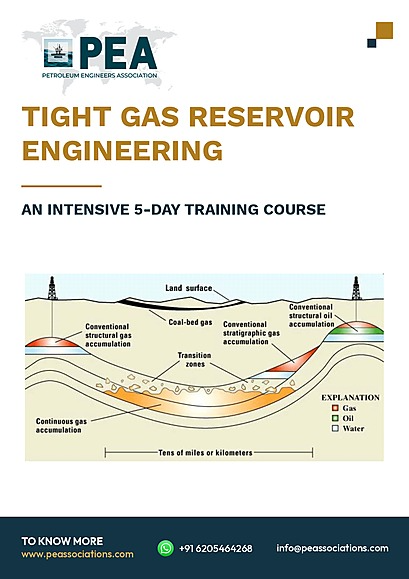
- Basin centred gas and continuous accumulations
- Distinction from shale gas and conventional gas
- Permeability ranges and their measurement difficulty
- Core permeability measurement: steady state, pulse decay, crushed rock
- Klinkenberg and slip flow effects
- Pore structure and its characterisation
- Natural fractures and their contribution
- Screening a formation as tight gas
Module 2 - Petrophysical Evaluation
- Log response in tight gas formations
- Porosity determination and its uncertainty
- Water saturation evaluation and low resistivity pay
- Capillary bound water and its significance
- Permeability estimation from logs and core calibration
- Nuclear magnetic resonance applications in tight rock
- Net pay definition and cut-offs in tight formations
- Gas in place estimation and its uncertainty
- Core-log integration and its difficulties
- Consequences of petrophysical uncertainty for reserves
Module 3 - Rock Properties and Stress Dependence
- Effective stress and its calculation
- Stress-dependent permeability and its magnitude in tight rock
- Permeability reduction with depletion
- Pore volume compressibility in tight formations
- Laboratory measurement of stress dependence
- Effect on well productivity through field life
- Effect on production forecasting
- Fracture conductivity degradation with increasing closure stress
- Incorporating stress dependence into analysis and simulation
- Geomechanical characterisation for tight gas
Module 4 - Stimulation Requirements
- Why every tight gas well requires stimulation
- Fracture geometry requirements for tight gas
- Optimal dimensionless conductivity in low permeability rock
- Fracture length as the dominant design variable
- Height containment and water zone risk
- Stress profile determination for design
- Vertical against horizontal well stimulation
- Multi-stage stimulation in horizontal wells
- Fluid and proppant selection consequences
- Cleanup and its difficulty in tight formations
- Reservoir engineering input to stimulation design
Module 5 - Flow Behaviour and Transient Analysis
- Flow regimes in fractured tight gas wells
- Duration of transient flow and its estimation
- Linear flow and its dominance
- Time to boundary dominated flow
- Pseudo-pressure and pseudo-time for tight gas
- Rate transient analysis methods
- Straight-line and type curve analysis
- Estimating fracture half-length and permeability
- Flowing material balance and contacted volume
- Pressure transient testing in tight gas and its practicality
- Analysis with poor quality rate and pressure data
Module 6 - Production Forecasting and Reserves
- Why conventional decline analysis fails during transient flow
- Hyperbolic b exponent behaviour in tight gas wells
- Modified decline models for transient-dominated production
- Terminal decline constraint and its selection
- Forecasting from transient analysis results
- Type well construction for tight gas
- EUR estimation and its uncertainty
- Reserves classification and evidence requirements
- Proved undeveloped location booking
- Historical reserves revision experience and its causes
- Probabilistic forecasting for tight gas wells
Module 7 - Well Spacing and Development Design
- Why drainage area concepts fail in tight gas
- Contacted volume and its relationship to spacing
- Interference timing and its detection
- Spacing pilot design and interpretation
- Recovery per well against recovery per section
- Vertical against horizontal well development
- Lateral length and stage count optimisation
- Infill drilling and depletion effects
- Development sequencing and its consequences
- Optimal spacing determination and its dependence on price
Module 8 - Field Management and Economics
- Production operations for low rate long life wells
- Liquid loading and deliquification in tight gas wells
- Compression requirement and timing
- Wellhead pressure reduction and its production benefit
- Surveillance programme for a tight gas field
- Refracturing candidates and expected uplift
- Well cost structure and its reduction
- Development economics and breakeven analysis
- Sensitivity to gas price, well cost and stimulation cost
- Portfolio management across acreage quality
- Economic limit and abandonment in tight gas
Upon successful completion of this training course, delegates will be awarded an official Certificate of Completion issued by the Petroleum Engineers Association (PEA), an ISO 9001:2015 certified training organization. The certificate carries 10 Credits and formally records the total learning hours completed.
Each certificate is signed by the Course Facilitator and the CEO of the Petroleum Engineers Association, and serves as verifiable proof of professional training that delegates can present to employers and professional bodies worldwide.
Your expert course leader is a senior petroleum engineering consultant, certified trainer and university lecturer with more than 25 years of experience, specialising in tight gas reservoir engineering.
His technical expertise covers low permeability rock and gas flow behaviour, petrophysical evaluation difficulties, stress-dependent permeability, hydraulic fracturing requirements, long transient flow and its analysis, reserves estimation, well spacing, development economics and field management.
Over the course of his career, he has provided consulting and project support to international operators and national oil companies across the Middle East, North Africa, Asia Pacific and the Americas, working on tight gas field development studies, hydraulic fracturing programme design and low permeability reservoir characterisation projects.
He has designed and delivered technical training programmes on tight gas reservoir engineering for engineers and technical teams, conducting these sessions both onsite and online across the Middle East, Asia Pacific, Africa and Europe.
Frequently Asked Questions
All course bookings made through PEA are strictly non-refundable. By registering for a course, you acknowledge and accept that all fees are payable in full and are not subject to refund under any circumstances, including changes in personal or professional commitments or partial attendance.
PEA reserves the right to make reasonable adjustments to course content, trainers, or schedules where necessary, without entitling delegates to a refund. Comprehensive details of each course — including objectives, target audience, and content — are clearly outlined before enrolment, and it is the responsibility of the delegate to ensure the course's suitability prior to booking.
For any inquiries related to cancellations or bookings, please contact our support team, who will be happy to assist you.
