


An Interactive 5-Day Training Course
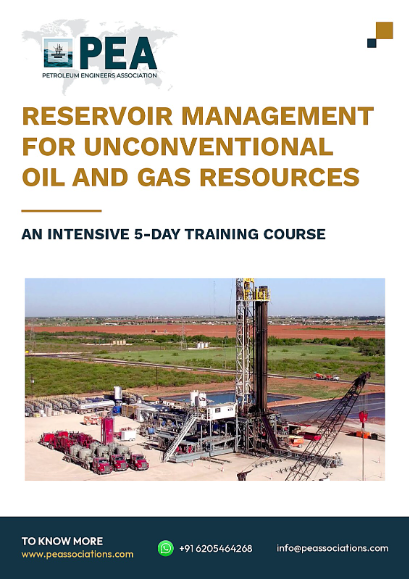
Reservoir Management for Unconventional Oil and Gas Resources
Managing shale and tight oil and gas assets
Secure your spot now!
Duration
5 Days
Price
$ 4,000
Starting From
23 Aug 2027



Reservoir Management for Unconventional Oil and Gas Resources
Have Questions ?
Reservoir Management for Unconventional Oil and Gas Resources - PRE-UCRG-PEA27
| Code | Date | Time | Duration | Location | Currency | Early Bird Fee Per Person |
|---|---|---|---|---|---|---|
| PRE-UCRG-PEA27 | 23 - 27 Aug 2027 | 10 AM CST | 4 Hours Per Day |
Online |
USD |
4000 |
Need this for a group? We deliver the same course in-house — face-to-face at your location or online — tailored to your assets and team level. Contact info@peassociations.com.
Boost your team's skills and your budget! Enjoy group discounts for collaborative learning. Send an inquiry to info@peassociations.com.
Reservoir Management for Unconventional Oil and Gas Resources
This training covers the management of unconventional oil and gas assets through their development and producing life. It works through play and resource assessment, landing zone and spacing decisions, completion design and its effect on recovery, parent-child depletion interference, production forecasting and reserves, surveillance programmes, refracturing and enhanced recovery options, and the economic framework that connects these decisions.
Description
Unconventional development inverts the conventional reservoir management problem. In a conventional field the reservoir is largely fixed and the engineering task is to drain it efficiently through a small number of wells. In an unconventional play the rock has negligible matrix permeability and produces only through induced fracture networks, which means the recoverable volume is created by the completion rather than found by the well. Decisions about well spacing, lateral length, landing zone, proppant and fluid intensity, and the sequence in which wells are drilled therefore determine how much of the resource is ever recovered.
This training covers those decisions as an integrated management problem. It begins with resource assessment and play characterisation, covering the rock, fluid and geomechanical properties that distinguish productive from marginal acreage. It then addresses development design: landing zone selection, lateral placement, well spacing and stacking, and the trade-off between recovery per well and recovery per section. Completion intensity is covered as a reservoir management variable, since proppant and fluid loading determine stimulated volume and therefore the shape of the production profile. Parent-child interference, depletion-induced stress change and frac hits are addressed in detail because they are the dominant cause of underperformance in infill drilling. The training closes with production forecasting and reserves, surveillance programme design, refracturing, enhanced recovery by gas injection, and the economics that govern development pace and capital allocation.
Recovery factors in unconventional reservoirs are low and the reasons are physical. Matrix permeability in the nanodarcy range means that hydrocarbon reaches the wellbore only from rock within diffusive distance of a conductive fracture. Everything outside the stimulated volume contributes little on any commercial timescale. This makes the stimulated volume, and how completely it is contacted, the central reservoir management variable, and it explains why spacing and completion design carry more weight in these plays than any conventional reservoir engineering parameter.
Well spacing is where the largest sums are decided. Wells drilled too far apart leave rock undrained between them. Wells drilled too close share the same rock, and the second well produces less while costing the same. Because depletion propagates slowly in ultra-low permeability rock, interference between wells may not appear for months or years, which means spacing decisions are frequently made on incomplete evidence and then repeated across a large development programme before the result is known.
Parent-child interaction compounds this. When an infill well is fractured next to a depleted producer, the reduced pore pressure around the parent well steers fracture growth toward it. The child well underperforms, the parent well is often damaged, and both outcomes are avoidable through sequencing, pressure management and completion design. The industry has accumulated substantial evidence on this, and applying it is one of the higher-value activities available in a developed play.
Finally, forecasting in these reservoirs is genuinely difficult. Long transient linear flow means wells produce for years before reaching boundary dominated flow, and decline curve methods developed for conventional wells extrapolate poorly through that period. Reserves booked from optimistic early-time fits have repeatedly required downward revision. Understanding the flow physics behind the decline is what separates a defensible forecast from an arithmetic exercise.
By the end of this training, participants will be able to:
- Assess unconventional resource potential using rock, fluid, geomechanical and completion quality criteria
- Select landing zones and lateral placement based on reservoir quality and completion quality distribution
- Evaluate well spacing and stacking options against recovery per well, recovery per section and capital efficiency
- Analyse the effect of completion intensity on stimulated volume, production profile and ultimate recovery
- Diagnose parent-child interference and depletion-induced fracture asymmetry and specify mitigation measures
- Forecast production and estimate reserves using methods appropriate to transient flow behaviour
- Design surveillance programmes including production data, pressure monitoring, tracers and diagnostic techniques
- Evaluate refracturing candidates and enhanced recovery options including gas injection in unconventional reservoirs
- Integrate subsurface, completion and economic considerations into a development plan and capital allocation decision
The training follows the development sequence from play assessment through well and completion design to producing life management, so that each decision is understood in terms of the decisions it constrains downstream. Field data from developed unconventional plays is used throughout, including spacing test results, production performance by completion design, interference test data and long-term decline behaviour. Forecasting methods are applied numerically to production data sets, with the limitations of each method examined against outcomes. Parent-child cases and refracturing results are examined in detail, and participants are encouraged to bring development questions from their own assets for group discussion.
Organisations sending participants to this training will:
- Improve capital efficiency by making spacing and completion decisions on sound reservoir management grounds
- Reduce infill well underperformance through better management of parent-child interference
- Improve the reliability of production forecasts and reserves estimates and reduce the frequency of downward revision
- Increase recovery per section through better landing zone selection and development sequencing
- Strengthen integration between subsurface, completion, drilling and commercial teams on development decisions
- Build internal capability to evaluate refracturing and enhanced recovery opportunities in mature acreage
Participants will:
- Understand why unconventional reservoirs behave as they do and what actually controls recovery
- Evaluate spacing, stacking and completion intensity decisions with a defensible technical basis
- Forecast unconventional well performance using methods suited to the flow physics
- Recognise and diagnose interference, depletion effects and frac hits from production and pressure data
- Contribute credibly to development planning and capital allocation discussions
- Build capability in the resource class that dominates activity in several major producing regions
- Reservoir engineers working on unconventional assets
- Production and completion engineers in shale and tight resource development
- Development and asset planning engineers
- Geoscientists supporting unconventional development decisions
- Reserves and evaluation engineers assessing unconventional properties
- Asset managers and technical supervisors responsible for development programmes
- Commercial and portfolio staff evaluating unconventional acquisitions and investment
Module 1 - Unconventional Reservoirs and Their Behaviour
- Definition and classification of unconventional resources: shale oil, shale gas, tight oil, tight gas
- Source rock characteristics, maturity and hydrocarbon generation
- Matrix permeability, porosity and storage mechanisms
- Free gas, adsorbed gas and the role of desorption
- Flow mechanisms: Darcy flow, slip flow, diffusion in nanopores
- Why recovery factors are low and what governs them
- Contrast with conventional reservoir behaviour and its consequences for management
- Major producing plays and their distinguishing characteristics
Module 2 - Resource Assessment and Play Characterisation
- Reservoir quality: porosity, saturation, permeability, hydrocarbon in place
- Completion quality: brittleness, stress profile, natural fracture presence, barriers
- Total organic carbon, thermal maturity and kerogen type
- Petrophysical evaluation in organic-rich mudstones and its difficulties
- Core analysis, crushed rock permeability and adsorption isotherms
- Geomechanical characterisation: stress magnitude, orientation, anisotropy
- Original hydrocarbon in place estimation and its uncertainty
- Acreage ranking, sweet spot identification and appraisal strategy
- Play maturity stages and the evolution of development approach
Module 3 - Well Placement, Landing Zone and Lateral Design
- Landing zone selection against reservoir and completion quality
- Vertical fracture growth, containment and barrier effectiveness
- Lateral length selection and its effect on recovery and economics
- Lateral azimuth relative to principal stress direction
- Wellbore placement accuracy, geosteering and its production consequence
- Toe-up and toe-down geometry and liquid loading implications
- Multi-bench and stacked development considerations
- Well trajectory and its interaction with completion effectiveness
Module 4 - Hydraulic Fracturing as a Reservoir Management Variable
- Fracture initiation, propagation and geometry in layered rock
- Stage count, cluster spacing and cluster efficiency
- Proppant type, size, loading and conductivity
- Fluid systems: slickwater, hybrid, gel, and their effect on fracture geometry
- Treatment intensity and the relationship between proppant loading and recovery
- Diminishing returns and the economic limit of intensity
- Stimulated reservoir volume: definition, estimation and its limitations as a concept
- Fracture conductivity degradation, proppant embedment and crushing
- Fracture diagnostics: microseismic, tracers, fibre optics, pressure analysis
- Completion design as a reservoir management decision rather than a service selection
Module 5 - Well Spacing, Stacking and Development Sequencing
- Drainage geometry in fractured horizontal wells
- Spacing test design and interpretation
- Recovery per well against recovery per section: the fundamental trade-off
- Vertical stacking, wine rack and cube development configurations
- Interference between wells within and between benches
- Development sequencing: full section development, co-development, phased infill
- Depletion effects on later wells and the cost of delayed infill
- Optimum spacing determination and its dependence on price and cost
- Field results from spacing pilots across major plays
Module 6 - Parent-Child Interference and Depletion Effects
- Pore pressure depletion around producing wells and its extent
- Stress reorientation and magnitude change with depletion
- Asymmetric fracture growth toward depleted regions
- Frac hits: mechanism, detection, and consequence to parent and child wells
- Parent well damage: proppant intrusion, fluid loading, casing deformation
- Child well underperformance and its quantification
- Mitigation: pressure maintenance, parent well shut-in, refracturing before infill, sequencing
- Protective completion designs and their effectiveness
- Monitoring and diagnostic methods for interference
- Economic consequence of interference across a development programme
Module 7 - Production Forecasting and Reserves
- Flow regimes in fractured horizontal wells and their duration
- Transient linear flow and why conventional decline methods fail during it
- Decline curve methods for unconventional wells: Arps limitations, hyperbolic b factors
- Modified methods: Duong, power law exponential, stretched exponential, logistic growth
- Rate transient analysis for forecasting and contacted volume estimation
- Terminal decline and boundary dominated flow onset
- Type well construction and normalisation for lateral length and completion intensity
- Uncertainty quantification and probabilistic forecasting
- Reserves classification and the evidence required for booking
- Historical forecast performance and the sources of systematic error
Module 8 - Surveillance and Performance Management
- Surveillance objectives across development and producing phases
- Production data collection, allocation and quality control
- Pressure monitoring: flowing pressure, buildups, permanent gauges
- Interference and pulse testing in unconventional settings
- Chemical and radioactive tracers for cluster efficiency and interference
- Fibre optic sensing: distributed temperature and acoustic measurement
- Flowback management and drawdown strategy
- Artificial lift selection and transition through well life
- Well performance benchmarking across completion designs and vintages
- Learning loops and applying results to subsequent development
Module 9 - Refracturing and Enhanced Recovery
- Refracturing rationale and the sources of incremental recovery
- Candidate selection criteria and screening methods
- Refracturing techniques: diversion, mechanical isolation, liner installation
- Expected uplift, decline behaviour and economic evaluation
- Timing of refracturing relative to infill drilling
- Gas injection enhanced oil recovery in unconventional reservoirs
- Huff and puff cyclic gas injection: mechanism, field results, limitations
- Containment, conformance and gas loss in unconventional injection
- Water and surfactant based methods and their limited application
- Screening enhanced recovery opportunities in mature acreage
Module 10 - Development Planning, Economics and Integration
- Full field development planning for unconventional assets
- Pad design, drilling sequence and facility phasing
- Capital efficiency metrics and their appropriate use
- Development pace, cycle time and its effect on value
- Cost structure, well cost drivers and cost reduction levers
- Price sensitivity, breakeven analysis and hurdle setting
- Portfolio allocation across acreage quality tiers
- Water sourcing, handling and disposal as development constraints
- Regulatory, land and environmental constraints on development
- Integrating subsurface, completion, drilling, facilities and commercial planning
Upon successful completion of this training course, delegates will be awarded an official Certificate of Completion issued by the Petroleum Engineers Association (PEA), an ISO 9001:2015 certified training organization. The certificate carries 10 Credits and formally records the total learning hours completed.
Each certificate is signed by the Course Facilitator and the CEO of the Petroleum Engineers Association, and serves as verifiable proof of professional training that delegates can present to employers and professional bodies worldwide.
Your expert course leader is a senior petroleum engineering consultant, certified trainer and university lecturer with more than 25 years of experience, specialising in reservoir management for unconventional oil and gas resources.
His technical expertise covers resource assessment, well spacing and stacking design, completion design intensity, parent-child interference, production forecasting, surveillance, refracturing, enhanced recovery methods and the economic decisions that govern unconventional development pace.
Over the course of his career, he has provided consulting and project support to international operators and national oil companies across the Middle East, North Africa, Asia Pacific and the Americas, working on shale and tight reservoir development programmes, well spacing optimisation studies and unconventional asset management projects.
He has designed and delivered technical training programmes on reservoir management for unconventional oil and gas resources for engineers and technical teams, conducting these sessions both onsite and online across the Middle East, Asia Pacific, Africa and Europe.
Frequently Asked Questions
All course bookings made through PEA are strictly non-refundable. By registering for a course, you acknowledge and accept that all fees are payable in full and are not subject to refund under any circumstances, including changes in personal or professional commitments or partial attendance.
PEA reserves the right to make reasonable adjustments to course content, trainers, or schedules where necessary, without entitling delegates to a refund. Comprehensive details of each course — including objectives, target audience, and content — are clearly outlined before enrolment, and it is the responsibility of the delegate to ensure the course's suitability prior to booking.
For any inquiries related to cancellations or bookings, please contact our support team, who will be happy to assist you.
