


An Interactive 5-Day Training Course
Behaviour of CO2 in Reservoirs
How CO2 Behaves in the Reservoir
Secure your spot now!
Duration
5 Days
Price
$ 4,000
Starting From
07 Jun 2027



Home Geology and Geoscience Behaviour of CO2 in Reservoirs
Behaviour of CO2 in Reservoirs
Have Questions ?
Behaviour of CO2 in Reservoirs - GG-CO2BEH-PEA27
| Code | Date | Time | Duration | Location | Currency | Early Bird Fee Per Person |
|---|---|---|---|---|---|---|
| GG-CO2BEH-PEA27 | 07 - 11 Jun 2027 | 10 AM CST | 4 Hours Per Day |
Online |
USD |
4000 |
Need this for a group? We deliver the same course in-house — face-to-face at your location or online — tailored to your assets and team level. Contact info@peassociations.com
Boost your team's skills and your budget! Enjoy group discounts for collaborative learning. Send an inquiry to info@peassociations.com.
Behaviour of CO2 in Reservoirs
This training covers the physical and chemical behaviour of carbon dioxide in reservoirs. It works through phase behaviour and properties, multiphase flow of CO2 and brine, relative permeability and hysteresis, plume migration and gravity override, trapping mechanism development over time, dissolution and convective mixing, geochemical reactions with rock, near wellbore effects and the simulation of CO2 behaviour.
Description
Predicting where injected carbon dioxide goes, how much is trapped and by which mechanism requires understanding its physical behaviour in porous media, which differs substantially from that of hydrocarbon gases. The density is high enough to reduce buoyancy but not to eliminate it; the viscosity is very low, which gives poor displacement efficiency; the solubility in brine is appreciable, which provides a trapping mechanism and drives density-driven convection; and the dissolved gas is acidic, which reacts with the rock.
This training covers that behaviour in detail. Phase behaviour and properties are established first, covering the phase diagram, the density and viscosity variation with pressure and temperature, and the effect of impurities. Multiphase flow of CO2 and brine follows, covering the displacement mechanics and the mobility ratio. Relative permeability and hysteresis are then developed, since the hysteresis between drainage and imbibition is what creates residual trapping. Plume migration and gravity override follow. Trapping mechanism development over time is then addressed. Dissolution and convective mixing follow, covering the density-driven process that accelerates dissolution far beyond diffusive rates. Geochemical reactions with rock are then developed. Near wellbore effects follow. The training closes with simulation.
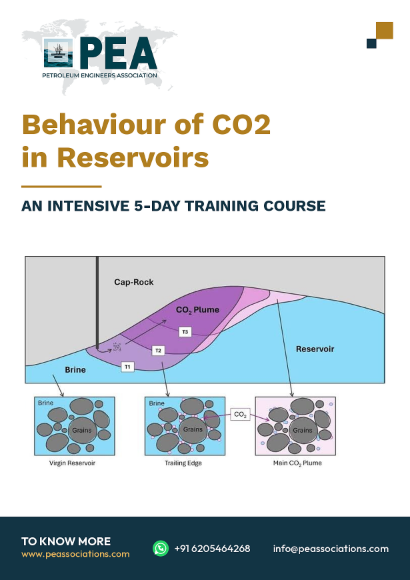
The mobility ratio is unfavourable and the plume is therefore inefficient. Carbon dioxide at storage conditions has a viscosity around a tenth that of brine, so when it displaces brine the displacement is unstable: the CO2 fingers forward and overrides, contacting a limited fraction of the pore volume. The practical consequences are that the plume extends further than a uniform displacement would predict, that the storage efficiency is lower, and that the CO2 reaches the top seal quickly and spreads laterally beneath it rather than filling the reservoir from the bottom up.
Residual trapping depends on relative permeability hysteresis and the parameter is poorly measured. When injection stops and the plume migrates, brine imbibes into the region the CO2 has left, and some CO2 is left behind as disconnected residual saturation that cannot flow. The amount depends on the difference between the drainage and imbibition relative permeability curves, which is the hysteresis. Measured hysteresis data for CO2-brine systems is limited and varies between rock types, and the residual trapping prediction, which is central to long term security, is correspondingly uncertain.
Convective mixing dissolves CO2 much faster than diffusion would. Brine with dissolved carbon dioxide is denser than brine without it, so the dissolved layer beneath the plume is gravitationally unstable and sinks in fingers, bringing fresh brine upwards to dissolve more. This convective process is orders of magnitude faster than molecular diffusion and converts a trapping mechanism that would take millions of years into one acting over decades to centuries. Capturing it in simulation requires fine vertical resolution, and models that are too coarse to resolve the fingers understate dissolution substantially.
Finally, near wellbore effects can reduce injectivity sharply. Injecting dry carbon dioxide into a brine-filled formation evaporates water from the near wellbore region, which concentrates the dissolved salts until they precipitate, reducing porosity and permeability at the point where the pressure drop is largest. The injected CO2 is also usually colder than the formation, which causes thermal contraction and in some cases hydrate formation. Both are localised, both reduce injectivity, and both are design considerations rather than reservoir scale problems.
By the end of this training, participants will be able to:
- Apply CO2 phase behaviour and property variation at storage conditions
- Assess the effect of impurities on CO2 properties
- Analyse multiphase flow of CO2 and brine and the mobility ratio
- Apply relative permeability and hysteresis to residual trapping
- Predict plume migration and gravity override
- Assess trapping mechanism development over time
- Quantify dissolution and convective mixing
- Assess geochemical reactions between CO2, brine and rock
- Predict near wellbore drying, salt precipitation and thermal effects
- Specify and interpret simulation of CO2 behaviour
The training combines property and flow calculation with simulation interpretation. Participants calculate CO2 properties across storage conditions, assess displacement efficiency from mobility ratios, and estimate residual and dissolution trapping. Simulation results at different grid resolutions are compared to show the effect on predicted dissolution. Geochemical reaction calculations are performed on reservoir mineralogies.
Organisations sending participants to this training will:
- Predict plume extent and behaviour more reliably
- Assess trapping mechanisms and their timescales
- Specify relative permeability measurements for storage
- Resolve convective dissolution in simulation
- Anticipate near wellbore injectivity problems
- Improve the physical basis of storage models
Participants will:
- Work confidently with CO2 properties and flow behaviour
- Predict plume migration
- Assess trapping mechanisms quantitatively
- Understand geochemical interactions
- Anticipate injectivity problems
- Interpret storage simulations critically
- Reservoir engineers on CO2 storage projects
- Geoscientists characterising storage sites
- Petrophysicists specifying storage core analysis
- Geochemists working on storage reactions
- Simulation engineers building storage models
- Technical staff interpreting plume predictions
- Regulators and advisors reviewing storage models
Module 1 - Phase Behaviour and Properties
- CO2 phase diagram
- Critical point and supercritical conditions
- Depth and pressure for supercritical storage
- Density variation with pressure and temperature
- Density discontinuity near critical conditions
- Viscosity variation
- Compressibility and its consequences
- Thermal properties and Joule-Thomson effects
- Impurity effects on phase behaviour
- Nitrogen, oxygen and methane impurities
- Hydrogen sulphide and sulphur oxides
- Specification requirements for injected streams
Module 2 - Multiphase Flow
- CO2 and brine as immiscible phases
- Mobility ratio and its value
- Unstable displacement and fingering
- Displacement efficiency
- Buoyancy and viscous force balance
- Capillary forces and their role
- Capillary number and flow regime
- Gravity number
- Flow regime diagrams
- Heterogeneity effects on flow
- Capillary barriers and trapping
- Flow in layered reservoirs
Module 3 - Relative Permeability and Hysteresis
- CO2 and brine relative permeability
- Drainage and imbibition curves
- Hysteresis and its magnitude
- Trapped gas saturation
- Land coefficient and trapping models
- Wettability and its effects
- Measurement of CO2 brine relative permeability
- Experimental difficulties
- Data availability and its limits
- Rock type dependence
- Uncertainty in residual trapping prediction
- Specifying special core analysis for storage
Module 4 - Plume Migration
- Plume development during injection
- Buoyant rise to the seal
- Gravity override and tongue development
- Lateral spreading beneath the seal
- Plume thickness and its detection
- Migration after injection ceases
- Structural control on migration
- Migration distance estimation
- Capillary and residual trapping during migration
- Spill point and migration beyond closure
- Migration timescales
- Monitoring plume position
Module 5 - Trapping Over Time
- Structural and stratigraphic trapping
- Residual trapping development
- Dissolution trapping development
- Mineral trapping and its timescale
- Relative contributions over time
- Trapping inventory calculation
- Security increasing with time
- Mobile fraction over time
- Factors accelerating trapping
- Engineered acceleration of trapping
- Brine injection and residual trapping
- Long term fate predictions
Module 6 - Dissolution and Convective Mixing
- CO2 solubility in brine
- Salinity and temperature effects on solubility
- Density increase from dissolution
- Gravitational instability of the dissolved layer
- Onset time for convection
- Convective finger development
- Convective dissolution rates
- Comparison against diffusive rates
- Rayleigh number and its role
- Grid resolution requirements for convection
- Underestimation in coarse models
- Long term dissolution estimates
Module 7 - Geochemical Reactions
- Carbonic acid formation and pH
- Carbonate mineral dissolution
- Calcite and dolomite reaction rates
- Feldspar and silicate dissolution
- Clay mineral reactions
- Mineral trapping reactions
- Carbonate precipitation
- Porosity and permeability changes
- Trace metal mobilisation
- Reaction rate limitations
- Reactive transport modelling
- Laboratory and natural analogue evidence
Module 8 - Near Wellbore Effects and Simulation
- Dry CO2 injection and water evaporation
- Salt precipitation and permeability loss
- Halite scaling mechanisms
- Mitigation by water or brine preflush
- Thermal effects of cold injection
- Hydrate formation risk
- Near wellbore stress and fracturing
- Simulator requirements for CO2
- Compositional against black oil formulations
- Grid resolution requirements
- Model validation against field data
- Interpreting storage simulation output
Upon successful completion of this training course, delegates will be awarded an official Certificate of Completion issued by the Petroleum Engineers Association (PEA), an ISO 9001:2015 certified training organization. The certificate carries 10 Credits and formally records the total learning hours completed.
Each certificate is signed by the Course Facilitator and the CEO of the Petroleum Engineers Association, and serves as verifiable proof of professional training that delegates can present to employers and professional bodies worldwide.
Frequently Asked Questions
All course bookings made through PEA are strictly non-refundable. By registering for a course, you acknowledge and accept that all fees are payable in full and are not subject to refund under any circumstances, including changes in personal or professional commitments or partial attendance.
PEA reserves the right to make reasonable adjustments to course content, trainers, or schedules where necessary, without entitling delegates to a refund. Comprehensive details of each course — including objectives, target audience, and content — are clearly outlined before enrolment, and it is the responsibility of the delegate to ensure the course's suitability prior to booking.
For any inquiries related to cancellations or bookings, please contact our support team, who will be happy to assist you.
