


An Interactive 5-Day Training Course
Petroleum Geomechanics Fundamentals
Rock Stress, Strength and Failure Explained
Secure your spot now!
Duration
5 Days
Price
$ 3,000
Starting From
18 Jan 2027



Home Geology and Geoscience Petroleum Geomechanics Fundamentals
Petroleum Geomechanics Fundamentals
Have Questions ?
Petroleum Geomechanics Fundamentals - GG-GEOM-PEA27
| Code | Date | Time | Duration | Location | Currency | Early Bird Fee Per Person |
|---|---|---|---|---|---|---|
| GG-GEOM-PEA27 | 18 - 22 Jan 2027 | 10 AM CST | 4 Hours Per Day |
Online |
USD |
3000 |
Need this for a group? We deliver the same course in-house — face-to-face at your location or online — tailored to your assets and team level. Contact info@peassociations.com
Boost your team's skills and your budget! Enjoy group discounts for collaborative learning. Send an inquiry to info@peassociations.com.
Petroleum Geomechanics Fundamentals
This training covers the fundamentals of petroleum geomechanics. It works through stress concepts and notation, the in-situ stress field and its measurement, pore pressure and effective stress, rock strength and failure criteria, the mechanical earth model, wellbore stability, production induced stress change, and the application of geomechanics to drilling, completion and reservoir management decisions.
Description
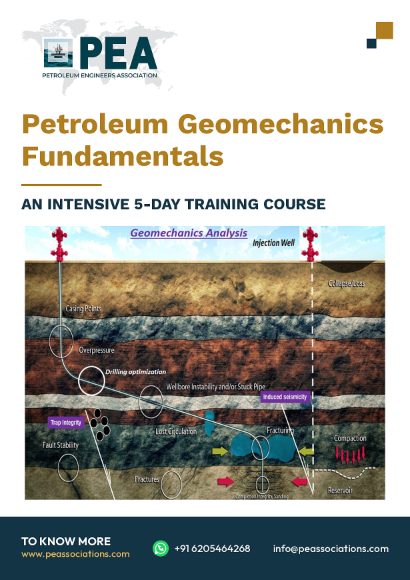
Geomechanics determines whether a wellbore stands up, whether a fault leaks, whether a reservoir compacts, whether a fracture propagates where intended and whether injection causes seismicity. These are expensive outcomes and they are all governed by the same small set of principles: the state of stress, the pore pressure, the rock strength and the way those three interact when any of them changes.
This training builds the subject from its foundations with petroleum application throughout. Stress concepts are established first, covering the stress tensor, principal stresses, the sign conventions used in the industry and the resolution of stress onto planes. The in-situ stress field follows, covering vertical stress from overburden, horizontal stress magnitudes and their determination, stress orientation and its indicators, and stress regimes. Pore pressure and effective stress are then developed, covering Terzaghi and Biot formulations and the central role of effective stress in all rock behaviour. Rock strength and failure criteria follow, covering compressive, tensile and shear failure, Mohr-Coulomb and other criteria, and the strength data required. The mechanical earth model is then developed as the integrating product. Wellbore stability follows as the main drilling application. Production induced stress change is then addressed. The training closes with application to drilling, completion and reservoir decisions.
Effective stress governs rock behaviour, not total stress. Rock strength, deformation, fracture opening and fault stability all depend on the difference between the total stress and the pore pressure. This is why raising pore pressure through injection can cause failure without any change in the applied load, and why depleting a reservoir increases the effective stress on its rock and causes compaction. Every geomechanical problem in the industry reduces to a change in effective stress somewhere.
The minimum horizontal stress is the one magnitude that can be measured directly and it is frequently measured badly. A properly conducted extended leak-off test, taken past breakdown and through a controlled shut-in with the pressure decline recorded, gives the fracture closure pressure and hence the minimum horizontal stress. A standard leak-off test stopped at the first deviation from linearity gives an upper bound on it at best. Many stress models are built on leak-off data that does not support the interpretation placed on it, and the error propagates into the mud weight window, the fracture gradient and the fault stability assessment.
The maximum horizontal stress cannot be measured and must be inferred. There is no direct measurement of the maximum horizontal stress magnitude, which is unfortunate because it strongly affects wellbore stability and fault reactivation. It is constrained by observations of wellbore failure: the width of borehole breakouts and the presence or absence of drilling induced tensile fractures bound its value when combined with the rock strength and the other stresses. This inversion is the standard method and it requires image log data and strength estimates, which is why both belong in a geomechanics data programme.
Finally, depletion changes the stress field and the change is predictable. As a reservoir depletes, the effective vertical stress increases and the horizontal stresses decrease by a fraction of the pore pressure change, typically half to two thirds. The consequences are practical: the fracture gradient falls, so a well drilled into a depleted reservoir may lose returns at a mud weight that was safe originally; the reservoir may compact, causing subsidence and casing damage; and the stress path may bring faults closer to failure. These effects are routine in mature fields and are quantifiable in advance.
By the end of this training, participants will be able to:
- Apply stress concepts, notation and the resolution of stress onto planes
- Determine vertical and horizontal stress magnitudes from available data
- Interpret leak-off and extended leak-off tests for minimum horizontal stress
- Constrain maximum horizontal stress from wellbore failure observations
- Determine stress orientation from image logs and other indicators
- Apply the effective stress principle to rock behaviour problems
- Select and apply rock failure criteria
- Build and quality control a mechanical earth model
- Assess wellbore stability and define a mud weight window
- Predict stress change from depletion and injection and its consequences
The training combines principle development with data interpretation exercises. Participants build stress profiles from log, test and density data, interpret leak-off tests and image logs, and constrain stress magnitudes from observed wellbore failures. Mechanical earth models are constructed and used to predict mud weight windows, which are then compared against the actual drilling experience of the wells supplied.
Organisations sending participants to this training will:
- Build mechanical earth models with defensible stress estimates
- Improve wellbore stability prediction and mud weight design
- Reduce drilling non-productive time from instability
- Predict depletion effects on fracture gradient and compaction
- Interpret stress test data correctly
- Apply geomechanics to drilling, completion and injection decisions
Participants will:
- Work confidently with stress and strength concepts
- Determine stress magnitudes and orientations from data
- Build a mechanical earth model
- Predict wellbore stability
- Assess depletion and injection stress effects
- Contribute geomechanical input to well and field decisions
- Geoscientists and engineers entering geomechanics
- Drilling engineers requiring stability understanding
- Petrophysicists working on pore pressure and stress
- Reservoir engineers assessing compaction and injection
- Completion engineers designing stimulation
- Structural geologists working on stress and fractures
- Technical staff reviewing geomechanical studies
Module 1 - Stress Concepts
- Stress definition and units
- The stress tensor and its components
- Principal stresses and their orientation
- Sign conventions in petroleum geomechanics
- Resolving stress onto a plane
- Normal and shear stress on planes
- Mohr circle construction and use
- Strain and deformation
- Elastic moduli and their relationships
- Static against dynamic moduli
- Poroelasticity in outline
- Stress units and conversions
Module 2 - The In-Situ Stress Field
- Vertical stress from overburden integration
- Density log and its gaps
- Minimum horizontal stress determination
- Leak-off test interpretation
- Extended leak-off and closure pressure
- Minifrac and DFIT interpretation
- Maximum horizontal stress constraint methods
- Stress polygon construction
- Stress orientation from borehole breakouts
- Drilling induced tensile fractures
- Stress regimes: normal, strike-slip, reverse
- Regional stress patterns and their sources
Module 3 - Pore Pressure and Effective Stress
- Normal compaction and hydrostatic pressure
- Overpressure generation mechanisms
- Disequilibrium compaction
- Fluid expansion mechanisms
- Pore pressure estimation from logs
- Eaton and Bowers methods
- Pressure measurement types and their reliability
- Terzaghi effective stress
- Biot coefficient and poroelastic effective stress
- Effective stress controls on strength
- Effective stress controls on compaction
- Pressure and stress coupling
Module 4 - Rock Strength and Failure
- Compressive strength and its measurement
- Unconfined and triaxial compressive strength
- Tensile strength and its measurement
- Cohesion and friction angle
- Mohr-Coulomb failure criterion
- Hoek-Brown and other criteria
- Modified Lade and polyaxial criteria
- Shear failure and its expression
- Tensile failure and its expression
- Pore collapse and compaction failure
- Strength estimation from logs
- Strength anisotropy in layered rock
Module 5 - The Mechanical Earth Model
- Mechanical earth model components
- Data requirements and their sources
- Elastic property profiles from logs
- Strength profiles from logs and core
- Core calibration of log derived properties
- Pore pressure profile
- Stress profiles and their construction
- One dimensional against three dimensional models
- Calibration against observed failures
- Uncertainty in the model inputs
- Model quality control
- Documenting and updating the model
Module 6 - Wellbore Stability
- Stress concentration around a wellbore
- Kirsch solution and hoop stress
- Breakout formation and its prediction
- Tensile fracture and lost circulation
- Mud weight window definition
- Collapse and fracture gradients
- Pore pressure and stability interaction
- Well trajectory effects on stability
- Stability in anisotropic and shale formations
- Time dependent instability
- Chemical effects of mud on shale
- Mitigation measures for instability
Module 7 - Production Induced Stress Change
- Depletion and effective stress increase
- Stress path and its coefficient
- Horizontal stress reduction with depletion
- Fracture gradient reduction
- Drilling into depleted reservoirs
- Reservoir compaction and its magnitude
- Compaction drive and its contribution
- Subsidence at surface
- Casing deformation and well integrity
- Injection and pore pressure increase
- Stress change from cooling
- Fault stability under production and injection
Module 8 - Applications
- Geomechanics in well planning
- Trajectory optimisation for stability
- Casing seat selection
- Sand production prediction
- Perforation stability
- Hydraulic fracture containment
- Fracture orientation and stress
- Fault seal and reactivation assessment
- Induced seismicity screening
- Geomechanics in storage projects
- Data acquisition programme design
- Reviewing a geomechanical study
Upon successful completion of this training course, delegates will be awarded an official Certificate of Completion issued by the Petroleum Engineers Association (PEA), an ISO 9001:2015 certified training organization. The certificate carries 10 Credits and formally records the total learning hours completed.
Each certificate is signed by the Course Facilitator and the CEO of the Petroleum Engineers Association, and serves as verifiable proof of professional training that delegates can present to employers and professional bodies worldwide.
Frequently Asked Questions
All course bookings made through PEA are strictly non-refundable. By registering for a course, you acknowledge and accept that all fees are payable in full and are not subject to refund under any circumstances, including changes in personal or professional commitments or partial attendance.
PEA reserves the right to make reasonable adjustments to course content, trainers, or schedules where necessary, without entitling delegates to a refund. Comprehensive details of each course — including objectives, target audience, and content — are clearly outlined before enrolment, and it is the responsibility of the delegate to ensure the course's suitability prior to booking.
For any inquiries related to cancellations or bookings, please contact our support team, who will be happy to assist you.
