


An Interactive 5-Day Training Course
Shelf-Edge Deltas & Clinoform Systems
Shelf-Edge Trajectory and Deepwater Sand Delivery
Secure your spot now!
Duration
5 Days
Price
$ 3,500
Starting From
14 Jun 2027



Home Geology and Geoscience Shelf-Edge Deltas & Clinoform Systems
Shelf-Edge Deltas & Clinoform Systems
Have Questions ?
Shelf-Edge Deltas & Clinoform Systems - GG-CLINO-PEA27
| Code | Date | Time | Duration | Location | Currency | Early Bird Fee Per Person |
|---|---|---|---|---|---|---|
| GG-CLINO-PEA27 | 14 - 18 Jun 2027 | 10 AM CST | 4 Hours Per Day |
Online |
USD |
3500 |
Need this for a group? We deliver the same course in-house — face-to-face at your location or online — tailored to your assets and team level. Contact info@peassociations.com
Boost your team's skills and your budget! Enjoy group discounts for collaborative learning. Send an inquiry to info@peassociations.com.
Shelf-Edge Deltas & Clinoform Systems
This training covers shelf-edge deltas and clinoform systems. It works through clinoform geometry and its scale hierarchy, shelf-edge trajectory analysis and its predictive value, shelf-edge delta facies and architecture, slope failure and sediment bypass mechanisms, the controls on sand delivery to deepwater, seismic interpretation of clinoform successions, and the exploration consequences for both shelf and deepwater reservoirs.
Description
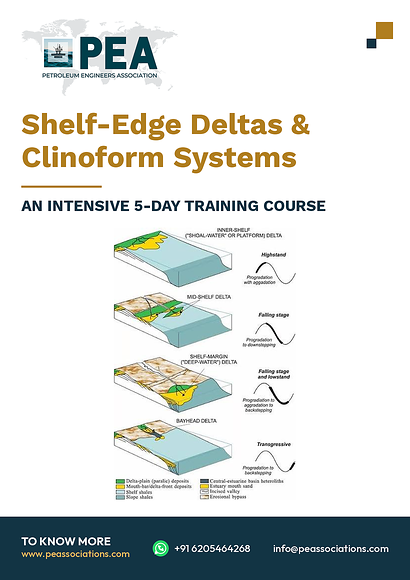
The shelf edge is the single most important position in a prograding margin. Sediment that reaches it can be delivered to the slope and basin floor; sediment that does not is stored on the shelf. Whether a deepwater fan exists at all, and how sand-rich it is, depends on whether the delta reached the shelf edge, and that is recorded in the trajectory of the shelf edge through the prograding succession. Shelf-edge trajectory analysis has become one of the more useful predictive methods in exploration because it links a shelf observation to a deepwater prediction.
This training develops the topic from geometry to exploration application. Clinoforms are established first, covering their geometry, the topset foreset bottomset division, the scale hierarchy from delta-scale to shelf-scale clinoforms, and the common confusion between them. Shelf-edge trajectory is then developed in detail: rising, flat and falling trajectories, their accommodation and supply controls, how each is measured on seismic, and what each implies for shelf sand storage and deepwater sand delivery. Shelf-edge deltas follow, covering their facies, their characteristically steep and unstable fronts, growth faulting and syndepositional deformation, and the differences from inner shelf deltas. Slope processes and bypass are then addressed: delta front failure, mass transport generation, canyon and gully incision, sediment bypass across the slope and the mechanisms by which sand crosses to the basin floor. Seismic interpretation of clinoform successions is covered in its own right. The training closes with the exploration consequences, including reservoir prediction on the shelf, on the slope and in the basin floor, and the risking of deepwater fans from shelf evidence.
Shelf-edge trajectory records the balance between accommodation and sediment supply at the margin, and it has a direct reservoir consequence. A strongly rising trajectory means accommodation was being created faster than the shelf edge could prograde, sediment was stored on the shelf, and relatively little sand reached the slope. A flat or falling trajectory means the shelf edge advanced with little or no aggradation, deltas sat at the shelf break, and sand was delivered to the slope and basin floor. Measuring the trajectory on a seismic line therefore produces a first-order prediction about deepwater reservoir presence before any deepwater well is drilled.
Clinoform scale is frequently confused and the confusion causes real errors. Delta-scale clinoforms have heights of tens of metres and represent the front of an individual delta on the shelf. Shelf-scale clinoforms have heights of hundreds of metres to over a kilometre and represent the whole shelf to basin profile. They look similar on a seismic section at different display scales, and interpreting a delta-scale clinoform as the shelf edge places the shelf break in the wrong position, which inverts the deepwater prediction entirely.
Shelf-edge deltas are unstable, and that instability is part of their reservoir character. Rapid deposition at a steep shelf break produces underconsolidated, overpressured sediment that fails readily. The result is growth faulting, rotational slumping, shale diapirism and mass transport complexes within and immediately basinward of the delta. For the shelf reservoir this means syndepositional structure, thickness variation across growth faults and fault-compartmentalised reservoirs. For the slope it means mass transport deposits that compartmentalise or seal, and canyons that focus later sand delivery.
Finally, bypass is what determines whether sand actually reaches the basin floor rather than being deposited on the slope. Slope gradient, flow magnitude, grain size and the presence of incised conduits all control it. A system with well developed canyons and gullies, and with flows energetic enough to remain erosive across the slope, delivers sand to the basin floor and leaves a bypass surface on the slope. A system without them deposits on the slope and starves the basin floor. Recognising bypass surfaces and conduits is the link between the shelf observation and the basin floor prediction.
By the end of this training, participants will be able to:
- Interpret clinoform geometry and distinguish clinoform scale hierarchies
- Measure and interpret shelf-edge trajectory from seismic data
- Relate trajectory to accommodation, supply and sand partitioning
- Characterise shelf-edge delta facies and architecture
- Interpret growth faulting and syndepositional deformation at shelf margins
- Assess slope instability and mass transport generation
- Identify sediment bypass mechanisms and bypass surfaces
- Predict sand delivery to slope and basin floor settings
- Interpret clinoform successions on seismic including resolution limits
- Apply trajectory analysis to shelf and deepwater reservoir prediction and risking
The training is worked largely on seismic data across prograding margins, with participants mapping clinoform surfaces, identifying the shelf edge at each stage and measuring trajectory through the succession. Trajectory-based predictions of deepwater sand presence are then compared against the actual basin floor section and well results. Shelf-edge delta successions are interpreted from core and log data, including growth-faulted intervals. Exploration cases where trajectory analysis correctly or incorrectly predicted deepwater reservoir are examined.
Organisations sending participants to this training will:
- Predict deepwater reservoir presence from shelf seismic evidence
- Reduce deepwater exploration risk through trajectory-based screening
- Avoid clinoform scale misinterpretation and its consequences
- Improve reservoir prediction in shelf-edge delta plays
- Assess growth fault compartmentalisation in shelf margin fields
- Build a capability linking shelf and deepwater exploration
Participants will:
- Map clinoforms and identify the shelf edge correctly
- Measure trajectory and interpret its reservoir implications
- Characterise shelf-edge delta reservoirs and their structure
- Assess bypass and sand delivery to deepwater
- Risk deepwater reservoir presence from shelf evidence
- Build specialist capability in margin scale reservoir prediction
- Exploration geoscientists working on shelf margin and deepwater plays
- Seismic interpreters mapping prograding margins
- Reservoir geologists on shelf-edge delta fields
- Basin analysts assessing sediment delivery systems
- New ventures staff screening deepwater basins
- Geoscientists working on slope and basin floor reservoirs
- Experienced geoscientists requiring margin scale capability
Module 1 - Clinoforms and Margin Architecture
- Clinoform definition and geometry
- Topset, foreset and bottomset divisions
- Offlap break and shelf break definition
- Clinoform scale hierarchy
- Delta-scale clinoforms
- Shelf-scale clinoforms
- Distinguishing clinoform scales on seismic
- Clinoform height and water depth relationship
- Foreset dip and its controls
- Margin types: constructional, erosional, aggradational
- Margin growth through time
Module 2 - Shelf-Edge Trajectory Analysis
- Trajectory concept and its measurement
- Rising trajectory and its implications
- Flat trajectory and shelf edge progradation
- Falling trajectory and forced regression
- Accommodation and supply control on trajectory
- Relative sea level and trajectory relationship
- Sediment partitioning between shelf and slope
- Trajectory and deepwater sand prediction
- Measuring trajectory on seismic data
- Trajectory variation along strike
- Trajectory analysis limitations and pitfalls
- Building a trajectory-based prediction
Module 3 - Shelf-Edge Deltas
- Shelf-edge delta setting and recognition
- Differences from inner shelf deltas
- Delta front steepness and instability
- Facies successions in shelf-edge deltas
- Mouth bar and distributary deposits at the shelf edge
- Sand body geometry and dimensions
- Rapid deposition and underconsolidation
- Overpressure development
- Delta front failure and its deposits
- Reservoir quality in shelf-edge delta sands
- Connectivity and compartmentalisation
- Development characteristics
Module 4 - Syndepositional Deformation
- Growth fault formation at shelf margins
- Listric fault geometry and detachment
- Rollover anticlines and their traps
- Expansion indices and thickness variation
- Fault compartmentalisation of reservoirs
- Counter-regional faults and their setting
- Shale diapirism and mobile shale
- Rotational slumping at the shelf edge
- Toe thrust systems downslope
- Linked extension and contraction systems
- Seismic recognition of growth structures
- Implications for trap and reservoir
Module 5 - Slope Instability and Mass Transport
- Slope failure triggers at prograding margins
- Failure scale and recurrence
- Mass transport complex generation
- Mass transport deposit character and extent
- Erosional relief at the base of mass transport deposits
- Mass transport deposits as barriers and seals
- Remobilised sand and injectites
- Slope scarps and their seismic expression
- Recovery and healing of failed slopes
- Mass transport and subsequent sand pathways
- Geohazard implications for development
Module 6 - Sediment Bypass and Delivery to Deepwater
- Bypass concept and its recognition
- Slope gradient and its control on bypass
- Flow magnitude and transformation across the slope
- Grain size and its effect on delivery
- Canyon formation and headward erosion
- Gully systems and their role
- Shelf incision and direct delta to canyon connection
- Bypass surfaces and their character
- Slope deposits against slope bypass zones
- Basin floor fan development and its triggers
- Linking shelf stratigraphy to basin floor fans
- Predicting basin floor sand presence and quality
Module 7 - Seismic Interpretation of Clinoform Systems
- Seismic expression of clinoform successions
- Mapping clinoform surfaces
- Resolution limits and clinoform imaging
- Shelf edge identification on seismic
- Seismic facies across the clinoform profile
- Amplitude behaviour on topsets and foresets
- Recognising bypass on seismic
- Canyon and gully imaging
- Mass transport deposit recognition
- Basin floor fan seismic expression
- Depth conversion across a margin
- Integrating well data with clinoform mapping
Module 8 - Exploration Application
- Play types across a prograding margin
- Topset and shelf reservoir plays
- Shelf-edge delta plays and their traps
- Slope channel and fan plays
- Basin floor fan plays
- Stratigraphic traps at clinoform pinch-outs
- Seal distribution across the margin
- Source and charge considerations
- Trajectory-based screening of deepwater potential
- Risking deepwater reservoir from shelf evidence
- Calibrating predictions against drilled results
- Exploration cases from prograding margins
Upon successful completion of this training course, delegates will be awarded an official Certificate of Completion issued by the Petroleum Engineers Association (PEA), an ISO 9001:2015 certified training organization. The certificate carries 10 Credits and formally records the total learning hours completed.
Each certificate is signed by the Course Facilitator and the CEO of the Petroleum Engineers Association, and serves as verifiable proof of professional training that delegates can present to employers and professional bodies worldwide.
Frequently Asked Questions
All course bookings made through PEA are strictly non-refundable. By registering for a course, you acknowledge and accept that all fees are payable in full and are not subject to refund under any circumstances, including changes in personal or professional commitments or partial attendance.
PEA reserves the right to make reasonable adjustments to course content, trainers, or schedules where necessary, without entitling delegates to a refund. Comprehensive details of each course — including objectives, target audience, and content — are clearly outlined before enrolment, and it is the responsibility of the delegate to ensure the course's suitability prior to booking.
For any inquiries related to cancellations or bookings, please contact our support team, who will be happy to assist you.
