


An Interactive 5-Day Training Course
Prospect Maturation
From Lead to Drillable Prospect
Secure your spot now!
Duration
5 Days
Price
$ 3,500
Starting From
13 Sep 2027



Home Geology and Geoscience Prospect Maturation
Prospect Maturation
Have Questions ?
Prospect Maturation - GG-PMAT-PEA27
| Code | Date | Time | Duration | Location | Currency | Early Bird Fee Per Person |
|---|---|---|---|---|---|---|
| GG-PMAT-PEA27 | 13 - 17 Sep 2027 | 10 AM CST | 4 Hours Per Day |
Online |
USD |
3500 |
Need this for a group? We deliver the same course in-house — face-to-face at your location or online — tailored to your assets and team level. Contact info@peassociations.com
Boost your team's skills and your budget! Enjoy group discounts for collaborative learning. Send an inquiry to info@peassociations.com.
Prospect Maturation
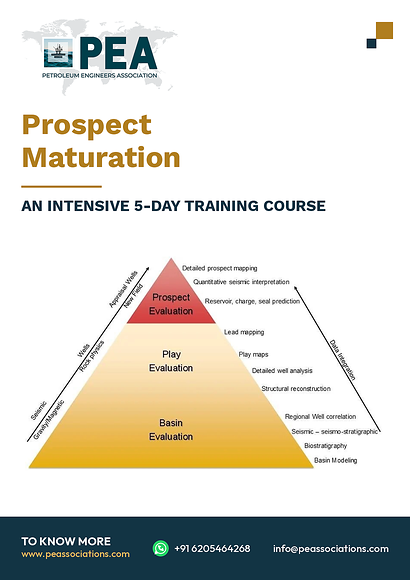
This training covers prospect maturation from lead to drill ready. It works through maturation stages and their criteria, the work required at each stage, data acquisition and interpretation decisions, trap reservoir seal and charge evaluation, volume and risk assessment, peer review and assurance, well proposal preparation, and the management of a maturation pipeline across a portfolio.
Description
Maturation is the process that takes an opportunity from a shape on a map to a well someone will fund. It has stages, each with entry criteria, defined work and exit criteria, and the discipline is in doing the right work at the right stage rather than everything at once. A lead needs enough work to decide whether it is worth more work; a drill ready prospect needs enough that the well can be committed. Work done out of sequence is usually wasted, and work left undone shows up as a surprise after spudding.
This training covers the process and the technical work within it. Maturation stages are established first, covering lead, prospect and drill ready definitions, the criteria for moving between them, and the practice of killing opportunities at the earliest stage that the evidence allows. The work at each stage follows, covering the level of interpretation, mapping, analysis and documentation appropriate to each. Technical evaluation is then developed element by element: trap definition and closure, reservoir presence and quality, seal capacity, charge access and timing, with the specific evidence required at drill ready standard. Volume and risk assessment follows at the maturity appropriate to each stage. Data acquisition and reprocessing decisions are addressed as value of information questions. Peer review and assurance follow, covering the challenge process and the standards applied. The training closes with well proposal preparation and the management of a maturation pipeline so that drill ready prospects are available when the rig is.
The commonest maturation failure is doing detailed work too early. A lead with an unresolved charge question does not need detailed depth conversion, amplitude analysis and probabilistic volumes; it needs the charge question answered, because if the answer is negative everything else is wasted. Identifying the question that could kill the opportunity, and answering that first, is the core discipline. It feels like skipping steps and it is the opposite: it is doing the decisive step first.
Drill ready means specific things and they should be written down. A prospect is drill ready when the trap is mapped in depth with its uncertainty quantified, the reservoir and seal are assessed with stated evidence, charge is established, volumes and risks are documented to the portfolio standard, the well location and trajectory are feasible, the data acquisition programme is defined and the proposal has passed assurance. An opportunity that fails any of these is not drill ready regardless of how attractive it looks, and committing a rig to it transfers the unfinished work into the operation.
Pipeline management is what keeps rigs drilling good wells. A rig slot arrives on a schedule set by contracts and partners, and the prospect drilled is whichever is ready. If the pipeline contains one drill ready prospect, that is what gets drilled whether or not it is the best opportunity. Maturing several in parallel so that a choice exists at the decision point is a portfolio level activity and it requires maturation effort to be allocated deliberately rather than following whichever prospect has the most enthusiastic advocate.
Finally, assurance is a technical service, not an obstacle. A peer review that challenges the correlation, questions the amplitude interpretation, tests the volume range and asks what evidence supports the charge is doing the work that the well would otherwise do more expensively. Teams that treat review as an approval hurdle to be managed get less value from it than those that bring their weakest element to it deliberately.
By the end of this training, participants will be able to:
- Apply maturation stage definitions and their entry and exit criteria
- Identify the decisive question at each stage and address it first
- Conduct the technical work appropriate to each maturation stage
- Define traps in depth with quantified structural uncertainty
- Assess reservoir, seal and charge to drill ready evidence standards
- Produce volume and risk assessments at the appropriate maturity
- Apply value of information to data acquisition and reprocessing decisions
- Prepare opportunities for peer review and assurance
- Produce well proposals that meet funding standards
- Manage a maturation pipeline across a portfolio
The training works a set of leads through the full maturation process. Participants identify the decisive question on each, do only the work that question requires, and make kill or continue decisions on the result. Survivors are matured through to drill ready, with the technical work at each stage and the documentation to match. Peer review is conducted on each other's prospects, with the weakest element identified. The exercise closes with well proposals and a managed pipeline plan.
Organisations sending participants to this training will:
- Kill unviable opportunities earlier and more cheaply
- Direct technical effort at decisive questions
- Maintain a pipeline of genuinely drill ready prospects
- Improve consistency of maturation standards
- Reduce surprises arising from work left undone
- Improve the quality of opportunities reaching the rig
Participants will:
- Mature opportunities efficiently through defined stages
- Identify and answer the decisive question first
- Meet drill ready standards consistently
- Use peer review productively
- Prepare fundable well proposals
- Build capability valued in every exploration team
- Exploration geoscientists maturing prospects
- Prospect evaluation and portfolio staff
- New ventures staff moving opportunities forward
- Exploration team leaders managing pipelines
- Technical staff conducting peer review and assurance
- Geoscientists preparing well proposals
- Graduate geoscientists entering exploration roles
Module 1 - Maturation Stages and Criteria
- Maturation process and its purpose
- Lead definition and criteria
- Prospect definition and criteria
- Drill ready definition and criteria
- Entry and exit criteria for each stage
- Stage gate review practice
- Killing opportunities and when to do it
- Work appropriate to each stage
- Avoiding premature detailed work
- Stage definitions across organisations
- Documenting stage progression
Module 2 - Identifying the Decisive Question
- Critical risk element identification
- What would have to be true for this to work
- Evidence available against evidence needed
- Questions that can be answered without drilling
- Questions that only a well can answer
- Directing work at the decisive question
- Recognising when the question is answered
- Kill decisions and their documentation
- Avoiding advocacy over evidence
- Revisiting killed opportunities with new data
Module 3 - Trap Maturation
- Trap definition from lead to drill ready
- Interpretation density by stage
- Horizon and fault interpretation standards
- Depth conversion at each stage
- Structural uncertainty quantification
- Closure and spill point definition
- Segment identification and dependency
- Fault dependency assessment
- Trap integrity and seal assessment
- Mapping standards for drill ready
- Documentation of the trap case
Module 4 - Reservoir and Seal Maturation
- Reservoir presence evidence by stage
- Analogue and regional evidence
- Seismic evidence for reservoir
- Reservoir quality prediction
- Net to gross and property estimation
- Seal presence and capacity assessment
- Column height prediction
- Lateral seal in stratigraphic traps
- Evidence standards at drill ready
- Reservoir and seal uncertainty statement
- Data that would reduce the uncertainty
Module 5 - Charge Maturation
- Source rock presence and maturity evidence
- Kitchen definition and drainage area
- Migration pathway assessment
- Charge access to the specific trap
- Charge volume against trap capacity
- Timing of charge against trap formation
- Fluid type prediction
- Evidence from nearby discoveries and shows
- Seepage and geochemical evidence
- Charge risk assignment
- Reducing charge uncertainty without drilling
Module 6 - Volumes, Risk and Data Decisions
- Volume estimation at each maturity stage
- Parameter distributions and their evidence
- Risk assessment at each stage
- Risk revision as work proceeds
- Consistency with portfolio standards
- Data acquisition options
- Seismic acquisition and reprocessing decisions
- Value of information calculation
- Cost and cycle time of data options
- Deciding when enough is known
- Documenting volume and risk basis
Module 7 - Peer Review and Assurance
- Purpose and value of peer review
- Review timing within maturation
- Preparing for review
- Bringing the weakest element forward
- Review panel composition
- Challenge questions and their value
- Common findings in prospect review
- Responding to review findings
- Assurance standards and sign-off
- Independent review and audit
- Review as a learning mechanism
- Culture and incentives around review
Module 8 - Well Proposals and Pipeline Management
- Well proposal content and structure
- Objectives and what the well tests
- Location and trajectory justification
- Depth prognosis and uncertainty
- Data acquisition programme
- Volume, risk and value presentation
- Alternative outcomes and decision points
- Defending a proposal
- Pipeline concept and its management
- Maturation effort allocation
- Matching ready prospects to rig availability
- Maintaining pipeline health over time
Upon successful completion of this training course, delegates will be awarded an official Certificate of Completion issued by the Petroleum Engineers Association (PEA), an ISO 9001:2015 certified training organization. The certificate carries 10 Credits and formally records the total learning hours completed.
Each certificate is signed by the Course Facilitator and the CEO of the Petroleum Engineers Association, and serves as verifiable proof of professional training that delegates can present to employers and professional bodies worldwide.
Frequently Asked Questions
All course bookings made through PEA are strictly non-refundable. By registering for a course, you acknowledge and accept that all fees are payable in full and are not subject to refund under any circumstances, including changes in personal or professional commitments or partial attendance.
PEA reserves the right to make reasonable adjustments to course content, trainers, or schedules where necessary, without entitling delegates to a refund. Comprehensive details of each course — including objectives, target audience, and content — are clearly outlined before enrolment, and it is the responsibility of the delegate to ensure the course's suitability prior to booking.
For any inquiries related to cancellations or bookings, please contact our support team, who will be happy to assist you.
