


An Interactive 5-Day Training Course
Inversion Tectonics & Reactivated Structures
Inverted Basins and Late Traps
Secure your spot now!
Duration
5 Days
Price
$ 3,500
Starting From
02 Aug 2027



Home Geology and Geoscience Inversion Tectonics & Reactivated Structures
Inversion Tectonics & Reactivated Structures
Have Questions ?
Inversion Tectonics & Reactivated Structures - GG-INVT-PEA27
| Code | Date | Time | Duration | Location | Currency | Early Bird Fee Per Person |
|---|---|---|---|---|---|---|
| GG-INVT-PEA27 | 02 - 06 Aug 2027 | 10 AM CST | 4 Hours Per Day |
Online |
USD |
3500 |
Need this for a group? We deliver the same course in-house — face-to-face at your location or online — tailored to your assets and team level. Contact info@peassociations.com
Boost your team's skills and your budget! Enjoy group discounts for collaborative learning. Send an inquiry to info@peassociations.com.
Inversion Tectonics & Reactivated Structures
This training covers inversion tectonics and structural reactivation. It works through inversion mechanisms and controls, recognition criteria and null points, partial and complete inversion, inversion structure geometry, the timing of inversion and its determination, the effect of inversion on source maturation migration and seal, trap quality and breach risk, and the exploration of inverted basins.
Description
Inversion turns a basin into a structure. A former depocentre, filled with thick syn-rift section including source rock, is shortened and uplifted, converting the hangingwall into an anticline. The resulting traps can be large, they are well imaged because they are shallow and gently dipping, and they sit directly above the kitchen that charged them. Several major producing provinces owe their structures to inversion. The risk is timing: inversion that postdates generation produces a trap that was not there when the hydrocarbons migrated, and inversion that reactivates faults can breach a seal that had held for a hundred million years.
This training develops inversion and its consequences. Inversion mechanisms are established first, covering the stress conditions that reactivate normal faults in reverse, the frictional and orientation controls on reactivation, and why some faults invert while adjacent ones do not. Recognition criteria follow: null points, harpoon and arrowhead geometries, syn-rift thickness relationships across inverted faults, uplifted and eroded hangingwalls, and the seismic evidence for each. Partial and complete inversion are distinguished, together with the measurement of inversion magnitude. Structural geometry is then developed, covering inversion anticlines, short-cut thrusts, buttressing and the relationship between inversion structures and the earlier extensional geometry. Timing determination follows, using growth strata, unconformities, thermal and thermochronological evidence. The effects on the petroleum system are then addressed: maturation changes from uplift, migration redirection, seal breach and remigration. The training closes with trap evaluation and exploration practice in inverted basins.
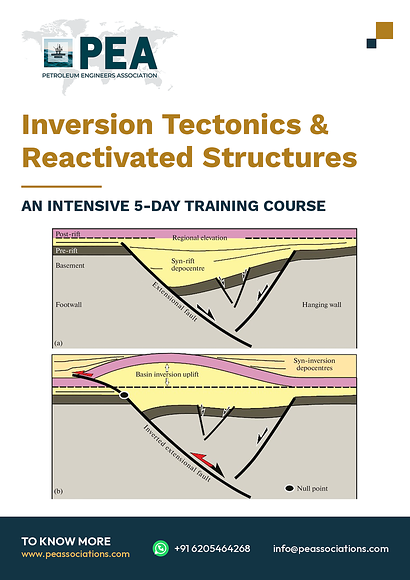
The null point is the diagnostic of inversion and it is where the evidence is clearest. On an inverted fault, the lower part retains net normal displacement because the original extension exceeded the later shortening, while the upper part shows net reverse displacement where shortening exceeded extension. The point between, where net displacement is zero, is the null point. A fault showing normal separation at depth and reverse separation above is inverted, and this single observation distinguishes inversion from simple contraction more reliably than the shape of the overlying fold.
Fault orientation determines what inverts. A normal fault favourably oriented relative to the later compression, meaning its strike is roughly perpendicular to the shortening direction and its dip is moderate, reactivates readily. A steep fault or one oblique to the compression does not, and the shortening is instead accommodated by new thrusts that cut across the older geometry, often as short-cut faults through the footwall. Predicting which faults in a basin will have inverted therefore starts with mapping their orientation against the later stress field.
Timing is the commercial question in every inverted basin. Generation and migration occurred at some point in the burial history; the inversion occurred at another. If inversion preceded or accompanied charge, the trap was available and the play works. If inversion followed charge, hydrocarbons migrated to whatever traps existed then, and the inversion anticline is a late structure that may be empty or may have been filled by remigration from a breached earlier trap. Determining the two timings and comparing them is the core of the risk assessment.
Finally, inversion both creates and destroys. The same event that produces a new anticline can reactivate the faults bounding an older trap, opening a leakage path and allowing an accumulation to escape. Evidence of palaeo-columns, residual saturations, tilted contacts and gas chimneys above older structures all point to this. In a basin that has been inverted, the question is not only where the traps are now, but which ones held and which ones leaked.
By the end of this training, participants will be able to:
- Explain inversion mechanisms and the controls on fault reactivation
- Identify inversion using null points and associated recognition criteria
- Distinguish partial from complete inversion and measure inversion magnitude
- Interpret inversion structure geometry including short-cut thrusts and buttressing
- Determine the timing of inversion from growth strata and other evidence
- Assess the effect of uplift on source rock maturation
- Evaluate migration redirection and remigration caused by inversion
- Assess seal breach risk from fault reactivation
- Evaluate trap quality and timing against charge history in inverted basins
- Apply the interpretation to exploration in inverted and reactivated settings
The training works on seismic data from inverted basins, with participants identifying inversion from null points and thickness relationships, mapping inversion magnitude and constructing restorations that separate the extensional and contractional phases. Timing is determined from growth strata and unconformities and compared against modelled charge timing. Traps are evaluated for whether they existed at charge, and evidence for breached palaeo-accumulations is examined. Exploration outcomes in inverted basins are reviewed for the timing or breach factor that governed them.
Organisations sending participants to this training will:
- Recognise inversion where it has been missed in earlier interpretation
- Assess trap timing against charge in inverted basins
- Evaluate seal breach and remigration risk properly
- Improve prospect risking in reactivated settings
- Identify remaining potential in mature inverted basins
- Build capability for a widespread and commercially important setting
Participants will:
- Identify inversion from diagnostic structural evidence
- Separate extensional and contractional phases in a restoration
- Date inversion and compare it against charge timing
- Assess breach and remigration risk
- Evaluate inversion traps with appropriate risking
- Build specialist capability in inversion tectonics
- Exploration geoscientists in inverted and reactivated basins
- Structural geologists and seismic interpreters
- Basin modellers assessing maturation and migration timing
- New ventures staff evaluating mature basin potential
- Geoscientists working on trap integrity and seal risk
- Technical staff reviewing structural and charge interpretations
- Experienced geoscientists extending into inversion settings
Module 1 - Inversion Mechanisms
- Inversion definition and terminology
- Positive and negative inversion
- Stress conditions for fault reactivation
- Frictional reactivation theory
- Fault orientation and reactivation potential
- Fault dip and the lock-up angle
- Pore pressure effects on reactivation
- Why some faults invert and others do not
- New thrust formation where reactivation fails
- Regional drivers of inversion
- Plate scale causes of basin inversion
Module 2 - Recognition Criteria
- Null point definition and identification
- Normal separation below, reverse above
- Syn-rift thickness across inverted faults
- Harpoon and arrowhead geometries
- Hangingwall uplift and erosion
- Truncation of syn-rift section
- Inversion anticline geometry
- Reverse drag and its recognition
- Short-cut thrusts in the footwall
- Buttressing against the fault plane
- Distinguishing inversion from simple contraction
- Distinguishing inversion from salt or shale structures
Module 3 - Inversion Magnitude and Geometry
- Partial against complete inversion
- Measuring inversion magnitude
- Net displacement calculation
- Inversion ratio and its use
- Along-strike variation in inversion
- Inversion anticline amplitude and wavelength
- Crestal faulting and extension
- Footwall short-cut geometry
- Inversion in multiple phases
- Selective inversion of a fault population
- Mapping inversion across a basin
Module 4 - Timing Determination
- Growth strata in inversion anticlines
- Syn-inversion sedimentation
- Unconformity development and its dating
- Erosional truncation as a timing marker
- Progressive unconformities
- Apatite fission track and thermochronology
- Vitrinite reflectance and exhumation estimation
- Sonic and density based exhumation estimates
- Regional correlation of inversion events
- Multiple inversion events and their separation
- Building an inversion chronology
- Uncertainty in timing estimates
Module 5 - Restoration of Inverted Structures
- Restoration objectives in inverted basins
- Separating extension and shortening phases
- Sequential restoration through both phases
- Area and line balance in inversion
- Decompaction and exhumation correction
- Restoring to the pre-inversion geometry
- Restoring to the pre-rift geometry
- Testing restorations for admissibility
- Reconstructing the original depocentre
- Reconstructing trap geometry through time
- Closure history from restoration
Module 6 - Petroleum System Effects
- Uplift and its effect on maturation
- Generation cessation on exhumation
- Palaeo-maturity against present maturity
- Thermal history modelling with exhumation
- Gas expansion and exsolution on uplift
- Migration redirection by inversion
- Remigration from breached traps
- Secondary migration into new structures
- Fluid phase changes on pressure reduction
- Biodegradation on shallowing
- Reservoir quality effects of exhumation
- Overpressure dissipation during uplift
Module 7 - Trap Quality and Breach Risk
- Inversion anticline trap geometry
- Closure definition and mapping
- Crestal extension and its seal risk
- Fault reactivation and seal breach
- Leakage along reactivated faults
- Gas chimneys and seal bypass evidence
- Residual saturation and palaeo-column evidence
- Tilted contacts as reactivation evidence
- Assessing whether a trap held
- Traps that filled after inversion
- Charge access to late structures
- Risking inversion traps
Module 8 - Exploration in Inverted Basins
- Inverted basin play types
- Footwall and sub-inversion plays
- Unaffected flank plays
- Stratigraphic traps in inverted settings
- Mapping requirements in inverted basins
- Seismic imaging considerations
- Prospect risking with timing emphasis
- Value of information on inversion timing
- Remaining potential in mature inverted basins
- Reassessing legacy dry holes
- Exploration workflow in an inverted basin
- Case studies from inverted provinces
Upon successful completion of this training course, delegates will be awarded an official Certificate of Completion issued by the Petroleum Engineers Association (PEA), an ISO 9001:2015 certified training organization. The certificate carries 10 Credits and formally records the total learning hours completed.
Each certificate is signed by the Course Facilitator and the CEO of the Petroleum Engineers Association, and serves as verifiable proof of professional training that delegates can present to employers and professional bodies worldwide.
Frequently Asked Questions
All course bookings made through PEA are strictly non-refundable. By registering for a course, you acknowledge and accept that all fees are payable in full and are not subject to refund under any circumstances, including changes in personal or professional commitments or partial attendance.
PEA reserves the right to make reasonable adjustments to course content, trainers, or schedules where necessary, without entitling delegates to a refund. Comprehensive details of each course — including objectives, target audience, and content — are clearly outlined before enrolment, and it is the responsibility of the delegate to ensure the course's suitability prior to booking.
For any inquiries related to cancellations or bookings, please contact our support team, who will be happy to assist you.
