


An Interactive 5-Day Training Course
Shallow Marine & Shelf Depositional Systems
Shoreface Sheets and Shelf Sands
Secure your spot now!
Duration
5 Days
Price
$ 3,500
Starting From
26 Apr 2027



Home Geology and Geoscience Shallow Marine & Shelf Depositional Systems
Shallow Marine & Shelf Depositional Systems
Have Questions ?
Shallow Marine & Shelf Depositional Systems - GG-SHELF-PEA27
| Code | Date | Time | Duration | Location | Currency | Early Bird Fee Per Person |
|---|---|---|---|---|---|---|
| GG-SHELF-PEA27 | 26 - 30 Apr 2027 | 10 AM CST | 4 Hours Per Day |
Online |
USD |
3500 |
Need this for a group? We deliver the same course in-house — face-to-face at your location or online — tailored to your assets and team level. Contact info@peassociations.com
Boost your team's skills and your budget! Enjoy group discounts for collaborative learning. Send an inquiry to info@peassociations.com.
Shallow Marine & Shelf Depositional Systems
Description
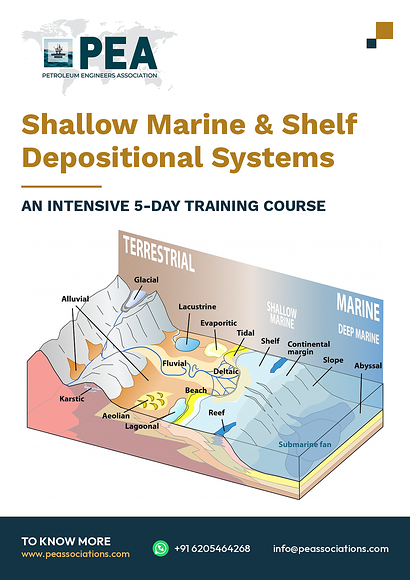
Shallow marine sandstones are the most predictable reservoir bodies in clastic geology. A shoreface sand deposited along a wave-dominated coast forms a sheet tens of kilometres long parallel to the palaeoshoreline, continuous along strike, with a gradational base and a consistent internal grain size trend. For a reservoir geologist this is as good as architecture gets, and it is why shallow marine fields are often developed with wide well spacing and good predictability. The difficulties lie elsewhere: downdip reservoir quality deterioration, bioturbation effects on permeability, and the thin transgressive intervals that separate and sometimes seal the sands.
This training develops these systems from process to development. Wave, storm and tidal processes are established first, together with the depth zonation they create and the way energy is distributed across a coastal profile. Shoreface successions follow in detail, covering upper middle and lower shoreface facies, offshore transition and offshore deposits, grain size and structure trends, and the bioturbation gradient that accompanies them. Barrier islands, strandplains, beaches and their associated washover inlet and lagoonal facies are then developed. Storm deposition is covered in its own right, including hummocky cross-stratification, tempestite bed structure and the distribution of storm beds basinward. Shelf environments follow: shelf sand ridges, sediment-starved shelves, condensed intervals, glauconite and transgressive lags, and the variability of shelf mudstones. Parasequence architecture and stacking is then developed as the stratigraphic framework. The training closes with reservoir quality distribution and the development of shallow marine fields.
Reservoir quality in a shoreface deteriorates downdip in a predictable way, and this is usually the controlling factor on field limits. The upper shoreface is coarse, well sorted, cross-bedded and lightly bioturbated, with excellent permeability. Moving basinward, grain size decreases, mud content increases and bioturbation intensifies, so permeability falls by orders of magnitude over a few kilometres while porosity falls much more slowly. The economic edge of a shoreface reservoir is therefore a permeability limit rather than a structural one, and predicting its position is a sedimentological rather than a geophysical exercise.
Bioturbation is a reservoir property in these systems, not just an environmental indicator. Intense bioturbation homogenises bedding, destroying the permeability contrast between sand and mud laminae and mixing mud into otherwise clean sand, which reduces permeability substantially. In some settings it does the opposite, where sand-filled burrows penetrate a mudstone and provide vertical connections through what would otherwise be a barrier. Either way, the bioturbation index recorded in core description has a direct permeability consequence and should be carried into rock typing.
Flooding surfaces separate parasequences and they are the critical correlation and barrier elements. Each shoreface parasequence is capped by a flooding surface across which water deepens abruptly, often marked by a thin transgressive lag, a glauconitic or phosphatic interval, or a condensed mudstone. These surfaces correlate reliably across a field, they define the layering the model should use, and they are frequently effective vertical barriers. The reservoir is best understood as a stack of discrete sheet sands separated by these surfaces rather than as a single thick sand body.
Finally, transgressive ravinement removes the top of the shoreface. As a shoreline retreats, wave erosion at the shoreface cuts down into the underlying succession, removing the uppermost and best quality part of the sand and replacing it with a lag. The amount removed can be several metres, which in a thin reservoir is a significant proportion of the net pay, and it is systematic rather than random. Recognising the ravinement surface in core prevents the best reservoir facies being mapped where it has in fact been eroded away.
By the end of this training, participants will be able to:
- Explain wave, storm and tidal processes and their depth zonation
- Interpret shoreface successions and identify their component facies
- Characterise barrier island, strandplain and beach systems and their facies
- Interpret storm beds and assess their basinward distribution
- Characterise shelf sand bodies and sediment-starved shelf deposits
- Assess shelf mudstone variability and its reservoir significance
- Identify flooding surfaces, ravinement surfaces and transgressive lags
- Correlate parasequences and interpret their stacking patterns
- Predict reservoir quality distribution across a shoreface profile
- Apply the interpretation to well placement and development in shallow marine reservoirs
Organisations sending participants to this training will:
- Predict reservoir limits and quality deterioration more accurately
- Improve parasequence correlation and model layering
- Represent flooding surface barriers correctly in reservoir models
- Improve net pay estimation in bioturbated intervals
- Place wells with better understanding of quality distribution
- Build capability in the most widespread clastic reservoir setting
Participants will:
- Interpret shallow marine facies and successions confidently
- Identify key surfaces and correlate parasequences
- Predict reservoir quality across a shoreface profile
- Assess bioturbation effects on reservoir properties
- Recognise ravinement and its effect on net pay
- Build core capability for shallow marine reservoir work
- Reservoir geologists working on shallow marine fields
- Sedimentologists describing shoreface and shelf successions
- Reservoir modellers building shallow marine static models
- Petrophysicists working on bioturbated and heterolithic intervals
- Exploration geoscientists evaluating shallow marine plays
- Reservoir engineers assessing layering and sweep
- Graduate geoscientists entering clastic reservoir roles
Module 1 - Shallow Marine Processes
- Wave generation, propagation and shoaling
- Wave base: fair weather and storm
- Breaking waves and surf zone processes
- Longshore currents and sediment transport
- Rip currents and their deposits
- Storm processes and geostrophic flow
- Combined flow and its bedforms
- Tidal processes in shallow marine settings
- Tidal range classification of coasts
- Relative importance of wave, storm and tide
- Energy distribution across a shoreface profile
Module 2 - Shoreface Successions
- Shoreface zonation and its basis
- Foreshore and swash zone facies
- Upper shoreface facies and structures
- Middle shoreface facies
- Lower shoreface facies
- Offshore transition zone
- Offshore and shelf mudstone
- Coarsening upward succession and its interpretation
- Grain size and sorting trends
- Sedimentary structure trends with depth
- Progradational shoreface geometry
- Log signature of shoreface successions
Module 3 - Barrier, Beach and Strandplain Systems
- Barrier island morphology and components
- Beach and berm facies
- Dune and aeolian cap facies
- Washover fan geometry and deposits
- Tidal inlet facies and their architecture
- Flood and ebb tidal delta deposits
- Lagoonal and back barrier facies
- Barrier migration and its record
- Strandplain and chenier systems
- Barrier reservoir geometry and dimensions
- Barrier against shoreface reservoir distinction
- Development characteristics of barrier reservoirs
Module 4 - Storm Deposition and Tempestites
- Storm processes on the shelf
- Hummocky cross-stratification and its formation
- Swaley cross-stratification
- Tempestite bed structure and divisions
- Erosional bases and sole structures
- Shell lags and storm concentrations
- Amalgamated storm beds
- Storm bed thickness and frequency basinward
- Proximal and distal tempestite character
- Storm beds as reservoir intervals
- Storm deposits in otherwise muddy sections
- Distinguishing storm beds from turbidites
Module 5 - Shelf Environments and Deposits
- Shelf morphology and process regimes
- Shelf sand ridge formation and geometry
- Sand ridge reservoir potential
- Tidal sand ridges and their orientation
- Sediment-starved shelf conditions
- Condensed intervals and their recognition
- Glauconite formation and significance
- Phosphate and hardground development
- Transgressive lags and their character
- Shelf mudstone variability and composition
- Organic enrichment on shelves
- Shelf deposits as seals and source rocks
Module 6 - Key Surfaces and Parasequence Architecture
- Parasequence definition and recognition
- Flooding surfaces and their character
- Maximum flooding surfaces
- Transgressive ravinement surfaces
- Amount of section removed by ravinement
- Sequence boundaries in shallow marine settings
- Parasequence stacking patterns
- Progradational, aggradational and retrogradational sets
- Clinoform geometry and shoreline trajectory
- Incised valleys cutting shallow marine successions
- Correlating parasequences across a field
- Layering a static model on parasequence boundaries
Module 7 - Reservoir Quality and Heterogeneity
- Reservoir quality by shoreface position
- Downdip permeability deterioration
- Porosity and permeability decoupling
- Detrital clay distribution across the profile
- Bioturbation intensity and its permeability effect
- Burrow fabrics and vertical connectivity
- Ichnofabric and reservoir quality relationships
- Heterolithic intervals and net to gross
- Cementation patterns in shallow marine sandstones
- Calcite cemented layers and their continuity
- Rock typing in shoreface reservoirs
- Predicting the permeability limit of a reservoir
Module 8 - Development of Shallow Marine Reservoirs
- Characteristic performance of sheet sand reservoirs
- Well spacing in laterally continuous reservoirs
- Horizontal well placement within a shoreface
- Flooding surfaces as vertical flow barriers
- Layered sweep and injection conformance
- Water breakthrough along high permeability upper shoreface
- Gravity effects in layered shallow marine reservoirs
- Updip and downdip field limit definition
- Infill drilling and remaining oil in layered systems
- Seismic reservoir characterisation in shallow marine settings
- Surveillance programme design
- Field cases from shallow marine developments
Upon successful completion of this training course, delegates will be awarded an official Certificate of Completion issued by the Petroleum Engineers Association (PEA), an ISO 9001:2015 certified training organization. The certificate carries 10 Credits and formally records the total learning hours completed.
Each certificate is signed by the Course Facilitator and the CEO of the Petroleum Engineers Association, and serves as verifiable proof of professional training that delegates can present to employers and professional bodies worldwide
Frequently Asked Questions
All course bookings made through PEA are strictly non-refundable. By registering for a course, you acknowledge and accept that all fees are payable in full and are not subject to refund under any circumstances, including changes in personal or professional commitments or partial attendance.
PEA reserves the right to make reasonable adjustments to course content, trainers, or schedules where necessary, without entitling delegates to a refund. Comprehensive details of each course — including objectives, target audience, and content — are clearly outlined before enrolment, and it is the responsibility of the delegate to ensure the course's suitability prior to booking.
For any inquiries related to cancellations or bookings, please contact our support team, who will be happy to assist you.
